

Close Menu

    Subscribe to Updates

    Get the latest news information from worldwide businesses.

    What's Hot

    Scientists propose spraying chemicals into Earth’s magnetic field to protect us from powerful solar storms

    June 8, 2026

    NFL fans react to Jared Verse’s first look in Browns uniform

    June 8, 2026

    The Lucid Gravity’s Latest Update Brings Hands-Free Driving And Google Maps Information

    June 8, 2026
    Facebook Instagram YouTube LinkedIn X (Twitter)
    Trending
    • Scientists propose spraying chemicals into Earth’s magnetic field to protect us from powerful solar storms
    • NFL fans react to Jared Verse’s first look in Browns uniform
    • The Lucid Gravity’s Latest Update Brings Hands-Free Driving And Google Maps Information
    • Donut Lab’s ‘solid-state’ battery exposed as regular li-ion in damning investigation
    • Some headaches need more than a painkiller: when you need to see a doctor
    • New Research Finds ERAS Protocol Speeds Recovery After Pelvic Surgery in Older Women
    • 44 things coming to your Apple devices that you might have missed
    • Apple bets cheaper AI will woo small developers
    Newspublicly
    • About Us
    • Advertise & Partner with us
    • Pitch Your Story
    • Contact Us
    Facebook Instagram LinkedIn X (Twitter)
    Subscribe
    • Home
    • World News
      • Asia
      • India
      • USA
      • UK & Europe
      • Middle East
    • Economy & Business
      • Global Economy
      • Corporate & Industry
      • Finance & Markets
      • Policy & Trade
    • Technology
      • Gadgets & Devices
      • Software & Apps
      • AI & Machine Learning
      • Robotics & Automation
    • Health & Medicine
      • Fitness & Nutrition
      • Research & Innovation
      • Disease & Treatment
      • Doctors, Clinics & Patient Care
    • Travel & Tourism
    • Automobile
      • Electric & Hybrid Vehicles
      • Auto Industry Insights
    • Sports
    • More
      • Education
      • Real Estate
      • Environment & Climate
      • Space & Astronomy
      • War & Conflicts
    Newspublicly
    Home»More»Space & Astronomy»James Webb Space Telescope weighs ‘sleeping giant’ black hole from 10 billion light-years away — and it’s 6 billion times our sun’s mass
    Space & Astronomy

    James Webb Space Telescope weighs ‘sleeping giant’ black hole from 10 billion light-years away — and it’s 6 billion times our sun’s mass

    AdminBy AdminJune 8, 2026No Comments5 Mins Read0 Views
    Share
    Facebook Twitter LinkedIn Copy Link WhatsApp


    Using the James Webb Space Telescope (JWST), astronomers have “weighed” a sleeping giant — a dormant supermassive black hole located a staggering 10 billion light-years away. That makes this black hole the most distant supermassive black hole scientists have ever measured the mass of.

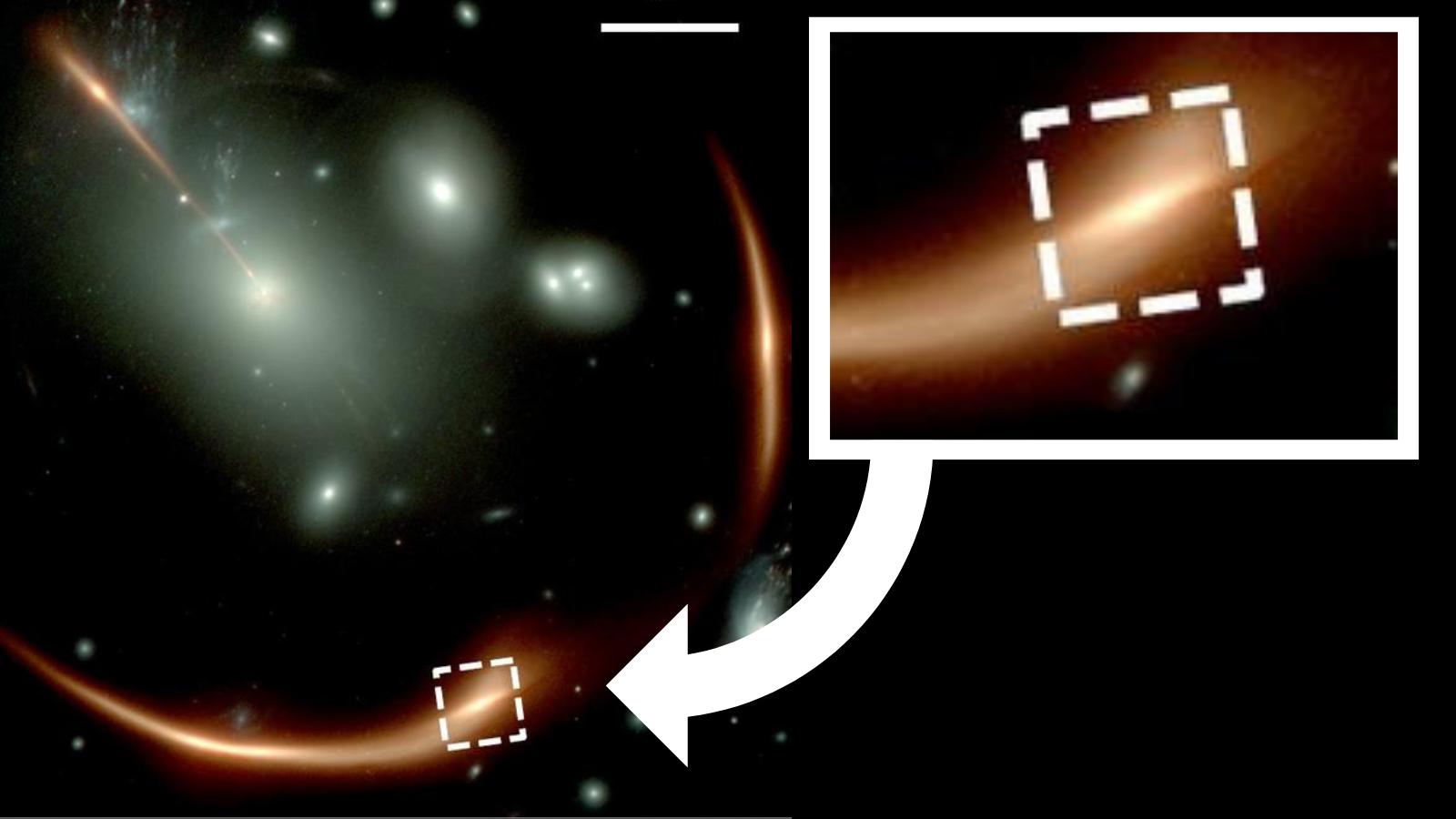
    The supermassive black hole is located at the heart of the galaxy MRG-M0138, which is seen as it was when the universe was just around 4 billion years old — and we now know, thanks to the James Webb Space Telescope (JWST), that it weighs an incredible 6 billion times the mass of the sun.

    Supermassive black holes can be very conspicuous when actively feeding and therefore surrounded by a wealth of matter in a region called an active galactic nuclei (AGN). Because of the black hole’s immense gravitational forces, an AGN glows very brightly. However, because black holes are surrounded by a light-trapping boundary called an event horizon, dormant black holes with larders that aren’t quite so well stocked are far more elusive. They’re practically invisible. Still, even these black holes have gravitational influences that can impact more than the swirling platters of gas and dust — that influence can also affect the motion of stars orbiting the black holes. And those stars are indeed visible.

    To detect and measure the mass of this supermassive black hole, the team behind this research used the JWST to track the motion of stars at the heart of MRG-M0138. This star-tracking trick has been used in the past to weigh dormant black holes much closer to Earth — for example, the 4.3-million-solar-mass supermassive black hole at the heart of our own galaxy, Sagittarius A* (Sgr A*). However, Sgr A* and its attendant stars are just 26,000 light-years away, and the most distant black hole this technique, called stellar dynamics, had been used to weigh was located just 700 million light-years away. At about 15 times that previous record-holding distance, this new research is the first time it has been successfully employed to measure the mass of such a distant sleeping giant.

    “Determining how stars collectively move within the core of this distant galaxy has allowed us to measure the mass of its otherwise undetectable supermassive black hole,” team leader and University College of London scientist Richard Ellis said in a statement. “By demonstrating the feasibility of such a technique for galaxies in the early universe, we can now undertake a more complete census of how black holes develop over time and infer their role in shaping galaxy evolution.”


    You may like

    However, determining the motion of the stars at the heart of MRG-M0138 was anything but straightforward. It required a natural cosmic phenomenon known as gravitational lensing, which emerged from Albert Einstein‘s magnum opus theory of gravity, known as general relativity.

    What is gravitational lensing?

    General relativity predicts that objects with mass create an actual curvature in the fabric of spacetime, the four-dimensional unification of the three dimensions of space and the one dimension of time. Gravity emerges from this curvature, and because the larger the mass, the greater the curvature, the larger the mass of an object, the stronger its gravity.

    Space

    Gravitational lensing occurs when a massive object such as a galaxy or a cluster of galaxies sits between a more distant foreground object and Earth. As light from a background source passes the curvature of space caused by the massive foreground object, or gravitational lens, its usually straight path becomes curved.

    The closer to the gravitational lens light passes, the more its path is diverted, and that means that light from the same object reaches our telescopes at different times. This can magnify the object and, in extreme cases, can make the same object appear multiple times at different positions in the same image.
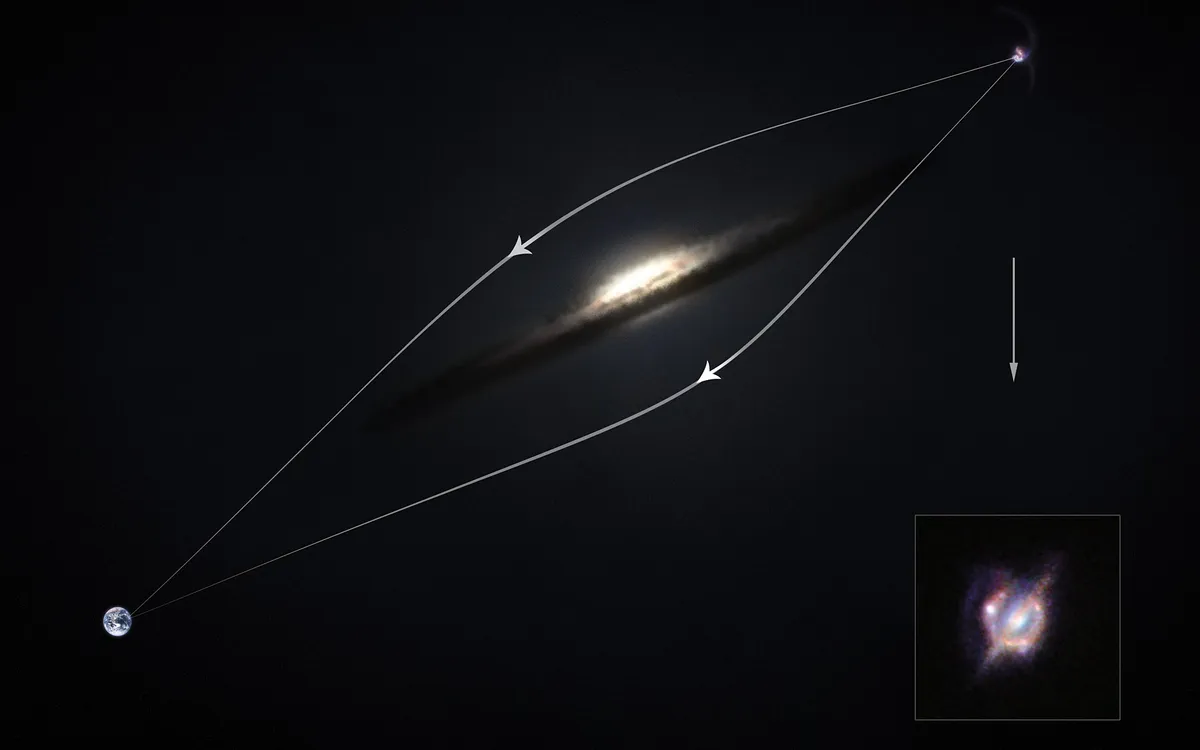
    A tiny illustration of Earth on the left and a cosmic object at the top right. A galaxy between distorts the farther away object's light on its way to Earth.

    This diagram shows how the effect of gravitational lensing around a normal galaxy focuses the light coming from a very distant star-forming galaxy merger to created a distorted, but brighter view. (Image credit: ESA/ESO/M. Kornmesser)

    The gravitational lensing effect of a galaxy between MRG-M0138 and Earth refocused the light from that distant galaxy, magnifying it by 30 times, allowing Ellis and colleagues to intricately reconstruct the internal details of MRG-M0138.


    What to read next

    “By combining JWST data with gravitational lensing, we could peer inside the black hole’s sphere of influence, where its gravity boosts the speeds of stars,” Andrew Newman of Carnegie Science in Pasadena, California, said. “This is one of the best techniques we have to weigh a black hole, so we were excited to extend it to a much earlier period in cosmic history.”

    A dark image of space with white, almost green, blobs in front. Two orange streaks are also seen in the foreground.

    The lensed galaxy MRG-M013 which the JWST used to weigh a distant supermassive black hole determining it to have 6 billion solar masses. (Image credit: NASA/JWST)

    In addition to investigating this dormant black hole, the team also determined that MRG-M0138 itself is dormant, meaning it is no longer forming new stars. This is likely the result of the supermassive black hole undergoing a ravenous feeding frenzy earlier in its history when it would have appeared as a blazing quasar at the heart of an AGN. The energy released during this phase would have pushed gas and dust away from both the black hole, ending its feeding phase, and from MRG-M0138 itself. This would deplete the galaxy of the raw material for star formation, thus quenching its stellar birth rate.

    This means that with these observations, and with more JWST dormant supermassive black hole data, scientists can better understand the relationship between galaxy growth and supermassive black hole growth, as well as the role these cosmic titans play in cutting off star formation in their host galaxies.

    The team’s research was published on Thursday (June 4) in Science.


    Source link

    Author

    • Admin

      NewsPublicly.com is News & Articles Platform that creating SEO-focused articles on travel, lifestyle, and digital trends.

    Admin
    • Website

    NewsPublicly.com is News & Articles Platform that creating SEO-focused articles on travel, lifestyle, and digital trends.

    Related Posts

    Scientists propose spraying chemicals into Earth’s magnetic field to protect us from powerful solar storms

    June 8, 2026

    Why do Venus and Jupiter meet up in the sky so often? It’s a symptom of a solar system that supports life on Earth

    June 8, 2026

    ‘Evolution’ at 25: A perfect fusion of ‘Ghostbusters’ and ‘Men in Black’ that’s become a sci-fi comedy classic

    June 8, 2026
    Leave A Reply Cancel Reply

    Demo
    Top Posts

    The Blue Moon rises on May 30— Where and when to see the second full moon of the month

    May 30, 202640 Views

    New SOCOM rifle allows barrel swapping and cartridge changes

    June 1, 202632 Views

    “Inside Gemini Robotics 1.5: How Robots Learn to Reason & Act

    November 22, 202525 Views

    525 pounds of cocaine seized after Nebraska K9 alerts troopers on I-80

    May 28, 202624 Views
    Don't Miss

    Scientists propose spraying chemicals into Earth’s magnetic field to protect us from powerful solar storms

    June 8, 20264 Mins Read0 Views

    When severe solar storms hurtle toward Earth, the planet’s first line of defense is its…

    NFL fans react to Jared Verse’s first look in Browns uniform

    June 8, 2026

    The Lucid Gravity’s Latest Update Brings Hands-Free Driving And Google Maps Information

    June 8, 2026

    Donut Lab’s ‘solid-state’ battery exposed as regular li-ion in damning investigation

    June 8, 2026
    Stay In Touch
    • Facebook
    • Twitter
    • Instagram
    • YouTube
    • LinkedIn
    • WhatsApp

    Subscribe to Updates

    Get the latest creative news from SmartMag about art & design.

    Demo
    NEWSPUBLICLY
    Facebook X (Twitter) Instagram LinkedIn

    Home

    • About Us
    • Leadership
    • Advertise & Partner With Us
    • Pitch Your Story
    • Media Kit & Pricing
    • Career
    • FAQs

    Guidelines

    • Editorial & Submission
    • Partnership
    • Advertising & Sponsor
    • Intellectual Property Policy
    • Community & Comment
    • Security & Data Protection
    • Send Your Opinion

    Quick Links

    • Cookie Policy
    • Payment & Billing Terms
    • Refund & Cancellation
    • Copyright Policy
    • Complaint & Support
    • Sitemap
    • Contact Us

    Subscribe Us

    Get the latest news and updates!

    Copyright © 2026 Newspublicly (DIGITALIX COMMUNICATION). All Rights Reserved.
    • Privacy Policy
    • Terms of Use
    • Disclaimer