

Close Menu

    Subscribe to Updates

    Get the latest news information from worldwide businesses.

    What's Hot

    ‘Doctor Who’ Christmas Special is cancelled as Russell T. Davies departs the show: What does this mean for the future of Doctor Who?

    June 10, 2026

    Emmanuel Acho doesn’t hold back on $120,000,000 WR calling 49ers ‘stupid and dumb’ 

    June 10, 2026

    EV sales just hit their best month since federal tax credits ended

    June 10, 2026
    Facebook Instagram YouTube LinkedIn X (Twitter)
    Trending
    • ‘Doctor Who’ Christmas Special is cancelled as Russell T. Davies departs the show: What does this mean for the future of Doctor Who?
    • Emmanuel Acho doesn’t hold back on $120,000,000 WR calling 49ers ‘stupid and dumb’ 
    • EV sales just hit their best month since federal tax credits ended
    • I Never Travel Without a Handheld Steamer—Here Are My Favorites
    • First BP Prescription Linked to Slight Increase in Fall Risk: Study Shows
    • Nearly a million passports and photo IDs were left unprotected on the public internet
    • Cybercriminals claim breach of Oracle PeopleSoft servers at 100-plus organizations
    • Airtel to continue its postpaid plan despite backlash over ‘slicing’
    Newspublicly
    • About Us
    • Advertise & Partner with us
    • Pitch Your Story
    • Contact Us
    Facebook Instagram LinkedIn X (Twitter)
    Subscribe
    • Home
    • World News
      • Asia
      • India
      • USA
      • UK & Europe
      • Middle East
    • Economy & Business
      • Global Economy
      • Corporate & Industry
      • Finance & Markets
      • Policy & Trade
    • Technology
      • Gadgets & Devices
      • Software & Apps
      • AI & Machine Learning
      • Robotics & Automation
    • Health & Medicine
      • Fitness & Nutrition
      • Research & Innovation
      • Disease & Treatment
      • Doctors, Clinics & Patient Care
    • Travel & Tourism
    • Automobile
      • Electric & Hybrid Vehicles
      • Auto Industry Insights
    • Sports
    • More
      • Education
      • Real Estate
      • Environment & Climate
      • Space & Astronomy
      • War & Conflicts
    Newspublicly
    Home»More»Space & Astronomy»James Webb Space Telescope finds evidence the mysterious ‘little red dots’ are black hole stars
    Space & Astronomy

    James Webb Space Telescope finds evidence the mysterious ‘little red dots’ are black hole stars

    AdminBy AdminJune 10, 2026No Comments5 Mins Read0 Views
    Share
    Facebook Twitter LinkedIn Copy Link WhatsApp


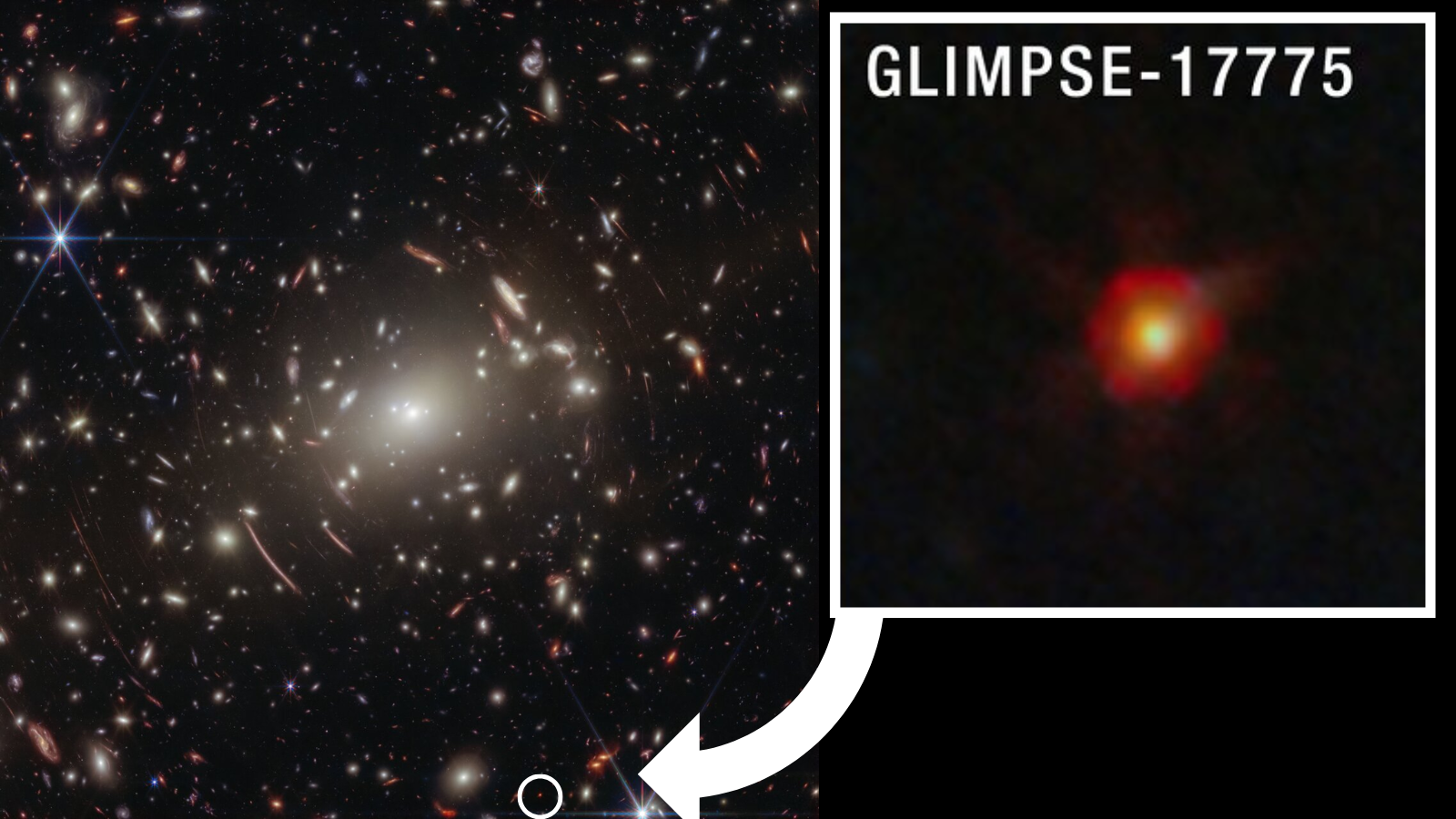
    Astronomers using the James Webb Space Telescope may be close to solving the mystery of “little red dots” in the early universe. The team has studied one of these strange objects, designated GLIMPSE-17775, finding evidence it is a black hole star — a ravenously feeding, growing supermassive black hole cocooned in a dense cloud of partially ionised gas.

    Little red dots first started to turn up when the James Webb Space Telescope (JWST) began sending data back to Earth in the summer of 2022. They were said by some scientists to have “broken cosmology” because they appear in large numbers around 600 million years after the Big Bang, but they appear to disappear before the universe reaches 2 billion years old. Several explanations for little red dots have been proposed, but one that has emerged as a frontrunner is the concept of black hole stars. If black hole stars exist, the little red dot disappearance would be the result of their intense, short-lived growth spurts that cause them to burn out — or, because the growing supermassive black holes at their centers eventually clear away the dense gas and dust obscuring them, changing their appearance as they evolve into more typical active galaxies.

    The problem is, however, that astronomers have been unable to gather observational evidence that little red dots are indeed black hole stars. That was until the JWST imaged little red dot GLIMPSE-17775, seen as it was just 1.8 billion years after the Big Bang, while making observations of the gravitational lens galaxy cluster Abell S1063. This data represents the deepest spectrum of light from a little red dot collected to date and, according to this team, contains multiple lines of evidence pointing to a black hole star.

    “I think part of the scientific community is converging on a singular picture — that little red dots can be explained by black hole star models. But none of the previous little red dots have all of the pieces of evidence in the same place,” Vasily Kokorev at the University of Texas at Austin said in a statement. “With GLIMPSE-17775 we can test these models because of how deep and amazing this source’s spectrum is.”

    Solving the little red dot puzzle with a hand from Einstein

    The JWST caught a glimpse of GLIMPSE-17775 while searching for the first generation of stars in our universe, somewhat confusingly called “Population III” stars. The telescope searched for these particular stars in the galaxies that comprise galaxy cluster Abell S1063.


    You may like

    Separately, Abell S1063 is a gravitational lens, meaning its massive gravitational influence actually curves the fabric of space and time (united as a single, four-dimensional entity called spacetime). This, in turn, means an object “behind” the galaxy cluster that’s emitting light toward our vantage point would have its light path curved in tandem with the spacetime curve. This can create a magnifying effect.

    The concept of gravitational lensing was first predicted by Albert Einstein in his theory of general relativity, and it’s how scientists were able to observe GLIMPSE-17775 — essentially turning 30 hours of observing time into just about 80.

    Space

    “When we saw the spectrum for the first time, it was like having all the pieces of a puzzle scattered on the floor,” Kokorev said. “We picked up each piece of the puzzle, measured the lines, and started combining the different pieces into a mosaic. Maybe a few pieces looked like nothing at first, but then a couple of them came together, and we realized that there was something there.”

    A view of lots of gravitationally lensed galaxies against the dark background of space.

    The galaxy cluster Abell S1063, a gravitational lens seen by the JWST. (Image credit: NASA, ESA, CSA, V. Kokorev (University of Texas at Austin), A. Pagan (STScI))

    The team identified several lines of evidence in the JWST observations that indicate “little red dot” GLIMPSE-17775 is indeed a black hole star. This includes emissions from elements that don’t conform with what would be expected in a rotating gas cloud. The emission lines instead indicate the scattering of electrons, which is expected when a source of radiation is enshrouded by a vast and dense cocoon of gas. Also indicative of a dense shroud of gas were signs of fluorescence and helium-absorbing radiation.

    The team also saw spectral lines from iron, which the team dubbed an “iron forest.” That is something expected as a result of the high-energy output of a rapidly feeding supermassive black hole: a black hole star.If little red dots are rapidly accreting supermassive black holes shrouded by dense gas envelopes, this would explain why these mystery objects are so faint in X-rays, as these cocoons should absorb this high-energy radiation.


    What to read next

    There is something missing from observations of GLIMPSE-17775, however.

    Little red dots usually have a strong characteristic dip in the spectra of light they emit, what’s known as a “Balmer Break.” The team thinks this feature is weaker for this little red dot than others because GLIMPSE-17775 is surrounded by a massive host galaxy. The team’s data therefore fits as a missing piece of the puzzle of little red dots, slotting in nicely with our understanding of the evolution of the universe.

    “Everything fits, nothing is broken, and I think that makes the puzzle that is our universe even better,” Kokorev concluded. “Looking ahead, I’m eager to dive deeper and learn about what is powering the central engines of little red dots. While we think it’s a black hole, there are some other interesting theories being proposed, which is exciting. “Maybe in a year or two, we’ll have the final answer to what powers these sources.”

    The team’s research was published on Wednesday (June 10) in The Astrophysical Journal.


    Source link

    Author

    • Admin

      NewsPublicly.com is News & Articles Platform that creating SEO-focused articles on travel, lifestyle, and digital trends.

    Admin
    • Website

    NewsPublicly.com is News & Articles Platform that creating SEO-focused articles on travel, lifestyle, and digital trends.

    Related Posts

    ‘Doctor Who’ Christmas Special is cancelled as Russell T. Davies departs the show: What does this mean for the future of Doctor Who?

    June 10, 2026

    NASA chief defends all-male Artemis 3 astronaut crew amid backlash: ‘I don’t think anyone should be reading into this’

    June 10, 2026

    ‘Voltron: Legendary Defender’ turns 10 today, and we think this mecha robot reboot was just as good as ‘Power Rangers’ and ‘Transformers’

    June 10, 2026
    Leave A Reply Cancel Reply

    Demo
    Top Posts

    The Blue Moon rises on May 30— Where and when to see the second full moon of the month

    May 30, 202640 Views

    New SOCOM rifle allows barrel swapping and cartridge changes

    June 1, 202632 Views

    “Inside Gemini Robotics 1.5: How Robots Learn to Reason & Act

    November 22, 202525 Views

    525 pounds of cocaine seized after Nebraska K9 alerts troopers on I-80

    May 28, 202624 Views
    Don't Miss

    ‘Doctor Who’ Christmas Special is cancelled as Russell T. Davies departs the show: What does this mean for the future of Doctor Who?

    June 10, 20263 Mins Read0 Views

    The BBC has announced that the planned “Doctor Who” 2026 Christmas special has been cancelled…

    Emmanuel Acho doesn’t hold back on $120,000,000 WR calling 49ers ‘stupid and dumb’ 

    June 10, 2026

    EV sales just hit their best month since federal tax credits ended

    June 10, 2026

    I Never Travel Without a Handheld Steamer—Here Are My Favorites

    June 10, 2026
    Stay In Touch
    • Facebook
    • Twitter
    • Instagram
    • YouTube
    • LinkedIn
    • WhatsApp

    Subscribe to Updates

    Get the latest creative news from SmartMag about art & design.

    Demo
    NEWSPUBLICLY
    Facebook X (Twitter) Instagram LinkedIn

    Home

    • About Us
    • Leadership
    • Advertise & Partner With Us
    • Pitch Your Story
    • Media Kit & Pricing
    • Career
    • FAQs

    Guidelines

    • Editorial & Submission
    • Partnership
    • Advertising & Sponsor
    • Intellectual Property Policy
    • Community & Comment
    • Security & Data Protection
    • Send Your Opinion

    Quick Links

    • Cookie Policy
    • Payment & Billing Terms
    • Refund & Cancellation
    • Copyright Policy
    • Complaint & Support
    • Sitemap
    • Contact Us

    Subscribe Us

    Get the latest news and updates!

    Copyright © 2026 Newspublicly (DIGITALIX COMMUNICATION). All Rights Reserved.
    • Privacy Policy
    • Terms of Use
    • Disclaimer