

Close Menu

    Subscribe to Updates

    Get the latest news information from worldwide businesses.

    What's Hot

    A ‘Reforestation Pipeline’ in New Mexico Trains Seedlings to Survive in Burn Scars

    June 5, 2026

    Portugal vs Chile Prediction and Betting Tips

    June 5, 2026

    Velotric Tempo review: A lightweight commuter e-bike that gets a lot right

    June 5, 2026
    Facebook Instagram YouTube LinkedIn X (Twitter)
    Trending
    • A ‘Reforestation Pipeline’ in New Mexico Trains Seedlings to Survive in Burn Scars
    • Portugal vs Chile Prediction and Betting Tips
    • Velotric Tempo review: A lightweight commuter e-bike that gets a lot right
    • Death of Tiruchi nursing student: Central agency inspectors check drug storage facilities at TNMSC warehouse
    • 7 medical colleges not paying stipend to MBBS interns, residents- NMC tells Supreme Court, penalty proceedings initiated
    • Chinese spies are using LinkedIn to lure Westerners into sharing sensitive information
    • India likely to outpace RBI growth forecasts, says World Bank’s Neelkanth Mishra
    • Evonith Steel acquires Indrajit Power in Maharashtra for Rs 232 cr
    Newspublicly
    • About Us
    • Advertise & Partner with us
    • Pitch Your Story
    • Contact Us
    Facebook Instagram LinkedIn X (Twitter)
    Subscribe
    • Home
    • World News
      • Asia
      • India
      • USA
      • UK & Europe
      • Middle East
    • Economy & Business
      • Global Economy
      • Corporate & Industry
      • Finance & Markets
      • Policy & Trade
    • Technology
      • Gadgets & Devices
      • Software & Apps
      • AI & Machine Learning
      • Robotics & Automation
    • Health & Medicine
      • Fitness & Nutrition
      • Research & Innovation
      • Disease & Treatment
      • Doctors, Clinics & Patient Care
    • Travel & Tourism
    • Automobile
      • Electric & Hybrid Vehicles
      • Auto Industry Insights
    • Sports
    • More
      • Education
      • Real Estate
      • Environment & Climate
      • Space & Astronomy
      • War & Conflicts
    Newspublicly
    Home»More»Space & Astronomy»Interstellar comet 3I/ATLAS is blasting out a bunch of methane. Here’s why that’s weird
    Space & Astronomy

    Interstellar comet 3I/ATLAS is blasting out a bunch of methane. Here’s why that’s weird

    AdminBy AdminJune 5, 2026No Comments4 Mins Read0 Views
    Share
    Facebook Twitter LinkedIn Copy Link WhatsApp


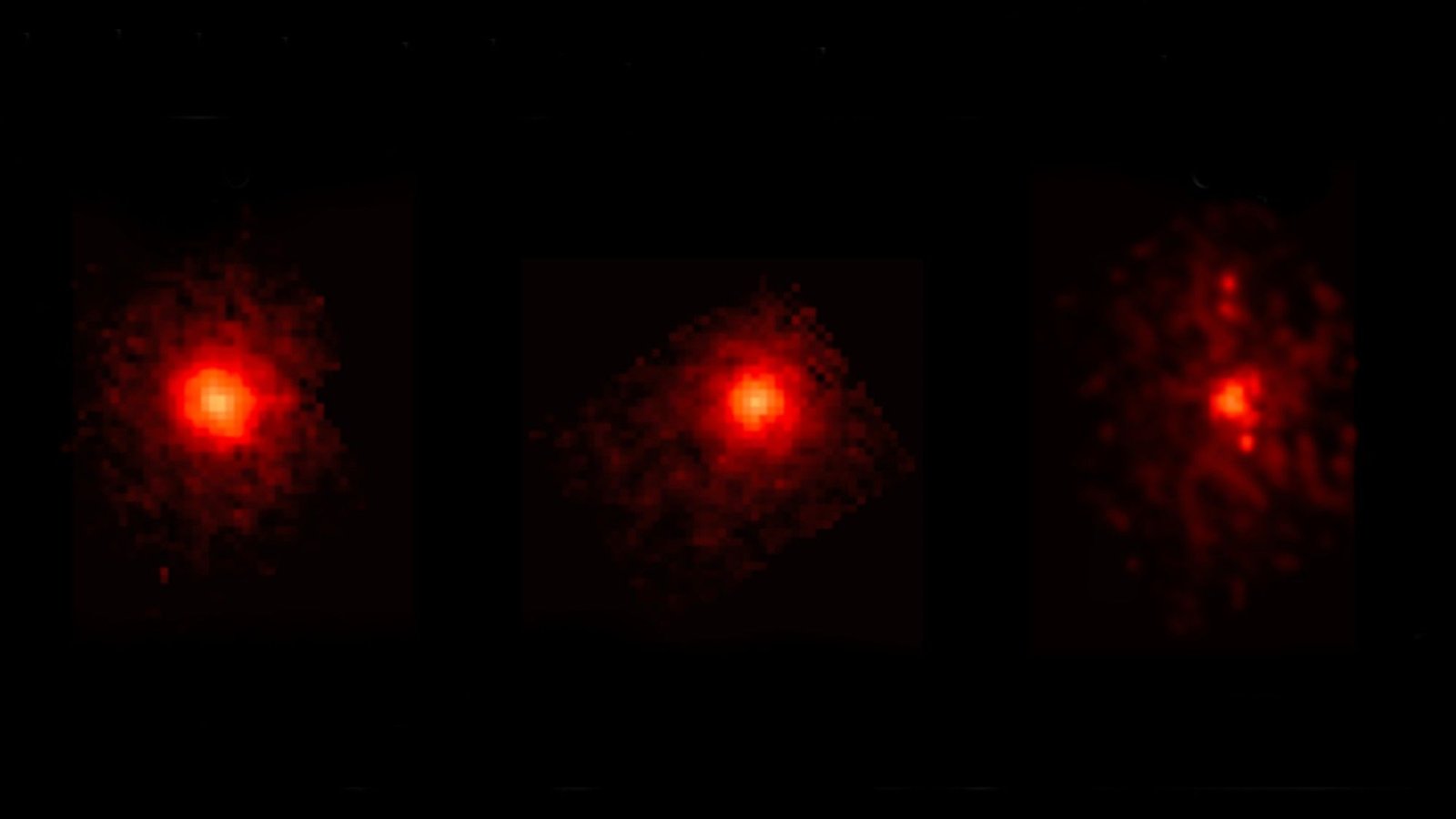
    Methane has been seen spewing from comet 3I/ATLAS, marking the first time that the gas has been identified on an interstellar object. The amount of methane, relative to water, is also larger than is typically seen in comets from our solar system, further highlighting how different this interstellar visitor is than objects from our own cosmic neighborhood.

    The James Webb Space Telescope (JWST) initially observed the interstellar comet with its Mid-Infrared Instrument (MIRI) on Dec. 15-16 2025, when 3I/ATLAS was 205 million miles (330 million kilometers or 2.20 astronomical units) from the sun. However, there was a problem with two of the observations, which failed to acquire a guide-star in order for the telescope to point accurately. This meant that those two observations had to be repeated later, on Dec. 27, when 3I/ATLAS was 236 million miles (380 million km or 2.54 AU) from the sun.

    As it happened, these repeat observations turned out to be quite fortuitous.

    Both sets of observations came less than two months after 3I/ATLAS had reached perihelion – its closest point to the sun – on Oct. 29, 2025. The extra heating from the sun had warmed the comet’s surface, increasing the amount of outgassing from the comet, but the level of outgassing was beginning to decrease as the comet moved away.

    MIRI detected water vapor streaming at large distances from the comet’s nucleus as icy grains in the coma (the gaseous ‘atmosphere’ surrounding the comet’s solid nucleus) vaporized.


    You may like

    However, this is where the observations on the Dec. 27 came into play: JWST noted that the production of water vapor had dropped sharply between Dec. 16 and 27, indicating that solar heating was fading and more water-ice was staying frozen, especially since by then 3I/ATLAS had crossed the ‘snow line’, which is the distance from the sun beyond which temperatures are low enough for water vapor to freeze to ice.

    “The water-ice line in the solar system is located around 2.5AU, and as 3I ATLAS approached those heliocentric distances … water production from the coldest regions of 3I’s surface and coma was starting to shut down,” wrote the research team, led by Caltech’s Matthew Belyakov, in their science paper. “Meanwhile, because of their much lower vapor pressures, carbon dioxide and methane are expected to have remained fully activated.”

    Space

    JWST also detected carbon-dioxide gas and even nickel vapor, matching previous observations and confirming that 3I/ATLAS has a surprisingly large abundance of carbon dioxide relative to water vapor.

    three blurry red splotches on a black background

    (Image credit: NASA, ESA, CSA, STScI, M. Belyakov (Caltech), I. Wong (STScI), Image Processing: A. Pagan (STScI))

    Most intriguing, though, was the detection of methane for the first time. Though not a rare gas, it hadn’t been detected on either of the previous two interstellar objects seen to pass through the solar system, and only became apparent on 3I/ATLAS after perihelion.

    The reason for its delayed appearance is probably because the methane is buried deeper into the cometary nucleus and it took time for the Sun’s heat to reach those depths and warm the methane enough for it to sublimate and burst out. Once upon a time the comet probably did have methane closer to, or even on, the surface, but it was lost to space long ago.


    What to read next

    “This could imply that 3I previously underwent a period of significant heating within its natal planetary system prior to its ejection into the cold interstellar medium that depleted the methane in the outermost layers,” wrote the researchers. “Consequently, the surviving reservoir of primordial methane-ice resides at depth and was only fully activated after the thermal wave induced by 3I’s perihelion passage propagated into the interior.”

    They also point out that the delayed production of methane is mirrored by a similar delayed production of carbon monoxide outgassing, which became notable in December by undergoing a 40-fold increase relative to carbon dioxide.

    Another fascinating facet is that, like carbon dioxide, methane also has a surprisingly high abundance relative to water on 3I/ATLAS.

    Yet while the ratio of methane and carbon dioxide to water seems unusually high for our solar system, it could be quite ordinary for the star system in which 3I/ATLAS formed, possibly as long ago as 11–12 billion years. Those ratios indicate that 3I/ATLAS must have formed in a somewhat different environment compared to the one in which the comets native to our solar system formed, with different physical conditions and a different chemistry.

    These findings illustrate the importance of studying interstellar objects, in that they give us a view into other planet-forming environments that we wouldn’t otherwise get. In turn, these insights can provide comparisons that can teach us more about how our own solar system and Earth formed.

    The results were reported in The Astrophysical Journal Letters.


    Source link

    Author

    • Admin

      NewsPublicly.com is News & Articles Platform that creating SEO-focused articles on travel, lifestyle, and digital trends.

    Admin
    • Website

    NewsPublicly.com is News & Articles Platform that creating SEO-focused articles on travel, lifestyle, and digital trends.

    Related Posts

    Glittering star cluster image reveals missing patch of stars: ‘We were not looking for the gap, but we found it’

    June 4, 2026

    August 2026 lunar eclipse — Everything you need to know about the 96% ‘blood moon’

    June 4, 2026

    SpaceX launches back-to-back Starlink missions from both coasts 19 hours apart (photos)

    June 4, 2026
    Leave A Reply Cancel Reply

    Demo
    Top Posts

    The Blue Moon rises on May 30— Where and when to see the second full moon of the month

    May 30, 202640 Views

    New SOCOM rifle allows barrel swapping and cartridge changes

    June 1, 202632 Views

    “Inside Gemini Robotics 1.5: How Robots Learn to Reason & Act

    November 22, 202525 Views

    525 pounds of cocaine seized after Nebraska K9 alerts troopers on I-80

    May 28, 202624 Views
    Don't Miss

    A ‘Reforestation Pipeline’ in New Mexico Trains Seedlings to Survive in Burn Scars

    June 5, 202610 Mins Read0 Views

    Four years after the Calf Canyon/Hermits Peak Fire burned 341,471 acres in northern New Mexico,…

    Portugal vs Chile Prediction and Betting Tips

    June 5, 2026

    Velotric Tempo review: A lightweight commuter e-bike that gets a lot right

    June 5, 2026

    Death of Tiruchi nursing student: Central agency inspectors check drug storage facilities at TNMSC warehouse

    June 5, 2026
    Stay In Touch
    • Facebook
    • Twitter
    • Instagram
    • YouTube
    • LinkedIn
    • WhatsApp

    Subscribe to Updates

    Get the latest creative news from SmartMag about art & design.

    Demo
    NEWSPUBLICLY
    Facebook X (Twitter) Instagram LinkedIn

    Home

    • About Us
    • Leadership
    • Advertise & Partner With Us
    • Pitch Your Story
    • Media Kit & Pricing
    • Career
    • FAQs

    Guidelines

    • Editorial & Submission
    • Partnership
    • Advertising & Sponsor
    • Intellectual Property Policy
    • Community & Comment
    • Security & Data Protection
    • Send Your Opinion

    Quick Links

    • Cookie Policy
    • Payment & Billing Terms
    • Refund & Cancellation
    • Copyright Policy
    • Complaint & Support
    • Sitemap
    • Contact Us

    Subscribe Us

    Get the latest news and updates!

    Copyright © 2026 Newspublicly (DIGITALIX COMMUNICATION). All Rights Reserved.
    • Privacy Policy
    • Terms of Use
    • Disclaimer