

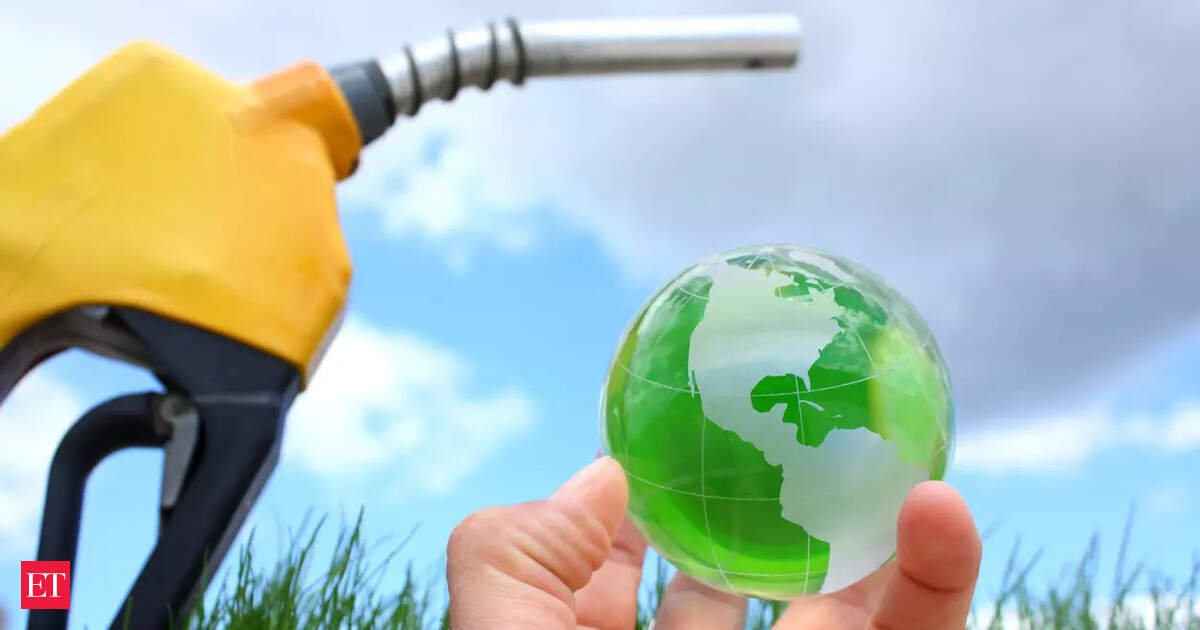
With the rollout of E85 fuel and policy changes to support mass flex-fuel deployment, the government is attempting something few large economies have tried—decarbonising road transport while extending the life of the internal combustion engine (ICE).
This sets India apart from China and Europe, where cleaner mobility has consistently meant shifting away from conventional engines.
However, even as the government pushes ahead, automakers are treading cautiously, consumers remain unconvinced, and experts warn that flex fuel should complement, not replace, India’s broader clean mobility strategy.
The latest trigger is the rollout of E85 fuel, containing 80-85% ethanol, at 48 retail outlets, with plans to expand the network to 500 stations by the end of 2026 and about 5,000 by 2027.

Govt targets solar, hydrogen components to cut import dependence
The move follows India’s nationwide transition to E20 petrol and marks the next phase of its ethanol roadmap. At the same time, the government is moving to formally include higher ethanol blends such as E85 and E100 in automotive fuel regulations, laying the groundwork for flexfuel vehicles.Measured Transition
Yet, experts emphasised that the transition must be measured. “India has drawn the right lesson from global experience,” said Randheer Singh, founder of ForeSee Advisors and former director–electric mobility at NITI Aayog. “But flex fuel should be used where the economics and ethanol supply already support it. That means sugar surplus states like Maharashtra, Uttar Pradesh and Karnataka, where demand can be built gradually.”

Singh said E20 should remain national priority as it complies with existing vehicle fleet and delivers immediate scale. Flex fuel, he argued, should only be developed as a regional solution that absorbs genuine ethanol surplus, boosts energy security, and supports farm incomes, and shouldn’t be forced into a nationwide mandate.
Automakers echo a similar caution, stating that the engineering challenge is no longer the biggest hurdle. “Engineering isn’t the problem anymore,” said an executive at a passenger vehicle maker, requesting anonymity. “Consumer confidence is. People want to know whether they’ll find the fuel, whether mileage will suffer, and whether the economics will work.”
India’s clean energy sector goes on a global talent hunt
Another senior executive at a leading carmaker said India is trying to compress a behavioural transition that took nations like Brazil decades to achieve. “Consumers are only beginning to understand E20,” the executive said. “Higher ethanol blends mean another shift in fuel habits. Infrastructure, affordability and confidence will have to evolve together.”
NEW FUEL ECOSYSTEM CHALLENGES
The concerns underscore the balancing act facing policymakers. Unlike battery-electric vehicles where consumers adopt a new technology, flex-fuel ones require buyers to embrace a new fuel ecosystem while continuing with conventional engines. Higher upfront prices could also weigh on demand.
Still, industry executives believe India has compelling reasons to pursue the ethanol route.
Instead of entirely replacing engines, flex-fuel technology adapts existing platforms to run on varying blends of petrol and ethanol, letting automakers leverage investments already made, while allowing India to reduce oil imports and lower vehicular emissions.
“China’s transition is driven primarily by battery-electric vehicles,” said Ravi Bhatia, president, Jato Dynamics. “Europe has used regulation to accelerate a similar shift. Brazil remains the only large market where ethanol has become a mainstream transport fuel. India is now attempting to build a comparable ethanol ecosystem, but in a much shorter time frame and alongside electrification rather than instead of it.”