

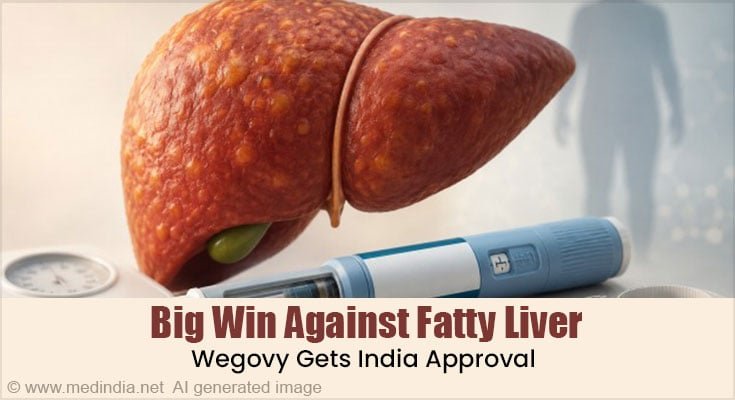
India has approved Wegovy (semaglutide) for adults with MASH, making it the country’s first GLP-1 therapy for this serious fatty liver disease.

- India approves Wegovy for adults with noncirrhotic MASH and moderate to advanced liver fibrosis
- Phase 3 trial showed better liver healing and less liver scarring than placebo
- The treatment also helps with weight management, an important factor in fatty liver disease
India’s drug regulator, the Central Drugs Standard Control Organisation (CDSCO), has approved Wegovy (Semaglutide 2.4 mg) for adults with noncirrhotic metabolic dysfunction-associated steatohepatitis (MASH) and moderate to advanced liver fibrosis, according to an announcement by Novo Nordisk India.
The drug is approved for use alongside a reduced-calorie diet and increased physical activity.
Novo Nordisk said Wegovy has become the first GLP-1 receptor agonist approved worldwide and in India to treat MASH, a severe form of fatty liver disease. However, the detailed CDSCO approval order was not publicly available at the time of writing, and the approval has so far been communicated through the company’s official statement and reports from multiple news agencies.
The approval comes months after the US Food and Drug Administration (FDA) cleared Wegovy for the same indication under its accelerated approval pathway (1✔ ✔Trusted Source
FDA Approves Treatment for Serious Liver Disease Known as MASH
).
For Indian patients, the approval expands Wegovy’s role beyond obesity and cardiovascular risk reduction by offering a treatment option for people with progressive fatty liver disease, an area where medicines have been limited until now.
Advertisement
What Is MASH and Why Is It Often Called a Silent Liver Disease?
Metabolic dysfunction-associated steatohepatitis (MASH) is an advanced form of metabolic dysfunction-associated steatotic liver disease (MASLD), previously known as nonalcoholic fatty liver disease (NAFLD).
It develops when excess fat builds up in the liver and triggers ongoing inflammation and scarring. Over time, this damage can progress to cirrhosis, liver failure, liver cancer, or the need for a liver transplant.
One of the biggest challenges with MASH is that it often develops quietly. Many people do not experience noticeable symptoms until the liver has already sustained significant damage. When symptoms do appear, they may include tiredness, unexplained weight loss, and muscle weakness.
People living with obesity, type 2 diabetes, high blood pressure, high triglycerides, or high LDL cholesterol are at greater risk of developing MASH because these conditions contribute to metabolic dysfunction.
As obesity and diabetes continue to rise in India, liver specialists warn that MASH is becoming an increasingly common cause of chronic liver disease.
Advertisement
How Did Wegovy Perform in the ESSENCE Trial?
The Indian approval is supported by findings from the Phase 3 ESSENCE trial, one of the largest international studies evaluating semaglutide in people with MASH and moderate to advanced liver fibrosis.
The trial enrolled 1,197 adults with biopsy-confirmed disease across multiple countries and will continue for 240 weeks. The current approval is based on an interim analysis of the first 800 participants after 72 weeks of treatment.
Published in the New England Journal of Medicine, the study showed that semaglutide significantly improved liver health compared with placebo.
The study found that people receiving Wegovy consistently performed better than those receiving a placebo across several important measures of liver health. The key findings are summarised below (2✔ ✔Trusted Source
Phase 3 Trial of Semaglutide in Metabolic Dysfunction-Associated Steatohepatitis
).
Advertisement
Key Findings from the Phase 3 ESSENCE Trial After 72 Weeks of Treatment
|
Treatment outcome after 72 weeks |
Wegovy (Semaglutide 2.4 mg) |
Placebo |
What does this mean? |
|
MASH resolved without worsening liver scarring |
62.9% |
34.3% |
Nearly 2 out of 3 people taking Wegovy showed healing of liver inflammation without further scarring. |
|
Liver scarring improved without worsening MASH |
36.8% |
22.4% |
More than 1 in 3 people had healthier liver tissue, which may help slow disease progression. |
|
Both liver inflammation and scarring improved |
32.7% |
16.1% |
Around 1 in 3 patients experienced improvements in both major signs of the disease. |
|
Average weight loss |
10.5% |
2% |
People taking Wegovy lost substantially more weight, an important part of managing MASH |
Supporting this evidence, another meta-analysis reviewed 13 clinical trials involving 1,811 participants (3✔ ✔Trusted Source
Glucagon-Like Peptide-1 Receptor Agonists Improve MASH and Liver Fibrosis: A Meta-Analysis of Randomised Controlled Trials ).
The researchers found that GLP-1 receptor agonists, especially semaglutide 2.4 mg, consistently improved MASH, reduced liver fat, and increased the chances of fibrosis improvement.
However, they noted that longer follow-up is still needed to confirm whether these benefits reduce the risk of liver failure, liver transplantation, or liver-related deaths.
Who Can Receive Wegovy and What Are Its Side Effects?
Wegovy should be used together with a reduced-calorie diet and increased physical activity. Besides its newly approved use in MASH, semaglutide is also indicated for several other conditions.
Wegovy is approved for:
|
Approved Use |
Eligible Patients |
|
Noncirrhotic MASH |
Adults with moderate to advanced liver fibrosis (F2 to F3) |
|
Chronic weight management |
Adults with a BMI of 30 kg/m² or above, or 27 kg/m² or above with at least one weight-related condition such as type 2 diabetes, hypertension, or dyslipidemia (abnormal amount of lipids (cholesterol or triglycerides) in the blood). |
|
Adolescent obesity |
Young people aged 12 years and older with obesity and body weight above 60 kg |
|
Cardiovascular risk reduction |
Adults with established cardiovascular disease who are overweight or living with obesity |
Like other GLP-1 receptor agonists, Wegovy commonly causes gastrointestinal side effects, particularly during the early weeks of treatment.
The most frequently reported side effects include
- Nausea
- Diarrhea
- Vomiting
- Constipation
- Abdominal pain
- Headache
- Fatigue
- Indigestion
- Dizziness
- Bloating
- Burping
- Gastroesophageal reflux
- Stomach infection
- Common cold symptoms
How Common Is Fatty Liver Disease in India?
India is witnessing a sharp rise in metabolic liver disease, driven by increasing rates of obesity, type 2 diabetes, unhealthy diets, and sedentary lifestyles.
Experts believe the country is facing a growing burden of MASLD and its more severe form, MASH, making early detection and treatment increasingly important.
A large multicenter MAP Study analyzed data from 13,750 adults who underwent FibroScan assessments across 105 diabetes and endocrine clinics in 23 states and Union Territories (4✔ ✔Trusted Source
Prevalence of Metabolic Dysfunction-Associated Steatotic Liver Disease: Mapping Across Different Indian Populations (MAP Study)
).
The study found that 68.2% of participants had MASLD, while 33.7% already showed evidence of liver fibrosis. North India recorded the highest disease burden, with MASLD affecting 73.3% of participants, highlighting significant regional differences across the country.
The growing disease burden explains why treatments that target both metabolic health and liver damage are receiving increasing attention.
Since MASH is closely linked with obesity and insulin resistance, medicines that improve weight, blood sugar, and cardiovascular risk factors may also help slow liver disease progression.
Why Does Wegovy Approval Matter?
Until recently, treatment for MASH mainly focused on losing weight, eating a healthier diet, exercising regularly, and managing diabetes or high cholesterol. While these lifestyle changes remain the foundation of care, maintaining long-term weight loss can be difficult for many people.
Wegovy offers doctors another option for eligible patients by targeting several factors that contribute to disease progression. Besides supporting meaningful weight loss, evidence suggests semaglutide can reduce liver inflammation and improve liver fibrosis, which is one of the strongest predictors of future liver complications.of the strongest predictors of future liver complications.
Frequently Asked Questions
Q: What is MASH?
A: Metabolic dysfunction-associated steatohepatitis (MASH) is an advanced form of fatty liver disease in which excess fat causes inflammation and scarring of the liver.
Q: Is Wegovy now approved for fatty liver disease in India?
A: Yes. According to Novo Nordisk India, CDSCO has approved Wegovy for adults with noncirrhotic MASH and moderate to advanced liver fibrosis.
Q: Can Wegovy reverse liver damage?
A: Clinical trials showed that Wegovy improved liver inflammation and fibrosis in many patients, but it may not reverse liver damage in everyone.
Q: Does Wegovy work only by helping people lose weight?
A: No. Researchers reported that some liver benefits could not be explained by weight loss alone, suggesting additional effects on liver health.
Q: Who is most at risk of developing MASH?
A: People with obesity, type 2 diabetes, high cholesterol, high triglycerides, and metabolic syndrome have a higher risk.
Q: Can lifestyle changes still help after starting Wegovy?
A: Yes. Wegovy is intended to be used together with a healthy diet and regular physical activity.
Q: What are the most common side effects?
A: Nausea, vomiting, diarrhoea, constipation, abdominal discomfort, and headache are among the most common side effects.
References:
- FDA Approves Treatment for Serious Liver Disease Known as MASH – (https://www.fda.gov/drugs/news-events-human-drugs/fda-approves-treatment-serious-liver-disease-known-mash)
- Phase 3 Trial of Semaglutide in Metabolic Dysfunction–Associated Steatohepatitis – (https://www.nejm.org/doi/full/10.1056/NEJMoa2413258)
- Glucagon-Like Peptide-1 Receptor Agonists Improve MASH and Liver Fibrosis: A Meta-Analysis of Randomised Controlled Trials – (https://onlinelibrary.wiley.com/doi/10.1111/liv.70256)
- Prevalence of Metabolic Dysfunction-Associated Steatotic Liver Disease: Mapping Across Different Indian Populations (MAP Study) – (https://link.springer.com/article/10.1007/s13300-025-01748-1)
Source-Medindia