

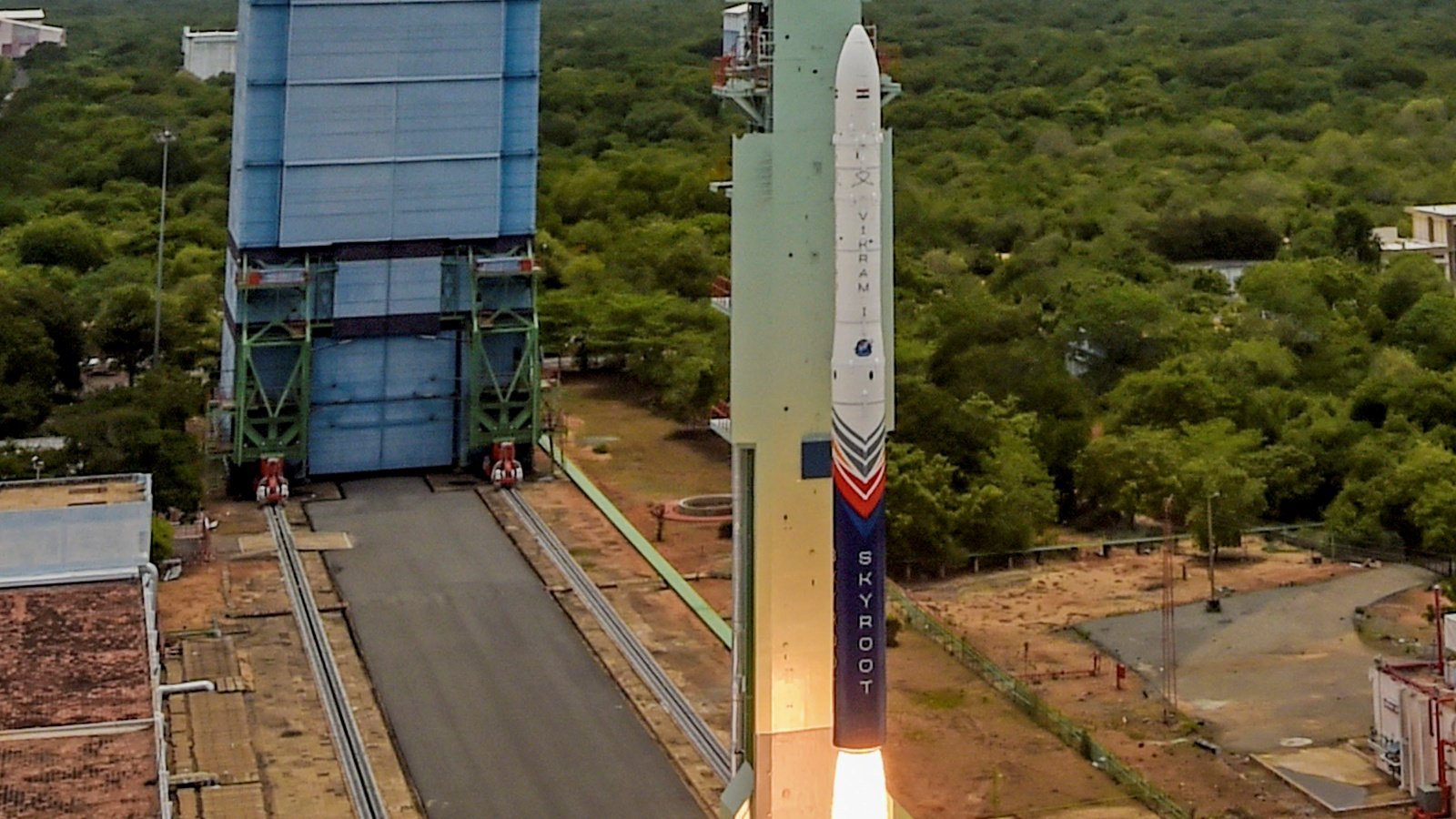
Built by the Hyderabad-based company Skyroot Aerospace, Vikram-1 marks the beginning of private space flights in India, a development that has been actively enabled and supported by the Indian Space Research Organisation (ISRO) and the government. With this launch, India has become just the third country, after the United States and China, to have launching capabilities in the private sector.

Saturday’s launch mission was named Aagaman, meaning ‘arrival’. The company said it signified the arrival of a new era in India’s space sector, an era in which “Indian innovation, engineering and enterprise come together to provide reliable access to orbit”.
Skyroot had flown Vikram-S rocket, an earlier version of the Vikram-1, to sub-orbital space in 2022. Another private company, the Chennai-based Agnikul, has also carried out a sub-orbital flight of its Agniban rocket, the world’s first to be powered by a 3-D printed engine, in 2024.
In sub-orbital flights, rockets usually fly alone, without any satellites, enter into space, and then fall off on to the Earth under the impact of gravity. They do not attain an orbit around the Earth, and are largely meant for technology demonstration.
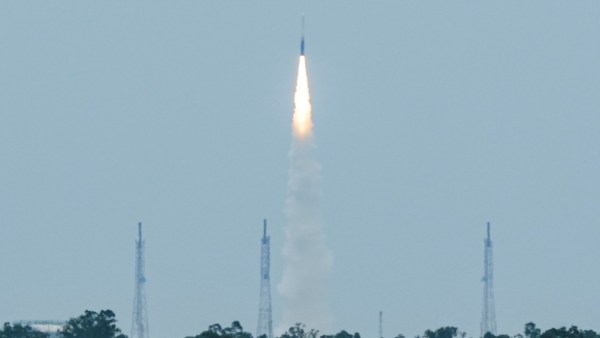 Space startup Skyroot Aerospace’s Vikram-1 rocket lifts off from the Satish Dhawan Space Centre in Sriharikota, Saturday. (PTI)
Vikram-1, on the other hand, has now become a full-fledged satellite launch vehicle, having deposited its payloads in the intended low-Earth orbits at an altitude of about 450 km.
“This is a defining moment in India’s space journey,” Prime Minister Narendra Modi said in a post on X. “The growing participation of our private sector is opening new frontiers and accelerating innovation. This achievement will encourage countless youngsters to dream bigger and innovate fearlessly,” he said.
🚨 𝗟𝗶𝗳𝘁𝗼𝗳𝗳 𝗼𝗳 𝗦𝗸𝘆𝗿𝗼𝗼𝘁 𝗔𝗲𝗿𝗼𝘀𝗽𝗮𝗰𝗲’𝘀 𝗩𝗶𝗸𝗿𝗮𝗺-𝟭 𝗿𝗼𝗰𝗸𝗲𝘁 𝗮𝘁 𝟭𝟮:𝟬𝟱 𝗣𝗠 𝗜𝗦𝗧 𝗳𝗿𝗼𝗺 𝘁𝗵𝗲 𝗙𝗶𝗿𝘀𝘁 𝗟𝗮𝘂𝗻𝗰𝗵 𝗣𝗮𝗱 𝗮𝘁 𝗦𝗛𝗔𝗥! 🚀
The era of commercial spaceflight has begun in India 🇮🇳#Skyroot | #Vikram1 pic.twitter.com/yba2WRW1Ck
— ISRO Spaceflight (@ISROSpaceflight) July 18, 2026
Soon after the launch from ISRO’s launch facility at Sriharikota, the young co-founders of Skyroot, Pawan Kumar Chandana and Naga Bharath Daka, had a conversation with Modi over phone. Modi, who has held several meetings with young space entrepreneurs in the last few years, had sent a signed postcard with the message “Vande Matram” that was carried on Vikram-1.
Story continues below this ad
Commending the company on its success, Modi said his government’s decision to open up the space sector to private players was seen by many to be risky, and thanked the Skyroot founders for proving him right. “There were lots of concerns raised, many said that this cannot happen, how can this be done. But I moved ahead and now, because of you, my decision has been proven right. Now my team will also accept that we should trust the youth of the country, we should give them work and they will do it. And, you have done it,” he told them.
The launch survived a few anxious moments in the morning, when the countdown had to be halted just five minutes ahead of the scheduled launch. However, it was resumed soon thereafter, the launch, initially slated for 11:30 am, happened at 12:05 pm. It was a smooth launch, and the rocket was able to deploy the satellites in their orbits in about 20 minutes.
🚨 𝗩𝗜𝗞𝗥𝗔𝗠-𝟭 𝗔𝗖𝗛𝗜𝗘𝗩𝗘𝗦 𝗢𝗥𝗕𝗜𝗧 𝗢𝗡 𝗙𝗜𝗥𝗦𝗧-𝗧𝗥𝗬!!
Skyroot Aerospace has successfully launched Vikram-1 into orbit around Earth on their maiden launch attempt! 🇮🇳🚀
Mission Aagaman is ACCOMPLISHED ✅️
Congrats to @SkyrootA and @isro!#Skyroot | #Vikram1 pic.twitter.com/z7Ugl3jTMF
— ISRO Spaceflight (@ISROSpaceflight) July 18, 2026
Vikram-1 is a multi-stage rocket, rising up to about seven storeys, and is powered by a propulsion system developed in-house, including 3-D printed engines and high-thrust solid fuel motors. It is designed to carry small satellites, weighing up to 350 kg, to low-Earth orbits.
There were huge celebrations at the launch facility once the rocket crossed 100-km altitude, marking its entry into space.
ISRO Chairman V Narayanan, former chairpersons S Somanath, A S Kiran Kumar, K Radhakrishnan, astronaut Shubhanshu Shukla, and Pawan Goenka, chairman of INSPACe (Indian National Space Promotion and Authorisation Centre) were present at the mission control in Bengaluru. In Delhi, Science and Technology Minister Jitendra Singh, who is also the minister in charge of the Department of Space, witnessed the launch live.
Story continues below this ad
“They have always been extremely innovative and creative. It is not an empty payload like many first missions carry. Here we have an experimental payload… If the PM had not opened the space sector, we would not have witnessed this. This marks India’s entry into the highly competitive global space sector. For India, sky is no longer the limit,” Jitendra Singh said.
He recounted that Chandana was always an innovator, even when he was working for ISRO. “Even when we were doing the sun mission Aditya-L1, it was his idea to put a camera on board so we could see what was happening with the mission while in space,” the minister said.
Lt Gen A K Bhatt (retd.), Director General, Indian Space Association (ISpA) said: “The successful deployment of such complex, IP-heavy payloads prove that our private ecosystem is now building critical global infrastructure for space sustainability and high-resolution Earth intelligence.”
Vikram-1 is an innovative launch vehicle, with its body being made of a carbon composite instead of metal. Its engines are 3D printed, reducing the time and cost. It is a four stage vehicle — three solid propellant-fuelled stages that give the rocket the maximum power to escape Earth’s atmosphere, and the fourth liquid propellant-based engine that gives it the precision to insert its payloads in orbit.
Story continues below this ad
While the name of the rocket pays homage to the father of India’s space programme, Dr Vikram Sarabhai, the solid engines have been named ‘Kalam’ for the rocket man, former President Dr APJ Abdul Kalam, and the liquid engine ‘Raman’ for the physicist, Dr C V Raman.