

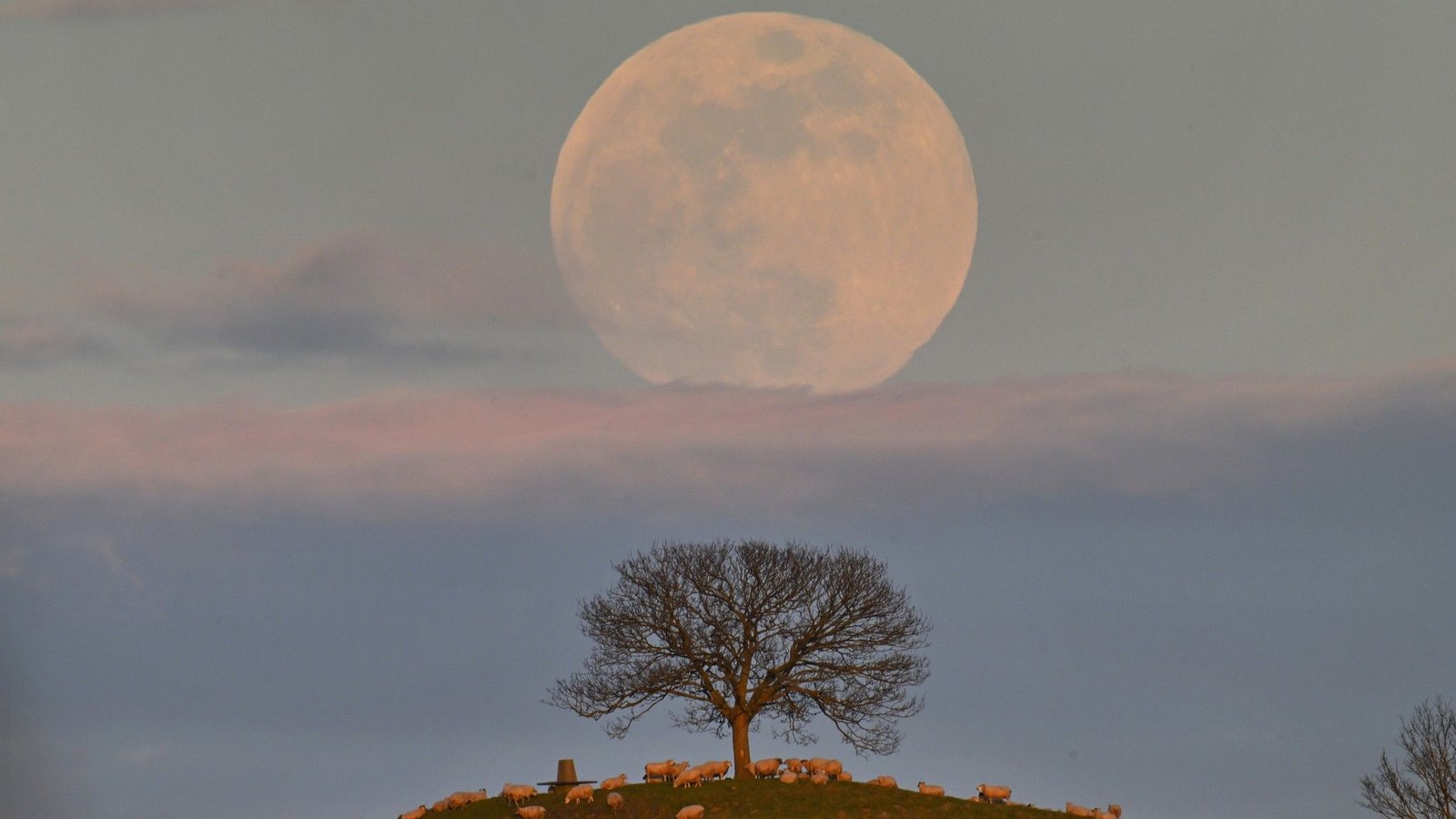
I was standing beside a bay in the middle of a city, leaning on a railing with a pair of binoculars, checking my watch for the third time. Moonrise had come and gone — at least on paper — but the eastern horizon was a mess of low cloud and distant rooftops. Nothing.
It’s a familiar frustration for moon-gazers. You’ve done the planning, arrived early and picked your spot, but there’s always a moment of doubt about whether you forgot some small detail. I kept scanning, sweeping slowly along the skyline, trying to second-guess where it might break through. Did I get the date wrong?!
Then it happened. A sudden hint of deep orange, almost glowing through the haze — the full moon appearing between two buildings, distorted, oversized, awesome. For a few moments, it felt like my own private moonrise. No one else along the promenade had noticed. People walked past me, heads down, conversations uninterrupted.
But there’s only so long a man with binoculars goes unnoticed. One person stopped. Then another. Heads tilted upward, phones came out. Within minutes, the rising of the full moon was a public spectacle — all because I had done my homework and knew exactly when and where to look. Then got lucky with clouds.
Unless you’re happy to leave it to chance, for the coming full Blue Moon, preparation is everything (and, no, it won’t be blue!). Here’s how not to miss a full moonrise.
What makes a full moonrise special
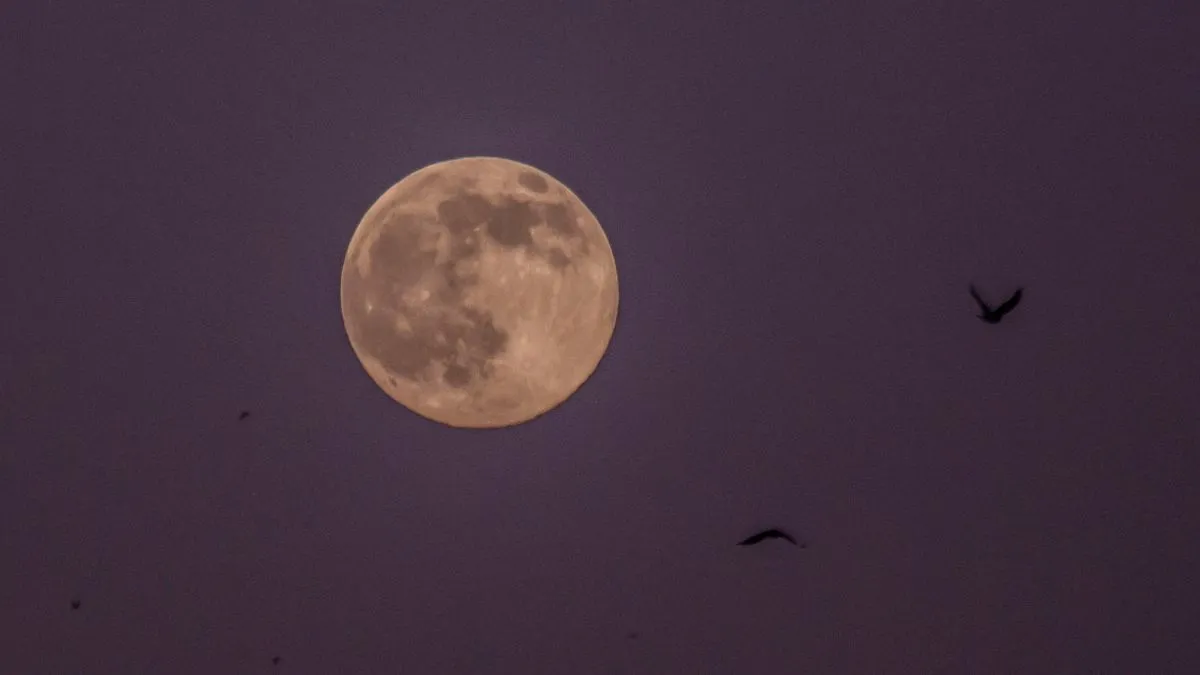
A full moonrise is a brief event, like the sunset it follows. For a few minutes, when the rising full moon appears low on the horizon during dusk, its light is filtered through thick layers of Earth’s atmosphere. That’s what gives it a warm orange hue against a bluish sky. It’s a beautiful sight.
Social media loves to shout about the full moon, but frequently gets the date wrong and rarely differentiates between the moment the full is 100%-illuminated — a completely meaningless global time — and when it will actually first appear. I find it frustrating that #sunset is one of the world’s most used hashtags while #moonrise is barely even understood by most people. Why the selective ignorance about an Earth-rotation moment?
The difference, of course, is that you can see a sunset coming. As the sun dips closer to the horizon, you get a timely warning and a steer about exactly where you need to look if you want to see it fall below the horizon. For the full moon, it’s the opposite — you need to do your research about exactly when it will be and where it will appear on the horizon. Otherwise, you’ll miss it completely.
How to calculate when to watch a full moonrise
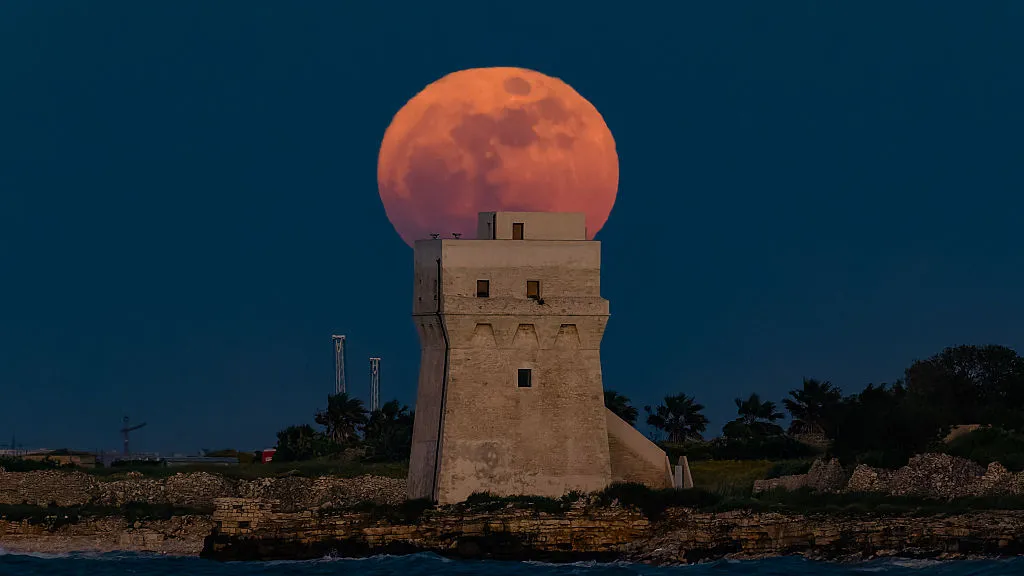
What few realize is that the exact time to see the full moonrise may differ from the date and time it reaches full. This week’s full Blue Moon is a good example. It turns full at 4:45 a.m. EDT on Sunday, May 31. So does that mean you should get up before sunrise to see it 100%-lit? Absolutely not. What you need to calculate is when moonrise closely follows sunset, ideally by about 20 minutes, so it rises during the blue hour — when it’s dark enough for its orange light to impress, but light enough to see it above a still-lit landscape. Ambient light is critical if you intend to photograph the full moon behind a foreground object. Try it in darkness, and you’ll get only a silhouette. However, that moment could be the night before or after the date of the full moon.
A good place to start is a sunrise-sunset calendar that builds in moonrise times, too. First, choose a location, then look at the sunset and moonrise times. For example, for New York on Sunday, May 31 — the date of the full moon — sunset is at 8:20 p.m., and moonrise is 9:13 p.m. That won’t work — the moon will rise in darkness. However, on Saturday, May 30, moonrise is at 8:14 p.m. while sunset is at 8:19 p.m. That’s not perfect — but it’s the best night to watch the full moonrise, which will occur during dusk.
How to calculate where to watch a full moonrise
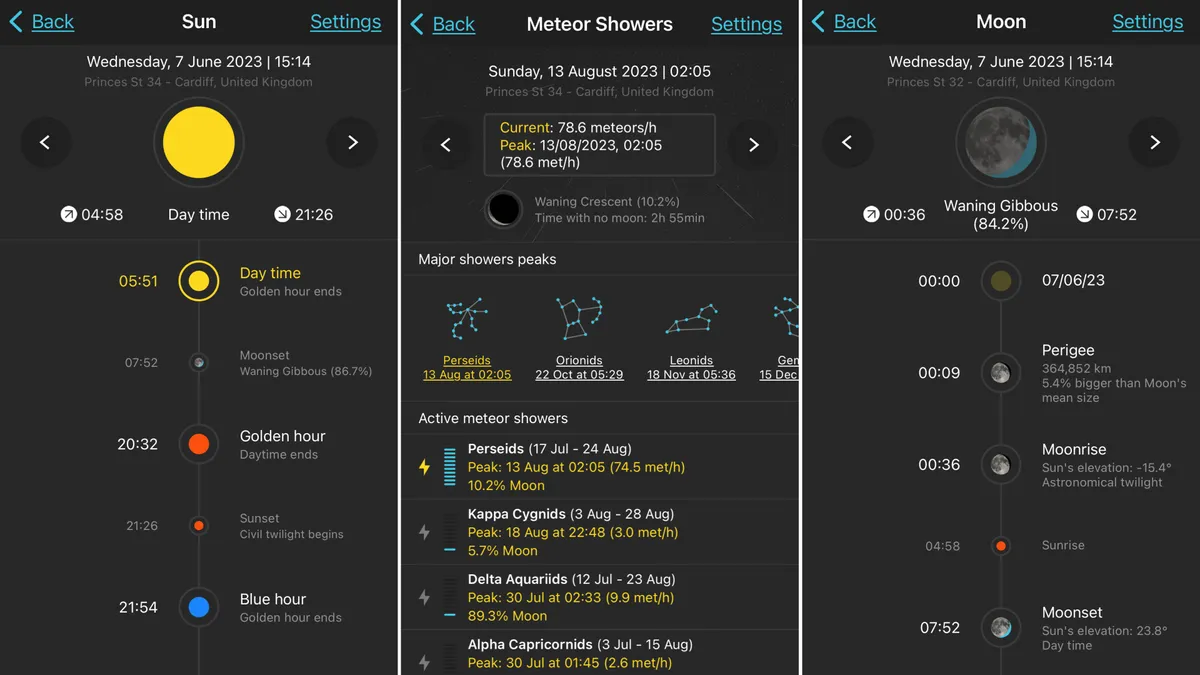
The best place to watch a full moonrise is generally a slightly elevated location that looks east across a distant, unobstructed horizon, though a skyline of low buildings is fine. For the latter, looking over an open stretch of water — such as a river, dock or bay — can work well.
What is crucial to understand is that the full moonrise point on the horizon is never in the same place from month to month. As for where to watch the moon appear on the horizon, it’s complicated by the fact that near the equinoxes, it rises close to due east, and near the solstices, it can rise much further northeast or southeast. The best option is to consult one of the many terrific precision planning apps available, such as TPE (The Photographer’s Ephemeris) (which has a web app), PhotoPills or Planit Pro. They’ll let you see exactly where the moon will appear on the horizon from any given point, with elevation data taken into account.
How to photograph a full moonrise
Once you’re in place, be patient. The moon rarely becomes visible exactly at the listed moonrise time. It can take 5-15 minutes to clear distant terrain and buildings, and when it does, it often seems to “pop” into view — already large, already glowing. Then it all happens very quickly, brightening and whitening as it gets higher, losing contrast and detail. The best photographic window is very short.
So act decisively and start taking photos. I use a 200-400mm lens on a tripod and try to get the moon as it sits just above a building or other structure. You can experiment with ISO and shutter speed, but a good place to start is 1/125s and ISO 100-200. My lens has excellent autofocus; if yours doesn’t, spend some time before moonrise checking and rechecking your focus using a distant object, and zooming in on images to make sure it’s sharp. You want a Blue Moon, not a blurred moon.
Being in place at moonrise is important because seeing a muted orange moon rising over a landscape is a far more special sight than a big, bright orb high up in a black sky. The next day, you’ll hear people saying things like, “Did you see the full moon last night? It was so bright!” and you’ll know one thing for sure — they completely missed the moment.
Stargazer’s corner: May 29-June 4, 2026
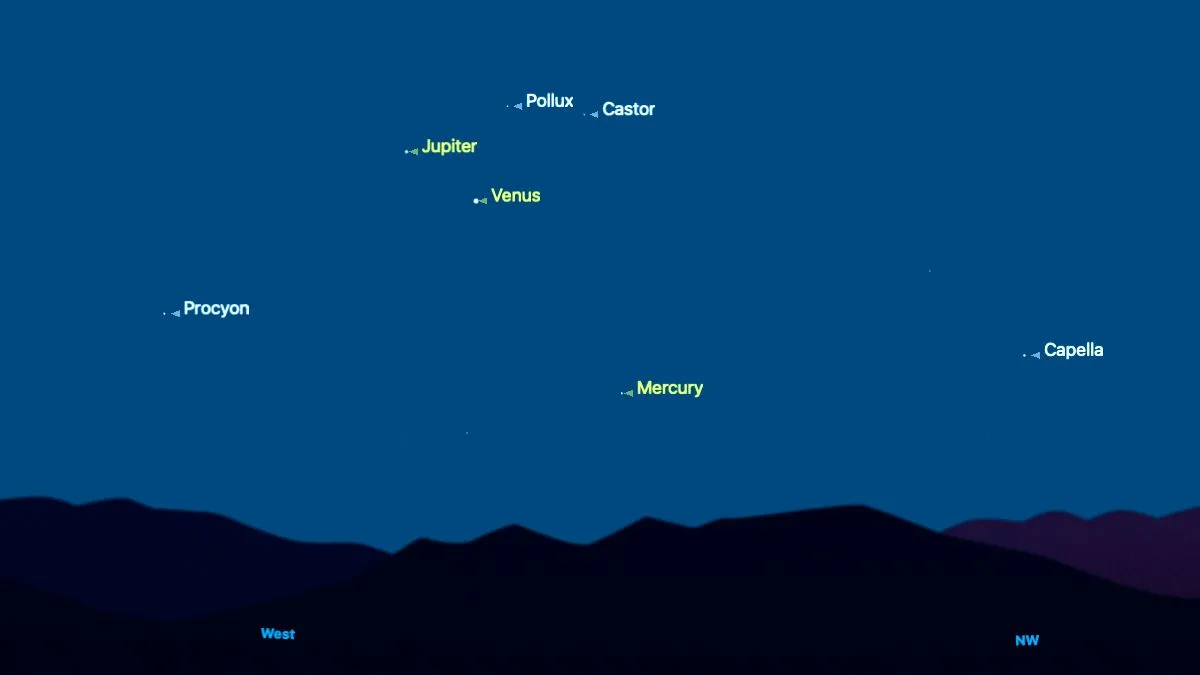
With the rise of the full moon this week, its light dominates to the detriment of faint stars and constellations, but with it comes an oddity. Despite the attention the Blue Moon will get, it’s actually the smallest full moon of the year — a so-called micromoon. The moon reaches apogee (the farthest it gets from Earth along its slightly elliptical monthly orbital path) on June 1. By then, stargazers will be busy checking out the two bright planets in the west just after sunset. Jupiter and the brighter Venus are getting closer each evening, with a close conjunction — when they appear to pass each other — due on June 9-11. For now, watch them approach each other while Pollux and Castor, the brightest stars in Gemini, look on. You may even see Mercury just below the two planets, much closer to the horizon, as it joins in late-spring’s “planet parade.”