

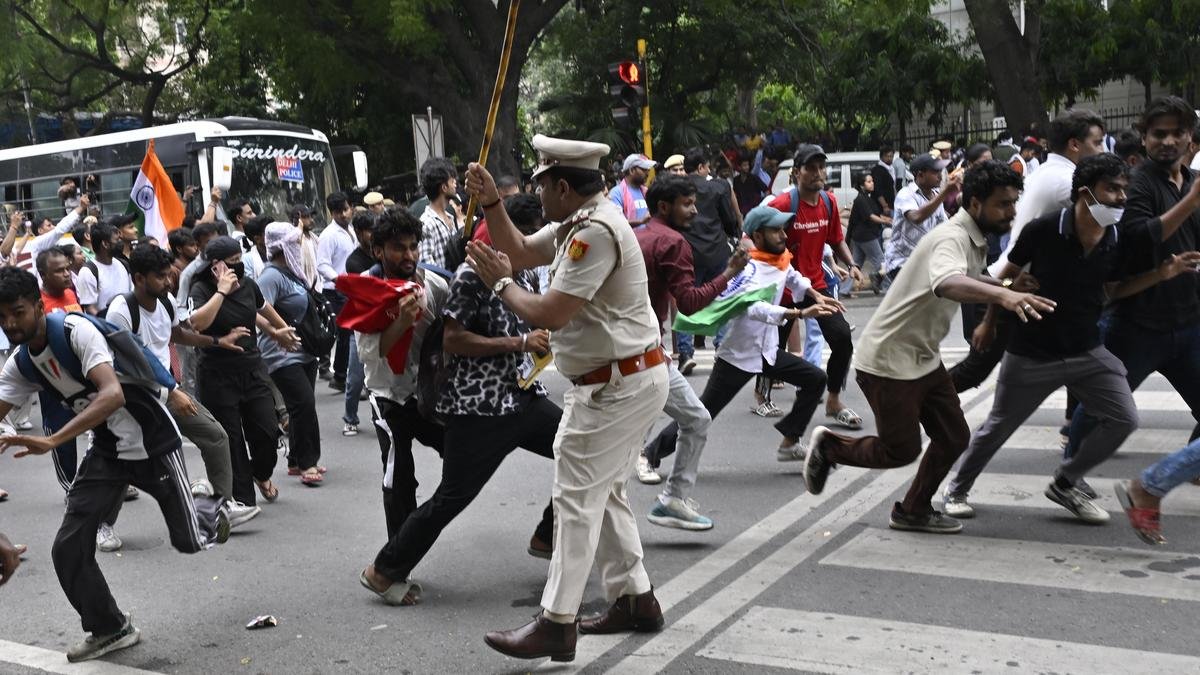
When 23-year-old Arhaan (name changed to protect identity) reached his accommodation after attending the Cockroach Janta Party protest march in New Delhi on July 20, his ears kept ringing with pain when he closed his eyes.
He remembers it started when a canister had burst with a loud sound near his head when he was trapped between the barricades and the police. He said he blacked out for a minute when it happened, before running away when the police started lathi-charging.
In the series of protests in Jantar Mantar called by the Cockroach Janta Party (CJP), the Delhi police and security personnel have been accused of using lathis, tear gas, pellet guns, and shock batons against peaceful protestors. Several protestors had to be treated for injuries, with one 20-year-old woman requiring ventilator support.
But while security forces have denied the use of many of these devices against protestors, transparency on the crowd control measures has been lacking.
‘Less lethal’
These devices are part of less-lethal crowd control measures. Forces deployed similar devices during the farmers’ protests in 2020-2021, protests against the Citizenship Amendment Bill 2019, and during crackdowns in Manipur and Jammu & Kashmir.
However, their use in excess and misuse is known to have severe long-term consequences for a person’s health, according to the U.S.-based nonprofit Physicians for Human Rights (PHR).
“We completed two systematic reviews looking at the health impacts of so-called ‘less lethal’ crowd control measures,” Madhavi Dandu, director of the University of California Global Health Institute and a member of PHR, said. “Across both reviews, injuries affected nearly every organ system and ranged from transient symptoms to lifelong disability and even death.”
The reviews were published in 2017 in BMJ Open and BMC Public Health.

A security official launches tear gas canisters following alleged stone-pelting by protesters during the ‘Bihar Bandh’, called by Left-wing student organisations over the NEET paper leak and police action against protesting students in New Delhi, Aurangabad, July 25, 2026.
| Photo Credit:
ANI
Deadly gaps
In India, the law requires the intensity and type of less-lethal crowd control measures to escalate only if the crowd does not disperse or becomes violent. However, regulations fall short on what these devices must be made of and on when and who can deploy these measures.
This lacuna can in turn be deadly. For example, tear gas is a lachrymatory — or tear-inducing — agent that the Chemical Weapons Convention classifies as a chemical weapon and has been banned in war. However, the Indian state can use it to control riots in exceptional circumstances.
In India, the most common chemical compound in tear gas is CS gas or o-chlorobenzylidene malononitrile. When in contact, it causes intense coughing, nausea, tightness in the chest, and even physical weakness for a short period of time.
Another compound the Tear Smoke Unit of the Border Security Force produces is pelargonic acid vanillylamide (or PAVA), a synthetic pepper spray. Oleoresin capsicum, a.k.a. pepper spray, is also used.
“Chemical irritants can lead to chronic respiratory disease, persistent eye injuries, skin conditions, and psychological effects such as PTSD,” Dr. Dandu said. Tear gas should never be used in places with poor ventilation or where protesters cannot safely escape from it, she added.
The risk is higher for people with pre-existing respiratory or skin conditions and allergies to these compounds. A 2025 study in Toxicology Reports reported that people exposed to CS spray during a protest in Georgia had significantly higher ECG abnormalities, indicating potential cardiopulmonary effects.
Tear gas canisters, when thrown into a crowd with force, can also cause head injuries and direct contact with the skin can cause burns.

Excessive force
In India, forces have been known to use grenade launchers to deploy tear gas canisters. These launchers can fire around 20 canisters in less than a minute and to up to 400 m. One 21-year-old protestor named Subhkaran Singh died during the farmers’ protests after sustaining a head injury from such a tear gas shell in 2024.
Handheld kinetic weapons, which include lathis or batons, are common less-lethal weapons used to control crowds. They are only to be used on violent protestors after adequate warning from an executive magistrate.
According to the Kerala Police Manual of 1970, personnel must use the lathi only against soft parts of the body — from the shoulder to the thighs — and avoid the neck and the head. The United Nations Guidance on Less-Lethal Weapons in Law Enforcement has also said that thorax, spine, throat, kidneys and abdomen should not be struck as they can suffer damage or be ruptured.
“Often we have seen security personnel hit whoever is in front of them,” Harjit Singh Bhatti, a member of Progressive Medicos and Scientists Forum, said. “This is a sign of poor training. Women, children, and the elderly are getting injured because of lathis.”
He added that when excessive force is used, the strikes may also lead to disability or nerve damage that can cause lifelong pain.
Protesters from the CJP march on July 20 alleged that some of the lathis were studded with nails, severely wounding protesters. Many also suffered fractures and head injuries. The incident was also the first known case of shock-batons being used for crowd control in the national capital. These batons release a mild electric shock at the moment of the strike.
Human rights groups have called for such batons to be banned as they can cause permanent disability and even death.
Caught off guard
Kinetic impact projectiles are plastic or rubber bullets with metal fragments, and include those fired by pellet guns. Around five protesters at the CJP march suffered pellet gun injuries, with one protester risking loss of vision. However, these projectiles are inaccurate, particularly at long distances, and can cause indiscriminate harm.
In 2016, more than 6,000 people in Jammu & Kashmir suffered severe pellet-gun injuries. In a study published in the Indian Journal of Ophthalmology, of 777 victims examined, 82% had lost vision to some degree.
“Kinetic projectiles should never target the head, neck or torso and should be fired from recommended distances at the lower extremities only when necessary for safety,” Dr. Dandu said.
Protesters are often caught off guard when confronted with such force and weapons. That can cause fear and panic, heightening the risk of a crowd collapse.
“Ideally, these weapons should only be considered when absolutely necessary and proportionate, after all other de-escalation efforts have failed,” according to Dr. Dandu. “Prioritise communication and avoid indiscriminate deployment.”
She added that rapid access to medical care, officer training, transparency, and accountability are also essential to minimising harm.
In India, information on the crowd control devices that security personnel possess and use is not easily available. Regular audits are necessary to ensure these devices meet quality standards and tests should be conducted in a manner that reveals the weapons’ full impact before they are deployed, per the UN guidance.
Also according to the guidance, the state must monitor the use of force and information about the crowd must be disaggregated to the extent possible on the basis of age, gender, and disabilities before deciding which devices to use. It also requires any serious injuries or deaths caused by such devices to be duly investigated by the competent authority.
nivedita.s@thehindu.co.in
