

Close Menu

    Subscribe to Updates

    Get the latest news information from worldwide businesses.

    What's Hot

    Cyclospora Cases Rise Among UK Travellers Returning From Mexico

    July 31, 2026

    With Switch 2, iPhone, and laptop tricks, the Sharge Disk Pro 2 is finally a worthy EDC

    July 31, 2026

    Rivian spinoff Also to start delivering e-bikes after months of delays

    July 31, 2026
    Facebook Instagram YouTube LinkedIn X (Twitter)
    Trending
    • Cyclospora Cases Rise Among UK Travellers Returning From Mexico
    • With Switch 2, iPhone, and laptop tricks, the Sharge Disk Pro 2 is finally a worthy EDC
    • Rivian spinoff Also to start delivering e-bikes after months of delays
    • PNB raising $1 billion for FCNR on-lending
    • Blinded by pellets in 2016, young J&K woman finally gets her Rs 41-lakh due | India News
    • Luigi Mangione lawyers argue media access rules violate public trial
    • How do supermassive black holes grow? AI finds 7 spacetime-warping ‘quasars’ that could help solve the mystery
    • Liv Morgan compared to Brock Lesnar ahead of SummerSlam
    Newspublicly
    • About Us
    • Advertise & Partner with us
    • Pitch Your Story
    • Contact Us
    Facebook Instagram LinkedIn X (Twitter)
    Subscribe
    • Home
    • World News
      • Asia
      • India
      • USA
      • UK & Europe
      • Middle East
    • Economy & Business
      • Global Economy
      • Corporate & Industry
      • Finance & Markets
      • Policy & Trade
    • Technology
      • Gadgets & Devices
      • Software & Apps
      • AI & Machine Learning
      • Robotics & Automation
    • Health & Medicine
      • Fitness & Nutrition
      • Research & Innovation
      • Disease & Treatment
      • Doctors, Clinics & Patient Care
    • Travel & Tourism
    • Automobile
      • Electric & Hybrid Vehicles
      • Auto Industry Insights
    • Sports
    • More
      • Education
      • Real Estate
      • Environment & Climate
      • Space & Astronomy
      • War & Conflicts
    Newspublicly
    Home»More»Space & Astronomy»How do supermassive black holes grow? AI finds 7 spacetime-warping ‘quasars’ that could help solve the mystery
    Space & Astronomy

    How do supermassive black holes grow? AI finds 7 spacetime-warping ‘quasars’ that could help solve the mystery

    AdminBy AdminJuly 31, 2026No Comments3 Mins Read0 Views
    Share
    Facebook Twitter LinkedIn Copy Link WhatsApp


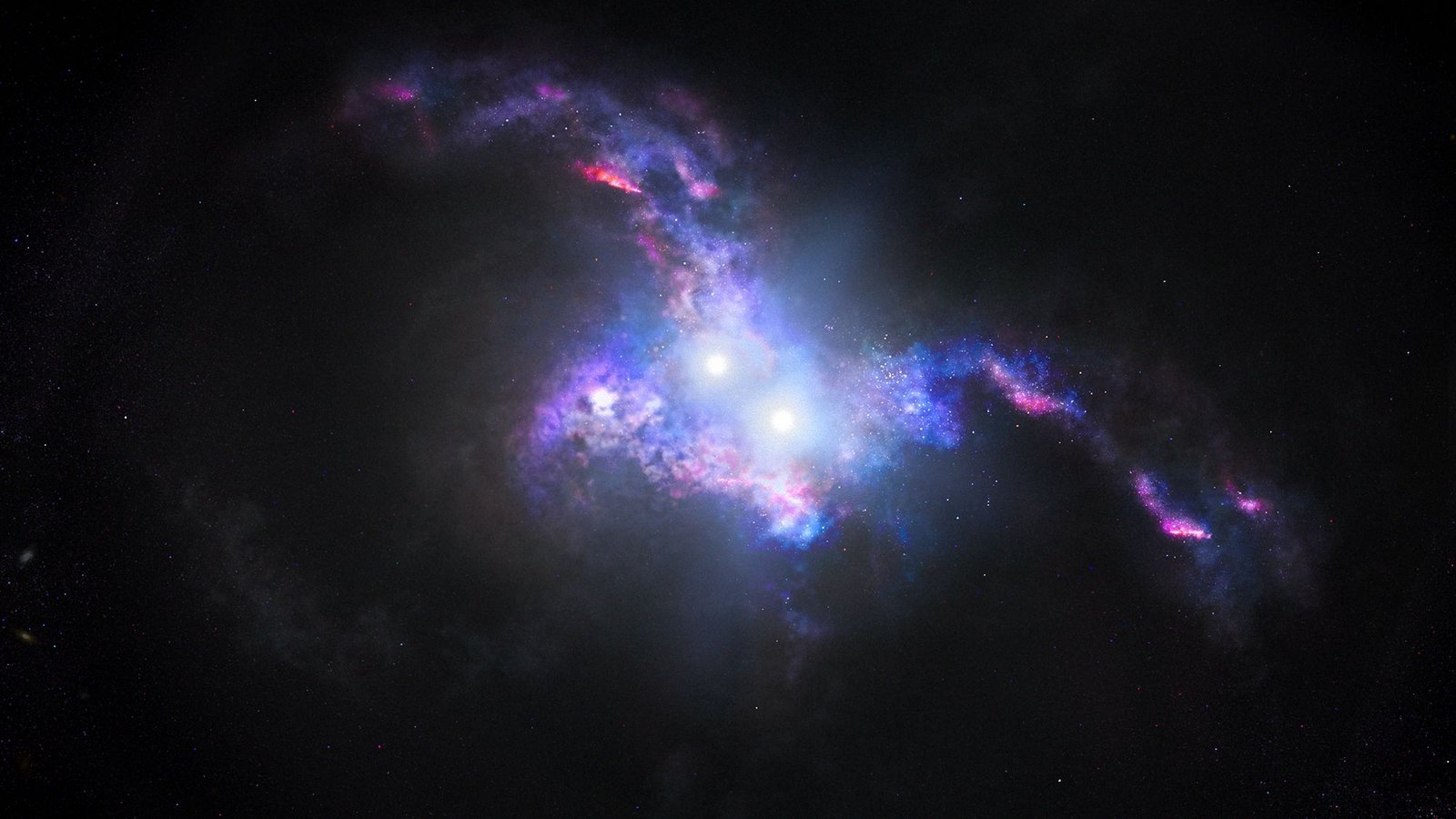
    Some of the brightest objects in the universe may also hold the key to understanding how galaxies evolve — especially when gravity transforms them into giant cosmic magnifying glasses.

    Using artificial intelligence to search through data from the Dark Energy Spectroscopic Instrument (DESI), astronomers have identified seven promising candidates for quasars acting as gravitational lenses — natural cosmic magnifying glasses created when a massive object’s gravity bends and magnifies light from a more distant object.

    These unusual systems could help researchers better understand how actively growing supermassive black holes evolve, according to a statement from Ohio State University.

    “Quasars are like the baby pictures of a supermassive black hole,” Everett McArthur, lead author of the study and a graduate student in astronomy at The Ohio State University, said in the statement. “So exploring how we get from quasars to those black holes is really important.”

    Quasars are the intensely bright centers of galaxies powered by actively feeding supermassive black holes. Studying these objects can help researchers understand how black holes evolve into the enormous ones found throughout the modern universe. But as these black holes pull in gas and dust, they release so much energy that they can outshine their entire host galaxies, making those galaxies difficult to study.


    You may like

    Rare cases where a quasar acts as a gravitational lens offer a way around that problem, giving astronomers a unique opportunity to observe both the quasar and the distant galaxy whose light is magnified by its gravity.

    Lots of gravitationally lensed objects in space. They look like different colored dots that are glowing. Some, which are lensed, look more like streaks.

    Gravitational lensing can be seen in this cosmic deep field. Notice how some glowing spots are dots while others are lines. (Image credit: Image: NASA, ESA, CSA, STScI, Jose Diego (IFCA), Jordan D’Silva (UWA), Anton Koekemoer (STScI), Jake Summers (ASU), Rogier Windhorst (ASU), Haojing Yan (University of Missouri); Image Processing: Joseph DePasquale (STScI))

    However, finding these rare alignments can be exceptionally challenging. To uncover them, the research team began with a catalog of roughly 800,000 quasars identified by DESI and used a machine-learning model to search for subtle signatures of gravitational lensing.

    Space

    Because so few quasars acting as gravitational lenses are known, researchers had little real-world data to train their AI model. Instead, they generated simulated examples of these cosmic alignments, allowing the algorithm to learn what to look for before searching the DESI catalog. The algorithm narrowed the search to about 200 candidates, which researchers then reviewed manually. That process resulted in seven new quasar lens candidates.

    Dense webs of blue and yellow strings above and below an image of the Milky Way.

    Two “fans” representing DESI observations above and below the plane of the Milky Way. (Image credit: DESI Collaboration/DOE/KPNO/NOIRLab/NSF/AURA/R. Proctor/ Robert Lea (created with Canva))

    The discoveries roughly double the number of known systems found through similar survey searches, according to the statement.

    While artificial intelligence played a key role in finding the candidates, the discoveries highlight the scientific potential hidden within the massive datasets produced by modern astronomy. DESI is mapping millions of galaxies and quasars, creating an enormous archive that would be nearly impossible to search by hand.

    Follow-up observations will be needed to confirm the newly identified quasar lenses and study their properties in greater detail. If verified, they could offer astronomers a powerful new way to investigate how supermassive black holes shaped the galaxies around them while demonstrating how AI can uncover rare cosmic phenomena hidden within the enormous datasets produced by modern sky surveys.

    Their findings were published July 22 in The Astrophysical Journal.


    Source link

    Author

    • Admin

      NewsPublicly.com is News & Articles Platform that creating SEO-focused articles on travel, lifestyle, and digital trends.

    Admin
    • Website

    NewsPublicly.com is News & Articles Platform that creating SEO-focused articles on travel, lifestyle, and digital trends.

    Related Posts

    Could JJ Abrams’ new ‘Twilight Zone meets Jurassic Park’ movie be the sleeper hit of the summer?

    July 31, 2026

    The Milky Way has a hidden feature you’ve probably never noticed. Here’s how to find it

    July 31, 2026

    Our recommendations for safe solar eclipse glasses for the Aug. 12, 2026 eclipse

    July 31, 2026
    Leave A Reply Cancel Reply

    Demo
    Top Posts

    The Blue Moon rises on May 30— Where and when to see the second full moon of the month

    May 30, 202640 Views

    New SOCOM rifle allows barrel swapping and cartridge changes

    June 1, 202633 Views

    “Inside Gemini Robotics 1.5: How Robots Learn to Reason & Act

    November 22, 202527 Views

    525 pounds of cocaine seized after Nebraska K9 alerts troopers on I-80

    May 28, 202624 Views
    Don't Miss

    Cyclospora Cases Rise Among UK Travellers Returning From Mexico

    July 31, 20264 Mins Read0 Views

    UK health officials have reported a rise in Cyclospora infections among returning travellers, with most…

    With Switch 2, iPhone, and laptop tricks, the Sharge Disk Pro 2 is finally a worthy EDC

    July 31, 2026

    Rivian spinoff Also to start delivering e-bikes after months of delays

    July 31, 2026

    PNB raising $1 billion for FCNR on-lending

    July 31, 2026
    Stay In Touch
    • Facebook
    • Twitter
    • Instagram
    • YouTube
    • LinkedIn
    • WhatsApp

    Subscribe to Updates

    Get the latest creative news from SmartMag about art & design.

    Demo
    NEWSPUBLICLY
    Facebook X (Twitter) Instagram LinkedIn

    Home

    • About Us
    • Leadership
    • Advertise & Partner With Us
    • Pitch Your Story
    • Media Kit & Pricing
    • Career
    • FAQs

    Guidelines

    • Editorial & Submission
    • Partnership
    • Advertising & Sponsor
    • Intellectual Property Policy
    • Community & Comment
    • Security & Data Protection
    • Send Your Opinion

    Quick Links

    • Cookie Policy
    • Payment & Billing Terms
    • Refund & Cancellation
    • Copyright Policy
    • Complaint & Support
    • Sitemap
    • Contact Us

    Subscribe Us

    Get the latest news and updates!

    Copyright © 2026 Newspublicly (DIGITALIX COMMUNICATION). All Rights Reserved.
    • Privacy Policy
    • Terms of Use
    • Disclaimer