

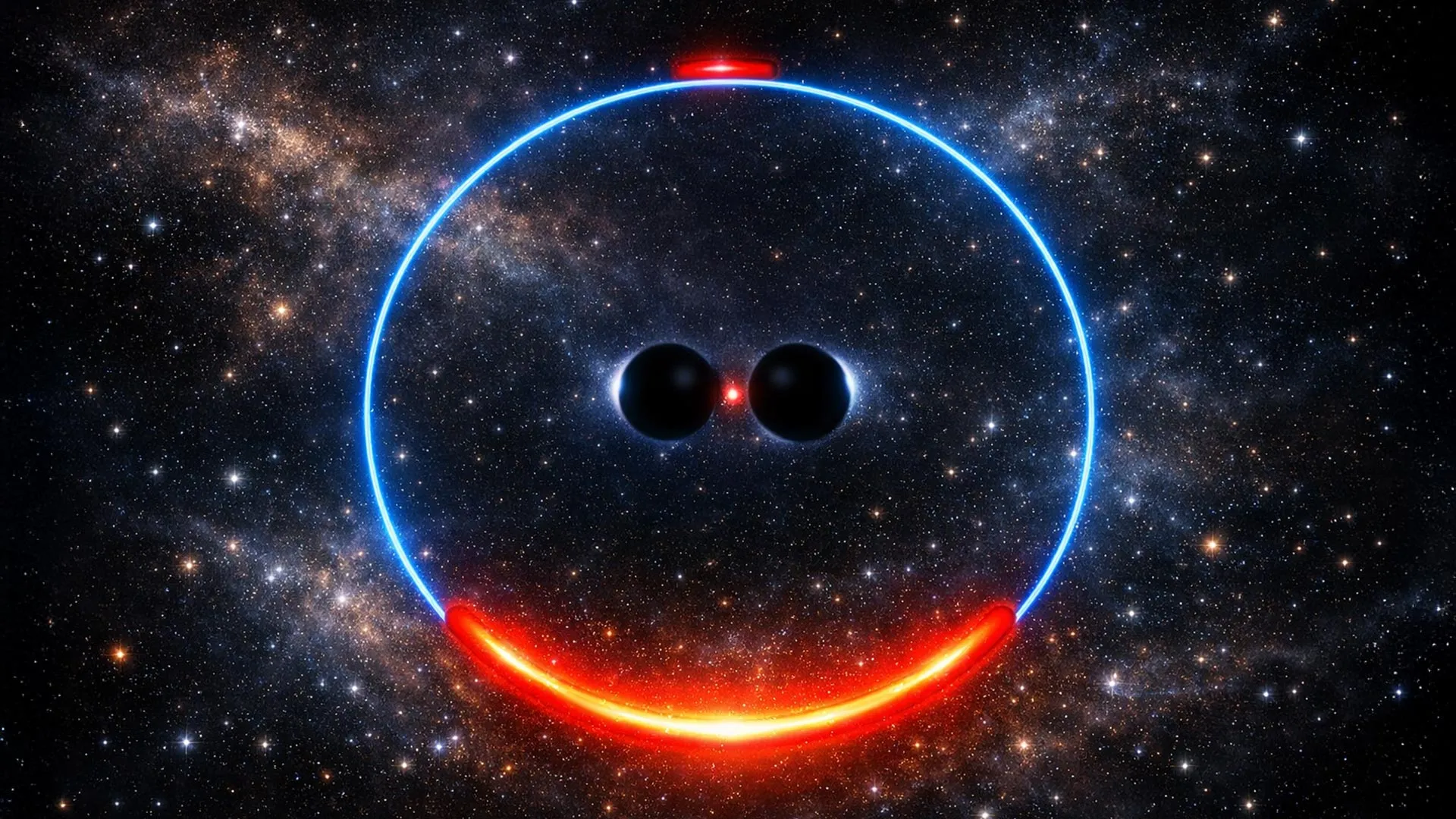
Astronomers from the University of Oxford and the Max Planck Institute for Gravitational Physics (Albert Einstein Institute) have outlined a new strategy for uncovering one of the universe’s most elusive objects: tightly bound pairs of supermassive black holes.
These giant black hole duos are expected to form naturally after galaxies merge. Although astronomers have identified some widely separated supermassive black hole pairs, finding those that orbit much closer together has proven far more difficult.
In a study published in Physical Review Letters, the researchers suggest searching for a distinctive signal. As the black holes orbit each other, their immense gravity could repeatedly magnify the light from stars located behind them, creating recurring flashes that may reveal the hidden systems.
Galaxy Mergers Create Supermassive Black Hole Binaries
Most galaxies contain a supermassive black hole at their center. When galaxies collide and eventually combine, their central black holes can become gravitationally bound, forming what scientists call a supermassive black hole binary.
These systems are important for understanding how galaxies evolve over time. They are also expected to generate some of the strongest gravitational waves in the universe.
Future space-based gravitational wave observatories should be able to detect these binaries directly. However, the new research suggests that astronomers may not have to wait. Existing and upcoming sky surveys could potentially identify them through their effects on visible light.
“Supermassive black holes act as natural telescopes,” said Dr. Miguel Zumalacárregui from the Max Planck Institute for Gravitational Physics. “Because of their enormous mass and compact size, they strongly bend passing light. Starlight from the same host galaxy can be focused into extraordinarily bright images, a phenomenon known as gravitational lensing.”
How Gravitational Lensing Creates Bright Flashes
A single supermassive black hole can dramatically magnify a background star, but only when the alignment is almost perfect.
A binary system behaves differently. With two black holes acting as gravitational lenses, the region where extreme magnification can occur becomes much larger. The pair creates a diamond-shaped feature known as a caustic curve, where stars can appear dramatically brighter.
In theory, a perfectly point-like star could be magnified infinitely. In reality, the finite size of stars places a limit on how bright the effect can become.
“The chances of starlight being hugely amplified increase enormously for a binary compared to a single black hole,” said Professor Bence Kocsis from the University of Oxford’s Department of Physics and a co-author of the study.
Repeating Stellar Flashes Could Reveal Hidden Black Holes
Unlike a single black hole, a black hole binary is constantly changing.
As the two black holes orbit each other, they gradually lose energy through the emission of gravitational waves, a process predicted by Einstein’s theory of general relativity. Over time, this causes the black holes to move closer together and orbit faster.
Graduate student Hanxi Wang is in Professor Kocsis’ group and led the study: “As the binary moves, the caustic curve rotates and changes shape, sweeping across a large volume of stars behind it. If a bright star lies within this region, it can produce an extraordinarily bright flash each time the caustic passes over it. This leads to repeating bursts of starlight, which provide a clear and distinctive signature of a supermassive black hole binary.”
Because the caustic structure continually shifts, the resulting flashes would occur again and again, creating a recognizable pattern that astronomers could search for.
Clues About Black Hole Masses and Orbits
The team found that the timing and intensity of these flashes should follow predictable trends rather than appearing randomly.
As gravitational waves slowly shrink the orbit, they subtly alter the shape and motion of the caustic curve. Those changes leave measurable signatures in both the brightness and frequency of the flashes.
By analyzing these patterns, researchers could estimate important characteristics of the hidden binary, including the masses of the black holes and details of their orbital evolution.
Powerful new observatories, including the Vera C. Rubin Observatory and the Nancy Grace Roman Space Telescope, are expected to dramatically expand the search for these repeating lensing events in the coming years.
“The prospect of identifying inspiraling supermassive black hole binaries years before future space-based gravitational wave detectors come online is extremely exciting,” concludes Professor Kocsis. “It opens the door to true multi-messenger studies of black holes, allowing us to test gravity and black hole physics in entirely new ways.”