

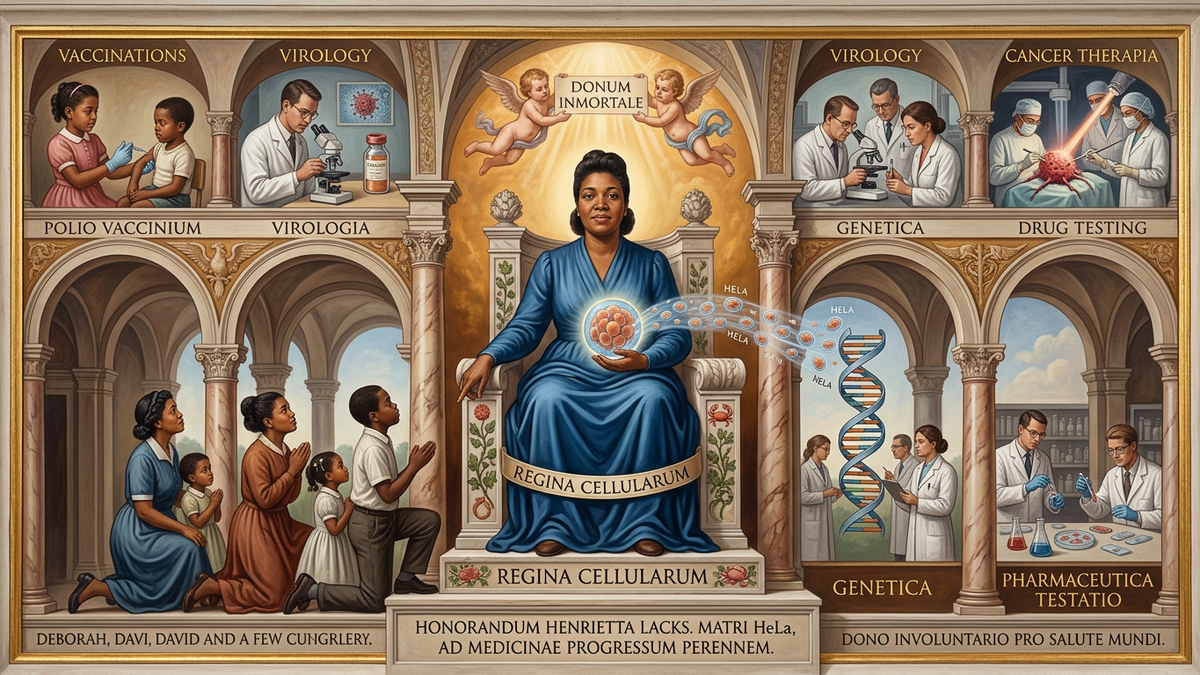
They also serve science, who are not scientists. One of science’s most egregious instances of epistemic dominance, where a powerful institution overrode and exploited a marginalised individual – was Henrietta Lacks – donor of the famous, immortal HeLa cell line. Cells extracted from her, without permission, transformed medical research, but her story was ignored, erased and obscured for decades. The scientific world that generously used this unique cell line for successful research into virology, vaccines, genetics and even cancer care, but the erasure of the donor of those cells was historic in its completeness.
Lacks, an African American tobacco farmer from southern United States, sought treatment at the ‘coloured ward’ in Johns Hopkins Centre for cervical cancer, way back in 1951. While it was common for medical professionals, in those days, to take samples and cells without the express permission of the patient, particularly if it was an African American woman, these cells were different. Johns Hopkins used the cells from her tumour to culture a line of cells that was extraordinarily durable outside the body. Usually human cells die outside of the body. Anonymised by a laboratory acronymn, Lacks’ cells (HeLa) turned out to be the first human cells to successfully grow, divide, and survive indefinitely outside the human body.
HeLa was a miracle that scientists had chanced upon. With HeLa, they could mass produce human cells in a standard format that could be used for biomedical research, and would underpin several breakthrough discoveries, that would revolutionise medical care. No one knew, however, of the immense exploitation behind this miracle cell line, and the profound lack of consent in procuring the samples.
Lacks, who died at merely 31 years, and was buried in an unmarked grave, remained invisible, not even a footnote, completely uncredited and her family entirely in the dark about her contribution to the world of science. Henrietta Lacks’ family first learned about her cells in nearly quarter of a century later, when scientists reached out to them, requesting blood samples once they suspected that the HeLa cell line had contaminated other research samples. This came as a bolt on the family, who could not fathom how cells from their mother had survived this long outside of her, and how this strange situation had come to be. While the academic world and several sections of the corporate world benefited richly from the HeLa cell line, Lacks’ own family had remained entrenched in poverty and struggling to make ends meet. The struggle of the family to come to terms with this exploitation, and the battles they had to fight with the system and science itself is well curated by Rebecca Sloot in her best selling book The Immortal Life of Henrietta Lacks.
In the 1950s, bioethical norms, particularly around informed consent were either non existent, or, at best, weak. But, in this particular case, Lacks was a black farmer from a rural unit, being treated in a segregated section in a large hospital. Consequently, an entrenched rascism, still alive in the southern United States in the 50s, and class bias contributed in good measure to the shabby treatment of this very valuable patient. Unhesitatingly and boldly, Sloot dragged this out into the open, through the book, knocking on the consciousness of the world and science, biomedical research, urging a discussion, a debate and at the end of it, a nod to what happened. It took years before these units would shamefully acknowledge the great injustice meted out to Lacks’ and her family.
The book, published in 2010, drew attention to the larger debate of patient rights and bodily autonomy. Sloot also underlined the fact that donors need to be acknowledged, heralding a new woke world of bio ethics, laboratory practices and the responsibilities of researchers. No longer could a moral failure be allowed to take patients for a ride, rules and regulations should replace the conscience and a situation like this would hopefully never happen again.

But this story does not end this way. After nearly 75 years of fighting this battle, the Lacks’ family finally found some closure. Reparation was finally achieved with the family settling with Johns Hopkins and other associated institutions in a landmark agreement that firstly acknowledged harm had been done, and also included measures to compensate the family and honour Lacks’ role in science. This included significant financial recompense, and involving the family into research using HeLa cells.
This agreement did reinforce the supremacy of informed consent practices, thus refining research ethics policy, but it also expanded the involvement of the patient and the community in research work. The Lacks’ family success is a milestone of sorts in biomedical research, with calls now being made to improve how institutions and labs credit how their biological materials, and also look at reparative action for families historically exploited by science.
Lacks’ story is a cautionary tale for science. It’s a reckoning with what has historically gone wrong, to set some wrongs right , and make sure the violations of the past are not repeated, but do inform the future, so that scientific progress can proceed without losing respect for human dignity. For this stupendous achievement, we have Henrietta Lacks to thank. From being denied even the footnote in history, she has created a brave new world in science.
Published – May 17, 2026 11:01 am IST