

When a major oil spill occurs at sea, emergency crews often face a difficult choice. They can allow the oil to spread across the water, threatening coastlines and marine life, or they can set it on fire.
Burning the oil, a technique known as an in situ burn, can prevent the slick from expanding. However, it also produces thick clouds of black smoke, releases soot into the atmosphere, and leaves behind a layer of unburned residue floating on the ocean’s surface.
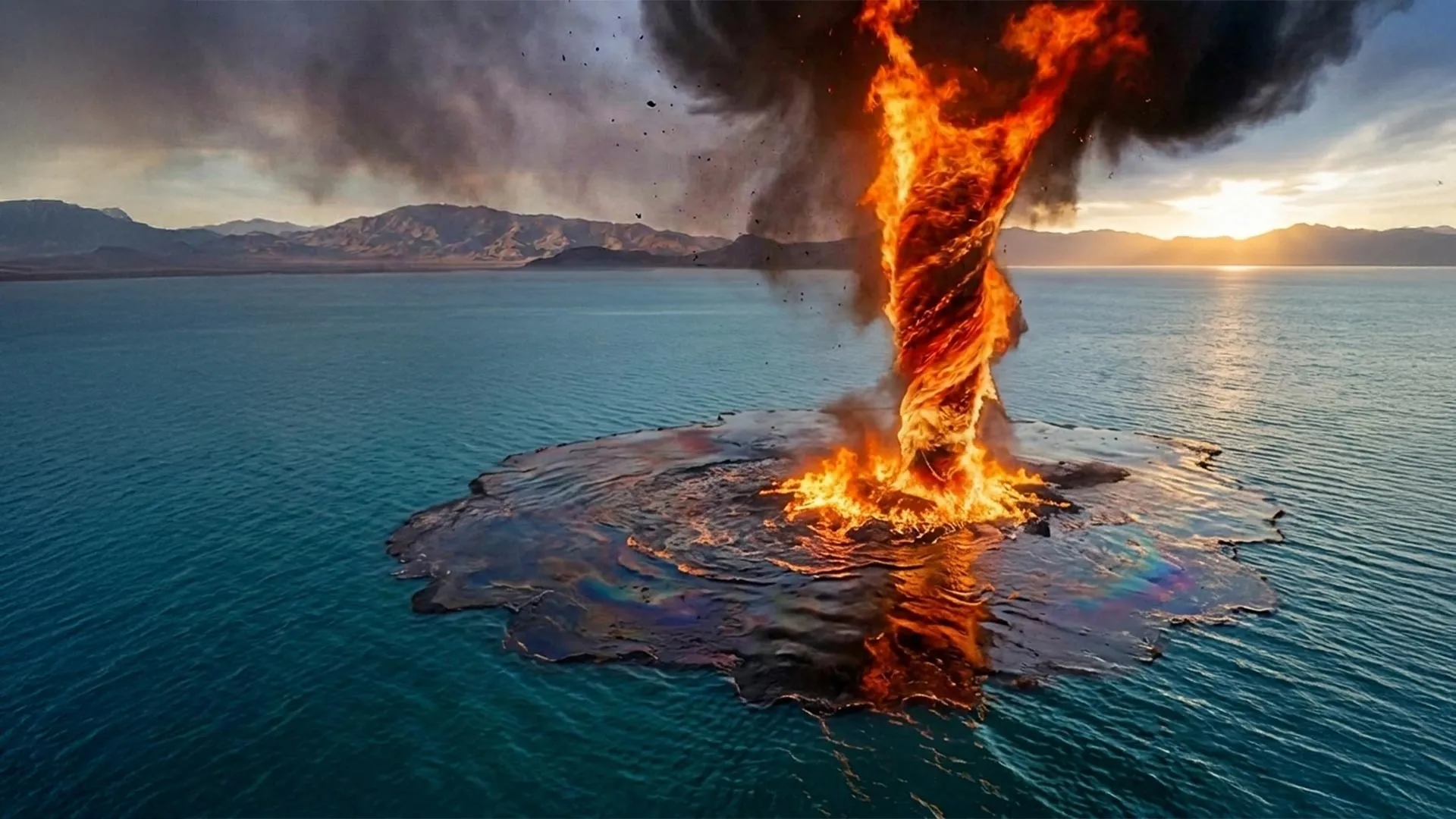
Now, researchers have demonstrated a striking new approach that could make this process far more effective. In a first-of-its-kind large-scale study, scientists created giant fire whirls, spinning columns of flame that resemble fire tornadoes, and found they burn oil faster and more cleanly than conventional methods.
The rotating vortex draws in large amounts of oxygen, creating a hotter and more efficient flame. As a result, the fire whirl consumed oil more rapidly while producing significantly less pollution.
The study, supported by the Bureau of Safety and Environmental Enforcement (BSEE), was led by Dr. Elaine Oran and Dr. Qingsheng Wang of Texas A&M University and Dr. Michael Gollner of the University of California, Berkeley.
“This the first time anyone has conceived using fire whirls for oil spill remediation, and it’s really just the beginning,” said Oran, professor of aerospace engineering in the College of Engineering. “Our goal is to harness the chaotic nature of fire whirls as a powerful, precise restoration tool, to protect coastlines, marine ecosystems and the environment as a whole.”
A Faster, Cleaner Way to Fight Oil Spills
The research introduces an unconventional strategy for dealing with one of the most damaging environmental emergencies.
The devastating Deepwater Horizon disaster in 2010 remains a powerful reminder of the impact offshore oil spills can have. The accident, the largest offshore oil spill in U.S. history, killed 11 workers, claimed the lives of thousands of marine animals, and caused widespread damage to ocean ecosystems.
“We are looking at environmental disasters like oil spills, and identifying ways to remediate them in faster, greener and more sustainable ways,” Oran said.
One of the most promising advantages of fire whirls is speed.
According to the researchers, fire whirls can burn crude oil nearly twice as fast as traditional in situ fire pools. Faster removal of oil could give response teams a critical advantage, allowing them to eliminate spills before they spread into sensitive habitats and protected coastal regions.
“Fire whirls burn through crude oil spills nearly twice as fast as in-situ fire pools, potentially giving cleanup crews faster operational and response times to eliminating the oils from spreading,” Oran said.
The technique could also reduce one of the biggest drawbacks of burning oil: smoke.
“One of the biggest challenges of burning oil spills is the sheer volume of smoke emitted,” Oran said. “Our results show that fire whirls, compared to in-situ fires, dramatically reduce overall emissions.”
Acting like a giant incinerator, the spinning flames destroy many of the particles responsible for dense smoke plumes. The process also vaporizes most of the oil before it can remain behind as a toxic tar-like residue on the water.
The findings may have applications beyond oil spill response. A better understanding of how fire whirls form and behave could help engineers develop more efficient combustion systems and improve efforts to predict and manage wildfires.
“Our study has universal applications,” Oran said. “By understanding the physical laws that govern fire whirls, we can harness their power beyond oil spill remediation.”
Building a 17-Foot-Tall Fire Whirl
Most previous studies of fire whirls have been conducted on a much smaller scale in laboratory settings.
To explore whether the phenomenon could be useful for real-world oil spill cleanup, the research team designed an experiment large enough to mimic more realistic conditions.
“The scale of our experiment is one of the reasons why our investigation is so unique, and what sets it apart as a first-of-its-kind,” Oran said.
The researchers built a 16-foot-tall triangular structure with three walls that allowed them to carefully control airflow. At the center, they placed a 1.5-meter-wide pool of crude oil floating on water.
Once ignited at the Texas A&M Engineering Extension Service (TEEX) Brayton Fire Training Field, the setup generated a powerful fire whirl that reached nearly 17 feet in height.
The results, published in Fuel, showed major improvements over conventional oil burning techniques.
“The fire whirls burned the oil about 40 percent faster, cut soot emissions by 40 percent, and achieved up to 95 percent fuel consumption efficiency compared to in-situ fire tests,” Oran said.
Finding the Fire Whirl “Goldilocks” Zone
Despite their impressive performance, fire whirls are not easy to control.
“Fire whirls are incredibly powerful, and can be incredibly beneficial,” Oran said. “But they’re also sensitive and only reach high efficiency when the conditions are just right.”
Strong winds can destabilize the spinning column or cause it to collapse altogether. Insufficient airflow control can prevent the vortex from forming, causing the fire to behave more like a conventional burn.
Researchers also discovered that the thickness of the oil layer plays an important role. When the slick became too deep, the fire whirls went out before consuming all of the fuel.
This narrow range of ideal conditions, described by the researchers as a “Goldilocks” zone, highlights both the promise and the challenge of bringing the technology into practical use.
Fire Tornadoes as Future Cleanup Tools
The team envisions a future in which portable systems could be deployed directly over burning oil spills to intentionally generate fire whirls on demand.
If successful, such systems could transform emergency oil spill response by converting ordinary fires into highly efficient cleanup tools.
“This study is more than just an experiment, it’s a glimpse into a future where fire isn’t a force of destruction, but a tool to protect our oceans and planet,” Oran said.
For now, the research stands as an impressive demonstration of what can happen when scientists rethink a familiar natural phenomenon.
It suggests that even one of nature’s most intimidating forces can potentially be redirected to address some of the world’s most urgent environmental challenges.