

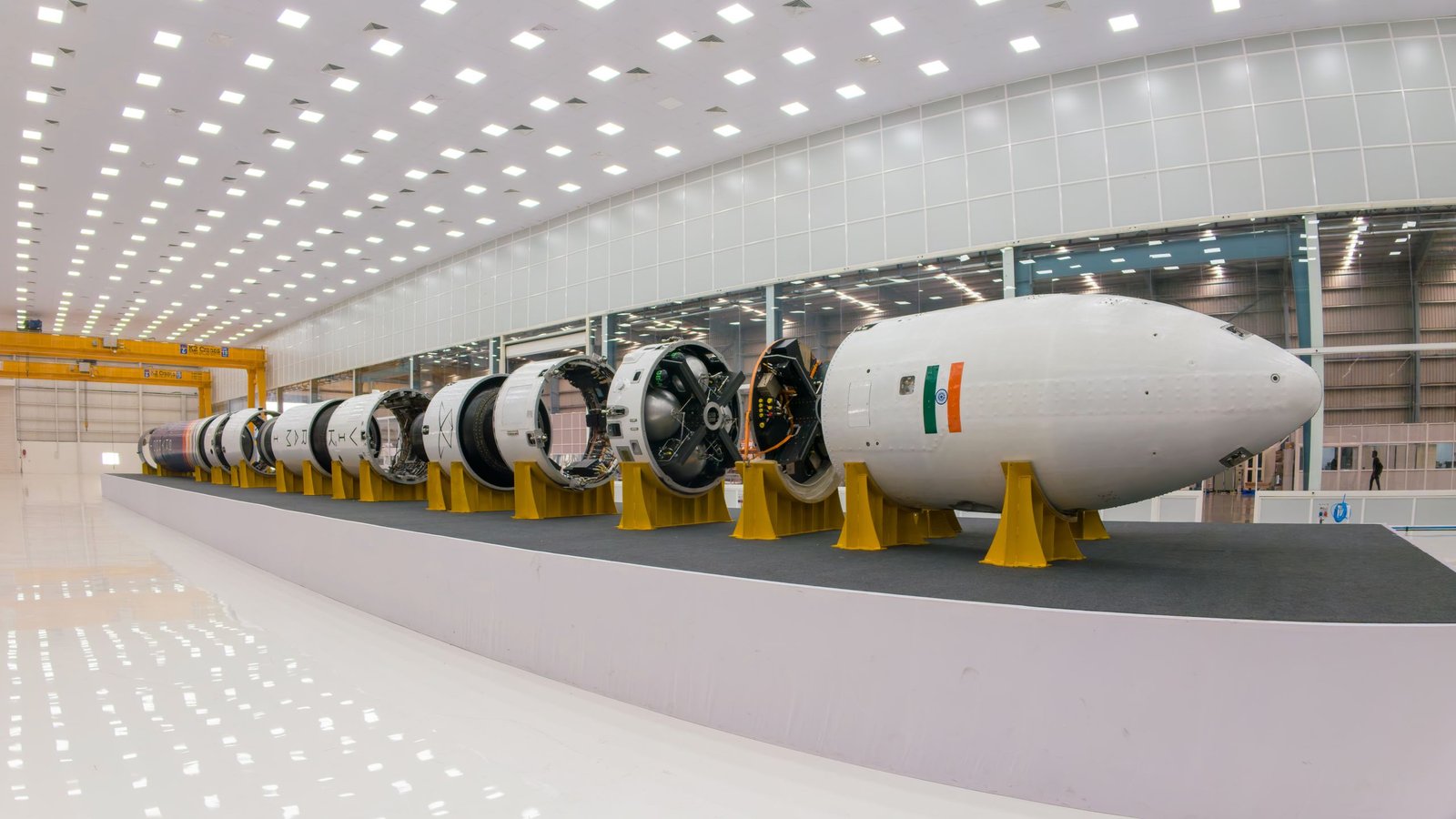
HYDERABAD, India — When Space.com visited Skyroot Aerospace’s Max-Q campus here in February, the company’s first orbital rocket, Vikram-1, was still coming together.
Inside the company’s 55,000-square-foot (5,110 square meters) rocket factory, engineers sat before computer screens, running critical simulations and systems checks on Vikram-1’s Orbit Adjustment Module, the liquid-fueled upper stage that stands at the center of the room and will guide the rocket’s final maneuvers in space. Unlike the rocket’s three solid-fueled lower stages, the upper stage can restart its engine, allowing Vikram-1 to deploy multiple customer satellites into different orbits during a single mission.
At the time, it was one of the last major components awaiting an overnight transport to the Satish Dhawan Space Centre in Sriharikota, where the rocket’s lower stages had already arrived for final integration.

Five months later, the fully assembled, seven-story rocket stands on the coastal launch pad, monitored by a launch team of about 200 people — roughly one-fifth of Skyroot’s workforce — preparing for a launch window that opens on July 12.
If all goes as planned, Vikram-1’s mission, named Aagaman — Sanskrit for “arrival” — will place multiple customer payloads into low Earth orbit, at an altitude of 280 miles (450 kilometers). Success would be historic: No private Indian company has ever launched a satellite to orbit.
The manifest includes Skyroot’s SCOPE satellite; a technology demonstration from the German company DCUBED; Indian startup Grahaa Space’s SOLARAS S3 satellite; and Embrace, a robotic arm designed to capture debris in orbit, from fellow Indian company Cosmoserve Space.
Vikram-1 will also carry two symbolic payloads — a floral-shaped artwork called Cosmic Bloom from the lab-grown-jewelry company Cosmos Diamonds, and a miniature 18-karat gold rocket by artist Ajay Kumar Mattewada that honors Indian scientific pioneers Vikram Sarabhai (after whom the Vikram rocket series is named), C.V. Raman and A.P.J. Abdul Kalam.
A successful mission would also move Skyroot closer to its goal of offering dedicated launches for small satellites that require precise orbital destinations. Rather than flying as secondary payloads aboard larger rockets, customers would be able to purchase missions tailored to their own orbital requirements — a model most successfully employed these days by the California-based company Rocket Lab.
Skyroot co-founder and CEO Pawan Kumar Chandana likens the strategy to booking a cab rather than taking a train.
“The ‘cab’ market is what we want to put our mark on with the Vikram series,” Chandana told Space.com. “There are very few opportunities for customers to reach customized orbits today.”
Aagaman is the first of three planned development flights intended to validate Vikram-1 before Skyroot begins commercial operations. If the vehicle performs as expected, the company hopes to scale production to one orbital rocket a month from its two Hyderabad campuses, according to Chandana.
“The whole idea is to go there as prepared as possible and to attain as much data as possible from the launch, so that we can get to fast-paced, high-frequency launches as soon as possible,” he said.
Skyroot first drew headlines in 2022, when its Vikram-S vehicle became the first privately developed Indian rocket to reach space.
The vehicle was a suborbital technology demonstrator, climbing to an altitude of roughly 54 miles (88 km) before falling back to Earth. (That’s above the boundary of space according to some, but not all, metrics.) According to Chandana, about 80% of the technologies now flying on Vikram-1 — including its carbon-composite structures, solid propulsion system, avionics and thermal protection materials — were first validated during that mission.
Even so, developing a rocket capable of reaching orbit took another four years. Roughly four times larger than Vikram-S, Vikram-1 must not only reach an altitude of 280 miles (450 km) but also accelerate its payloads to about 8 km (5 miles) per second — fast enough to remain in orbit around Earth. Along the way, it must execute a precisely timed sequence of stage separations before relying on its restartable liquid-fueled upper stage to place satellites into their intended orbits — capabilities that Skyroot has extensively tested on the ground but has yet to demonstrate in flight.
“We were very optimistic that we will get to an orbital launch in maybe two, three years from there,” said Chandana. “However, rocket science is rocket science.”
“We learned a lot of things on the go,” he added. “Because of that optimism, we were able to process progress very fast.”
🚀 Announcing Vikram-1 Test Flight-1: Mission Aagaman, India’s first private orbital rocket launch.📍 Satish Dhawan Space Centre, Sriharikota🛰️ 450 km, 60 degree inclination, Low Earth Orbit📅 Launch Window: July 12 – August 4, 2026Vehicle is now fully stacked at India’s… pic.twitter.com/mqqJnO5RoIJuly 2, 2026
When Chandana and co-founder Bharath Daka left the Indian Space Research Organisation (ISRO) to establish Skyroot in 2018, India’s private launch industry was almost nonexistent. The country had yet to adopt a national space policy or create a formal framework for private investment, and startups had no established pathway to use government launch facilities. Instead, Skyroot relied on India’s existing aerospace supplier base, the expertise of former ISRO engineers and the founders’ belief that India’s proximity to the equator would eventually help make the country an attractive base for commercial launches. (Earth spins faster near the equator, giving rockets launched from low latitudes an extra push toward orbit.)
“We just took the leap of faith,” Chandana said.
That bet paid off. In 2020, the Indian government opened the space sector to private companies by establishing the Indian National Space Promotion and Authorization Center (IN-SPACe). The move, followed by a new space policy in 2023, allowed startups to independently design, test and launch their own space technologies while also giving them access to ISRO’s launch pads, propulsion test stands, and other facilities.
“That accelerates our development cycles, because we need not invest and put energy into building facilities,” Chandana said.
Since the reforms, India’s space sector has grown from a state-dominated enterprise to an ecosystem of more than 400 startups. Jitendra Singh, India’s minister of state for science and technology, recently estimated that the country’s space economy, valued at roughly $8.4 billion in 2022, could expand to about $40 billion over the next decade as private investment and launch activity accelerate.
Skyroot is already looking beyond small satellites to capture a share of that growing market. Chandana said the company, now valued at $1.1 billion after raising $60 million in May, plans to develop larger launch vehicles capable of carrying heavier payloads while investing in reusable rocket technology to decrease launch costs.
“There’s a very attractive market for the bigger payloads and bigger vehicles as well,” Chandana said. Reusable rockets, he added, will become increasingly important particularly for launching big satellite constellations.
For now, however, the company’s attention is fixed on the rocket standing on the launch pad in Sriharikota.
The final days before launch are among the most operationally demanding for the team. Chandana said there is also a palpable sense of excitement in the debut of India’s first privately developed orbital rocket, particularly for the company’s young workforce, many of whom are experiencing their first orbital launch campaign.
“We have been preparing ourselves for quite some time towards this launch,” said Chandana. “For us, the mood is very energetic right now.”