







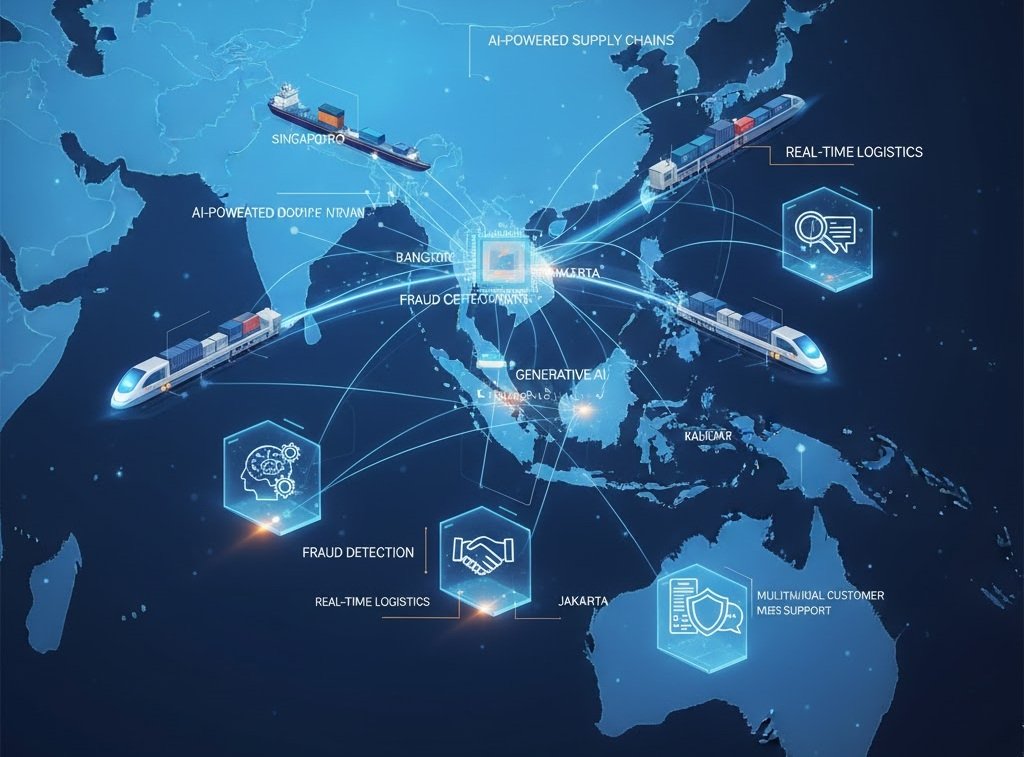
As Asia becomes the world’s fastest-growing trade hub, a new technological force is reshaping how goods move across borders: Generative Artificial Intelligence (AI). From digitizing customs processes to predicting supply chain risks, AI is now deeply integrated into Asia’s cross-border trade networks. Experts say the shift is particularly noticeable in Southeast Asia, where governments and businesses are investing heavily in digital trade infrastructure. This transformation is also fueling the broader trend of AI trade Southeast Asia, a keyword increasingly associated with regional economic innovation.
What’s Driving AI Adoption in Southeast Asia’s Trade Ecosystem?
Countries across ASEAN—including Singapore, Vietnam, Indonesia, Thailand, and Malaysia—are accelerating the adoption of digital technologies to keep up with global trade demands. Rapid e-commerce expansion, complex supply routes, and rising compliance requirements have made traditional trade processes difficult to scale.
Analysts note three major forces pushing governments and businesses to integrate generative AI into trade operations:
- Growth of digital-first commerce
- The need for transparent, traceable supply chains
- Rising demand for real-time information in logistics and customs
Industry insiders point out that AI’s ability to learn from data and automate decisions is especially valuable in a region where documentation, compliance rules, and trade regulations vary widely from country to country. This environment has created a fertile ground for the expansion of AI trade Southeast Asia, a trend now supported by both public and private sectors.
Role of Digital Policies & ASEAN Framework
ASEAN has taken a proactive role through initiatives like the ASEAN Single Window, a platform that enables streamlined customs processing across member states. The next phase of this platform includes integrating AI-driven tools that help identify risks, validate documents, and support regulatory checks with greater accuracy.
Singapore’s TradeTrust framework and Malaysia’s National eCommerce Strategic Roadmap also emphasize the integration of AI into digital trade systems. These policies aim to:
- Improve interoperability between countries
- Reduce manual paperwork
- Boost the reliability of trade data
- Enable AI-supported predictive compliance
A digital policy expert from Jakarta noted, “We’re seeing a shift from simple automation to intelligent automation powered by generative AI. This allows trade systems to not only process data but analyze and explain it.“
How Generative AI Is Reshaping Supply Chains?
Generative AI is fundamentally changing how supply chains operate in Asia. Instead of relying solely on historical data, modern systems now generate new insights, simulate scenarios, and reduce uncertainties in cross-border movements.
Predictive Forecasting, Documentation Automation, Trade Compliance
1. Predictive Forecasting
Generative AI tools analyze shipping routes, weather forecasts, port congestion data, and geopolitical developments to predict disruptions before they happen. This allows logistics companies to reroute shipments in real time.
For example, a major freight forwarder in Singapore recently reported a 22% reduction in delays after integrating AI-driven forecasting tools.
2. Documentation Automation
Cross-border trade in Asia requires hundreds of documents—from certificates of origin to customs declarations. Generative AI can now:
- Convert paper-based forms into digital formats
- Auto-fill compliance documents
- Detect errors in customs filings
- Translate multilingual trade documents
This cuts processing times dramatically. In Vietnam, AI-based document automation systems have reduced form validation times from 40 minutes to under 5 minutes.
3. Enhanced Trade Compliance
Compliance remains one of the biggest challenges in trade. Generative AI can cross-check shipments against:
- Tariff codes
- Country-specific regulations
- Sanctions lists
- Safety standards
Customs agencies in Thailand and Malaysia are testing AI-powered anomaly detection tools that flag risky shipments with greater accuracy and fewer false positives.
Impact on SMEs and Regional Exporters
Small and medium-sized enterprises (SMEs) are the backbone of Southeast Asia’s export economy. Yet SMEs traditionally lack the resources to manage complex trade procedures. Generative AI is changing this.
Key benefits for SMEs:
- Cheaper access to automated documentation tools
- Instant translation for regional trade partners
- AI-powered price forecasting for international markets
- Better access to global supply chain networks
A textile exporter from Ho Chi Minh City said, “We used to spend hours preparing export files. With AI assistance, we’re able to produce them in minutes, and accuracy has significantly improved.”
Generative AI is leveling the playing field, enabling smaller exporters to compete with larger companies by lowering administrative costs and reducing reliance on manual labor.
Challenges and Data Security Concerns
Despite its many advantages, generative AI adoption in trade brings significant challenges:
1. Data Privacy Risks
Trade data often includes sensitive commercial information. Uploading such data to AI systems—especially cloud-based ones—raises concerns about compliance with national data protection laws.
2. Interoperability Issues
Not all Southeast Asian countries use the same digital trade standards. AI tools must be adapted to various regulatory frameworks, which increases implementation complexity.
3. Skill Gaps
The region still faces a shortage of AI-trained professionals capable of building, maintaining, and securing AI-driven trade systems.
4. Risk of Over-Automation
Over-reliance on AI could lead to vulnerabilities if systems are not carefully monitored, particularly in critical trade processes like customs clearance.
ASEAN governments are actively working on frameworks that ensure AI is deployed responsibly, with governance, transparency, and human oversight at the core.
Future of AI-Powered Cross-Border Trade in Asia
The next decade is expected to bring even deeper integration of AI into Asia’s trade ecosystem. Analysts predict the rise of:
- Fully automated smart ports
- Real-time digital trade passports
- Blockchain-integrated AI documentation
- Autonomous cargo inspections
- AI-assisted trade negotiations
Countries like Singapore, Japan, and South Korea are already piloting advanced AI models capable of processing millions of data points from regional shipping networks. Meanwhile, ASEAN’s growing digital economy—expected to reach USD 1 trillion by 2030—offers a strong foundation for large-scale AI deployments.
This expansion will further strengthen the prominence of AI trade Southeast Asia, especially as nations continue modernizing customs, logistics, and trade compliance systems.
Conclusion
Generative AI is rapidly becoming a cornerstone of Asia’s cross-border trade transformation. From smart supply chains to automated customs documentation, AI’s ability to analyze, generate, and optimize data is improving efficiency at every stage of trade operations. While challenges around security, policy, and skills remain, the momentum behind AI adoption is undeniable. As governments and businesses continue to invest in digital trade ecosystems, Southeast Asia is poised to become one of the most advanced AI-driven trade hubs in the world.


