


The nation’s electric grid is stressed out.
Unprecedented energy demands for large customers, such as data centers and cryptomines, are straining power supplies, raising electric rates in some regions, and stoking consumer advocates’ concerns that residential ratepayers could get stuck with the bill.
Today federal energy regulators issued sweeping orders that require the nation’s six major grid operators within 60 days to propose reforms or justify their rules that govern how data centers and other large customers connect to the electric grid.
Additionally, within 30 days, each grid operator and its transmission owners must submit a detailed report describing how the grid operator will ensure there is adequate generation to serve existing and new large loads.
The purpose of the order is to expedite connections between large customers and utilities, but with some proposed protections for residential and small commercial customers.
The wholesale energy market for two-thirds of the United States, roughly 200 million customers, is managed and monitored by regional grid operators, such as PJM Interconnection, Midcontinent Independent System Operator (MISO) and the Electric Reliability Council of Texas (ERCOT).
U.S. Secretary of Energy Chris Wright ordered the Federal Energy Regulatory Commission (FERC) last October to begin rulemaking to address energy demands and grid stability related to large customers, in particular data centers for AI and cryptomining.
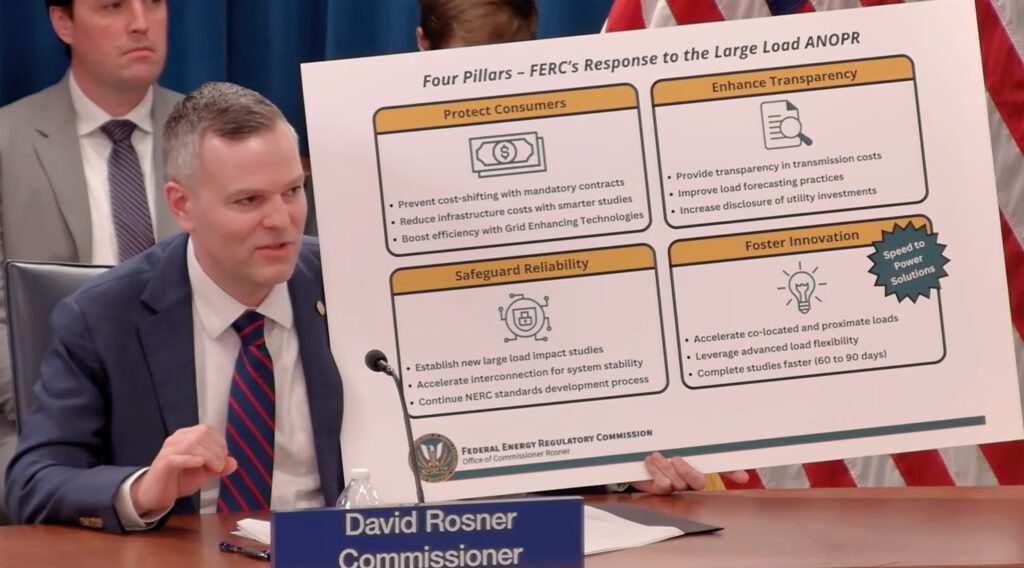
Although FERC’s order accounts for regional differences, its common goal is to stabilize the grid, add transparency to the ratemaking process and prevent utilities from shifting additional data-center energy costs to residential ratepayers.
“This product is not as ambitious as what Secretary Wright asked them to do,” said Nick Guidi, a senior attorney for the Southern Environmental Law Center. “I think they responded in a way that makes sense for traditional FERC activity, in a way that seems like it has some pluses and minuses.”
The order also requires grid operators to examine how they accommodate co-location agreements, which allow data centers to be built at or near power plants, and “behind-the-meter” energy supplies, in which the data centers themselves build their own power plants.
Additionally, within 30 days, grid operators must submit a detailed report describing how they intend to ensure that adequate generation will be available to serve existing and new large loads.
The order allows grid operators to define “large load.” Many states have set a threshold of 100 megawatts, but as more of these customers connect to the grid, it could be lowered.
Within the past three years, there have been several instances of large customers destabilizing the power grid. Two years ago, lightning hit a high-voltage transmission line in Dominion Energy’s territory in Virginia, within PJM, according to an incident report analysis by the North American Electric Reliability Corp.
This story is funded by readers like you.
Our nonprofit newsroom provides award-winning climate coverage free of charge and advertising. We rely on donations from readers like you to keep going. Please donate now to support our work.
As a result, 60 data centers decided to simultaneously drop off the system and resort to their own backup power, causing a sudden loss of 1,500 megawatts in demand. That could have resulted in a voltage spike, according to the NERC report. Grid operators were able to reduce voltage levels to normal operating levels.
Meanwhile, in Texas, ERCOT reported five loss incidents of greater than 100 megawatts from October 2023 to October 2024.
Even with FERC’s order, state utility commissions still have latitude to regulate their respective power providers.
“Nothing in today’s orders intrudes either on the authority of states to select sites and permit generating resources or on the authority of states to set the rates, terms and conditions of retail sales of electricity,” said FERC Chairman Laura Swett at the meeting.
“We make clear that we act today to guard against cost-shifting among transmission customers, but the states have the responsibility to ensure that there is no cost-shifting among retail customers,” she said.
The Sierra Club filed 4,000 comments to FERC from its members during an earlier public comment period. The nonprofit environmental group said in a prepared statement that “while the full orders have not yet been released, FERC’s announcement at today’s meeting is responsive to Sierra Club’s requests on several fronts, including protecting consumers from costs incurred by large loads.”
Many consumer advocates are concerned about utilities overbuilding natural gas to meet the forecasted demand. If the energy use never materializes, ratepayers could end up on the hook for the costs of these “stranded assets,” as they’re known.
In their comments to FERC before today’s ruling, state consumer advocate offices in Pennsylvania, Delaware and New Jersey noted there can be a mismatch between the time a large customer needs energy and the life of a pipeline or natural gas plant, which can last decades.
The consumer advocate offices recommended that the time frames in the utilities’ energy services contracts with large customers more closely align.
FERC agreed. It is requiring grid operators to design contracts that ensure that if new transmission infrastructure is built to serve a data center, “and that data center doesn’t show up, other customers, especially regular consumers, will not be on the hook for those costs,” Commissioner David Rosner said at the meeting.
Similar cost protections have already been approved by Virginia regulators at the State Corporation Commission, who are also reviewing Dominion’s interconnection process for 70 gigawatts of data center requests. Virginia is considered the “data center capital of the world.”
More broadly across the Mid-Atlantic, PJM is already finalizing co-location rules, which the SELC’s Guidi said should require data centers to pay for connecting to the grid as a backup even if they have their own on-site power generation. PJM also launched a reliability backstop auction after requests by the White House and governors, and is debating a process called connect and manage that involves load flexibility rules to reduce demand or give data centers interruptable service until there is sufficient generation and transmission built to serve them.
FERC “would like to see states and PJM and the various industry sectors of PJM figure something out and come to an agreement on how to deal with this stuff, but they’re going to give them a short leash,” Guidi said. “[If] they don’t have an answer, then [FERC] will be more inclined to force something on them.”
What’s concerning for Guidi is the voluntary rather than mandatory responsibility to comply with FERC’s order for utilities not bound by a regional transmission organization in southeastern states like North Carolina, Tennessee, Alabama and Georgia. Not imposing rules on those states would respect their state jurisdictional authority, but Guidi said those states are seeing massive data center buildouts without cost protections for residential ratepayers.
“There’s no real quarantining of the cost caused by data centers to those data centers, and really just kind of spread throughout the whole customer base,” said Guidi. “I think we were hoping to see a little bit of federal standardization of that process.”
About This Story
Perhaps you noticed: This story, like all the news we publish, is free to read. That’s because Inside Climate News is a 501c3 nonprofit organization. We do not charge a subscription fee, lock our news behind a paywall, or clutter our website with ads. We make our news on climate and the environment freely available to you and anyone who wants it.
That’s not all. We also share our news for free with scores of other media organizations around the country. Many of them can’t afford to do environmental journalism of their own. We’ve built bureaus from coast to coast to report local stories, collaborate with local newsrooms and co-publish articles so that this vital work is shared as widely as possible.
Two of us launched ICN in 2007. Six years later we earned a Pulitzer Prize for National Reporting, and now we run the oldest and largest dedicated climate newsroom in the nation. We tell the story in all its complexity. We hold polluters accountable. We expose environmental injustice. We debunk misinformation. We scrutinize solutions and inspire action.
Donations from readers like you fund every aspect of what we do. If you don’t already, will you support our ongoing work, our reporting on the biggest crisis facing our planet, and help us reach even more readers in more places?
Please take a moment to make a tax-deductible donation. Every one of them makes a difference.
Thank you,

Reporter, North Carolina
Lisa Sorg is the North Carolina reporter for Inside Climate News. A journalist for 30 years, Sorg covers energy, climate environment and agriculture, as well as the social justice impacts of pollution and corporate malfeasance.
She has won dozens of awards for her news, public service and investigative reporting. In 2022, she received the Stokes Award from the National Press Foundation for her two-part story about the environmental damage from a former missile plant on a Black and Latinx neighborhood in Burlington. Sorg was previously an environmental investigative reporter at NC Newsline, a nonprofit media outlet based in Raleigh. She has also worked at alt-weeklies, dailies and magazines. Originally from rural Indiana, she lives in Durham, N.C.

Virginia Correspondent
Charles Paullin is a Richmond, Virginia-based reporter focusing on energy and environment issues. He’s won several awards for his previous work covering state policy with the Virginia Mercury and local news with the Northern Virginia Daily in the Northern Shenandoah Valley. His first reporting gig was with the New Britain Herald in Connecticut, a couple years after attending the University of Hartford, where he first studied sports journalism.