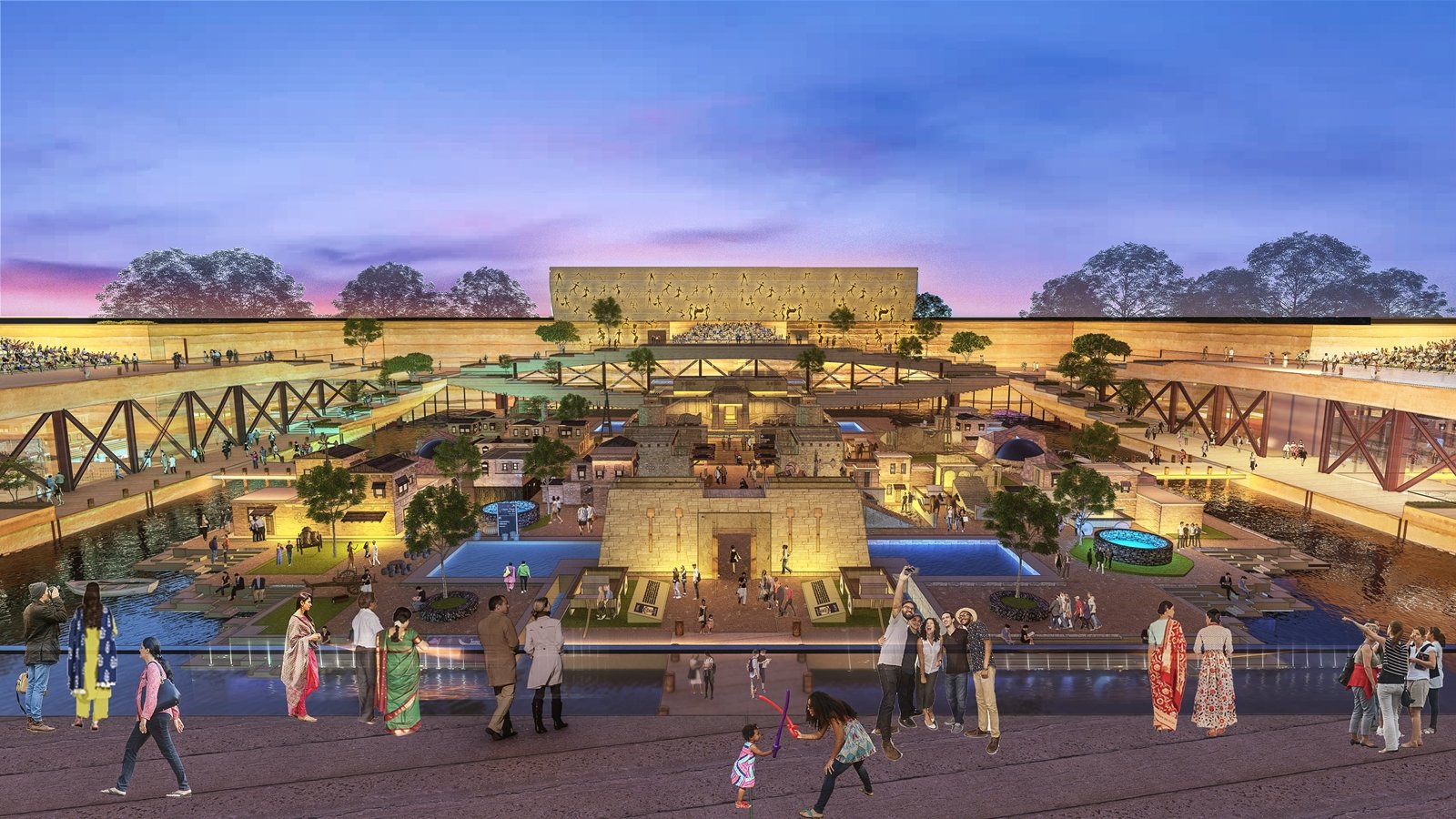
Very soon, visitors to Lothal, one of the most prominent outposts of the Indus Valley Civilisation, will be able to get a feel of walking through Harappan streets, dockyards, markets and civic spaces.
Just a few minutes away from the archaeological site, about 80 km from Ahmedabad, architects are recreating parts of the historic town for a museum that will be part of the Rs 4,000-crore National Maritime Heritage Complex (NMHC), whose first phase will be inaugurated within weeks.

Lothal is believed to have existed around 4,500 years ago, with excavations at the site revealing the world’s oldest known artificial dock, connected to an old course of the Sabarmati river.
According to officials, the first phase of the complex cost an estimated Rs 775 crore, and includes six museum galleries, a jetty walkway, and a display of maritime artefacts spanning ancient, medieval, colonial and modern times.
But the centrepiece of the 375-acre project, cleared by the Union Cabinet in 2024, remains the recreation of Lothal town.
“Rather than displaying history behind glass, we wanted people to physically walk through reconstructed Harappan streets, dockyards, markets, and civic spaces to understand how advanced these settlements were,” Karl Wadia, Principal Architect at Architect Hafeez Contractor, who is heading the project, told The Indian Express.
The firm was signed on to design the project by the Union Ministry of Ports and Shipping, the nodal ministry involved, with the total project cost pegged at around Rs 4,000 crore, officials said. “The idea was to create a world-class cultural and educational destination where visitors can experience India’s 4,500-year maritime history in an immersive, engaging way,” Wadia said.
The complex brings together museums, public landscapes, historic recreations, research facilities, eco-tourism and entertainment programming within a single integrated complex. “Alongside maritime artefacts from ancient, medieval, colonial, and modern periods, we are incorporating large-scale audio-visual projections, tactile exhibits, underwater-themed galleries, suspended ship installations, and digital storytelling environments that trace the evolution of Indian seafaring traditions,” Wadia said.
Beyond the maritime museum, the complex will include a lighthouse museum, a 5D theatre, children’s galleries, waterfront promenades, public plazas, eco-resorts and themed attractions. “The maritime museum is really the heart of the entire NMHC project. At roughly 7 lakh sq ft, it will be the world’s largest maritime museum. The design is inspired by the archaeological remains of the ancient city of Lothal,” Wadia said.
The museum comprises monumental stone-clad forms raised on elevated plinths, reinterpreting the flood-resistant citadels of Harappan settlements. Two inclined forms at the top resemble ship hulls, inspired by the righting-lever principle used in naval engineering, according to the concept.
Inside, visitors will move through 14 interconnected galleries organised around a recreated Lothal settlement. The experience begins in an 18-metre-high arrival hall and unfolds through galleries arranged around a circulation spine, featuring large water tanks with staged displays, immersive projections, suspended artefacts and underwater-themed installations.
The narrative spans ancient Harappan trade networks, Indian Ocean commerce, South Indian naval power, colonial encounters and modern Indian shipping, said design firm officials. At the centre of the museum will be an 80m x 80m living-history recreation of Lothal town. “We wanted visitors to engage with history spatially and experientially rather than simply viewing it as an exhibit,” the officials said.
Asked how the project engages with the legacy of the Indus Valley Civilisation, Wadia said Lothal’s history as a significant maritime site made it a natural choice as the project’s grounding site, being home to what is considered the world’s earliest known man-made dockyard.
“Historically, Lothal connected the Indian subcontinent to Mesopotamia, Egypt, and West Asia through maritime trade, so the origins of Indian seafaring culture are deeply rooted there. We wanted the project to reconnect contemporary audiences with the sophistication, innovation, and global outlook of the Indus Valley Civilisation,” he said.
Future phases will introduce eco-resorts, museum-hotels, state-sponsored cultural pavilions and themed attractions through public-private partnerships, officials said.
India has already signed MoUs with over a dozen countries, including the Netherlands, Denmark, Germany, South Korea, UAE, Portugal, Vietnam, Oman, Israel and Thailand, for collaboration in developing NMHC as a global centre of maritime history, according to the Union Shipping and Ports Ministry.
The next phase, Phase 1B, will entail an investment of Rs 3,000 crore and include eight additional museum galleries and a 50-dome theatre, among other attractions, officials said.