

(‘The Right Choice’ is a series by The Indian Express that addresses common questions, misconceptions, and doubts surrounding undergraduate admissions. You can read the stories here.)
– By Dr Umesh Kothari

For many commerce graduates, the choice between an MBA and an MCom appears straightforward at first. One is seen as a management degree, the other as a commerce degree. One is associated with corporate leadership, the other with academic and financial depth. Yet this simple comparison often hides the real issue: students are not choosing between two degrees; they are choosing between two very different career operating systems.
Depth versus range
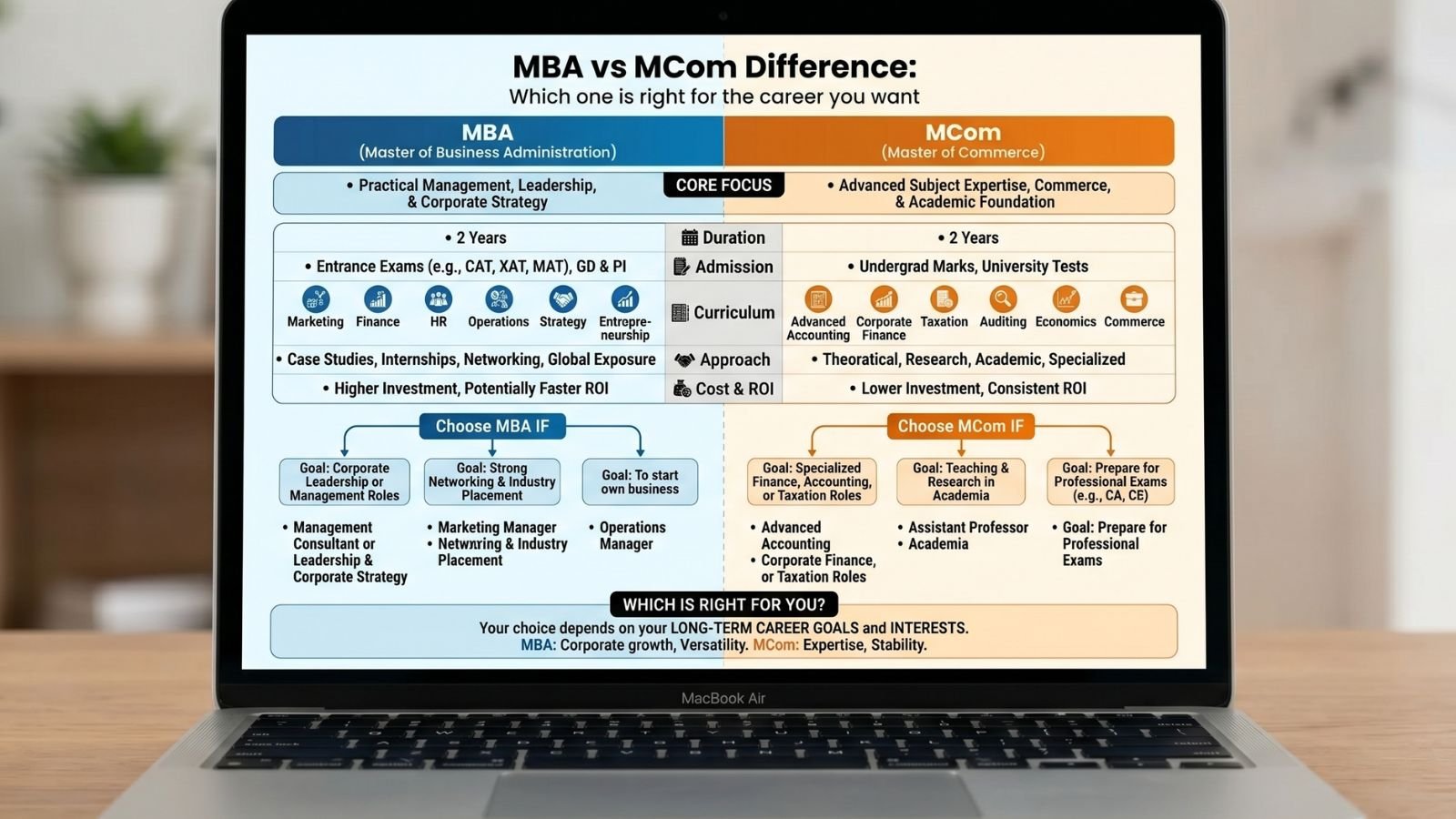
An MCom builds depth. An MBA builds range. That is the most practical way to understand the difference. The Master of Commerce is best suited for students who want to strengthen their expertise in accounting, finance, taxation, economics, auditing, banking, or academic research. It is a natural pathway for those preparing for careers in teaching, research, public sector roles, financial services, or professional qualifications such as CA, CMA, CS, CFA, or similar credentials. The MCom rewards students who enjoy conceptual clarity, subject specialisation, and technical mastery.
The MBA, on the other hand, is designed for students who want to understand how businesses work as complete systems. It is not limited to one discipline. It brings together finance, marketing, operations, strategy, analytics, technology, leadership, and organisational behaviour. A strong MBA does not simply teach students what a balance sheet means or how a market works. It trains them to make decisions when the data is incomplete, the stakes are high, and multiple stakeholders are involved. That distinction matters because the workplace has changed.
Why the workplace has changed the equation
Employers are no longer hiring only for degrees. They are hiring for problem-solving ability, communication, adaptability, commercial judgment, and the ability to work across functions. A candidate who understands finance but cannot present a business case clearly may struggle in leadership-track roles. A candidate who understands marketing but cannot read financial impact may struggle to earn trust in strategic discussions.
This is where the MBA often has an advantage. It gives students repeated exposure to real or simulated business decisions. Case studies, live projects, internships, consulting assignments, group work, industry sessions, and leadership exercises help students build confidence in practical decision-making. The best MBA classrooms are not passive lecture halls. They are rehearsal spaces for management.
MCom programs serve a different but equally important purpose. They give students the depth that many analytical and finance-linked careers require. A student who wants to work in taxation, accounting policy, audit, financial research, academia, or economic analysis may find the MCom more relevant than a general MBA. It can also be a more cost-effective option, especially for students who already know they want to stay within commerce-led specialisations.
Story continues below this ad
Avoiding the MBA is always better trap
The mistake many students make is treating the MBA as the default “better” option. It is not. A weak MBA chosen for prestige can be far less valuable than a strong MCom aligned with a clear professional path. At the same time, an MCom chosen only because it feels familiar may limit a student who desires leadership, mobility, and broader business exposure.
Students who want specialist careers should consider the MCom seriously. If the goal is to build authority in accounting, finance, taxation, research, or higher education, the MCom offers a focused route. It allows students to go deeper into a field and pair that knowledge with professional qualifications. Students who want managerial careers should consider the MBA. If the goal is to work in consulting, product management, brand management, business analytics, strategy, entrepreneurship, operations, or leadership roles, an MBA is usually the stronger fit. It develops breadth, confidence, networks, and the ability to connect business decisions across departments.
Start with career intent
Work experience is another important factor. An MBA becomes significantly more powerful when students bring professional exposure into the classroom. Even one or two years of work experience can make case discussions, peer learning, and internship choices more meaningful. Students who pursue an MBA immediately after graduation should be especially clear about why they are doing it. Without clarity, the degree can become an expensive extension of undergraduate study rather than a career accelerator.
Return on investment should also be evaluated carefully. The cost of an MBA is often higher, but the potential upside can also be higher if the program provides strong placements, industry access, alumni networks, global exposure, and leadership development. The MCom may involve lower financial risk and can be an excellent investment when paired with the right specialisation or certification. Students should ask themselves if the desired degree will make them more employable, more capable, and more credible in the career they want.
Story continues below this ad
There is no universal winner between an MBA and an MCom. The better degree is the one that matches the student’s ambition, temperament, and professional direction. In today’s market, success belongs not to those who collect degrees, but to those who choose them with precision.
The author is an Assistant Dean, GMBA/MGB and GCGM, & Assistant Professor at SP Jain School of Global Management.