

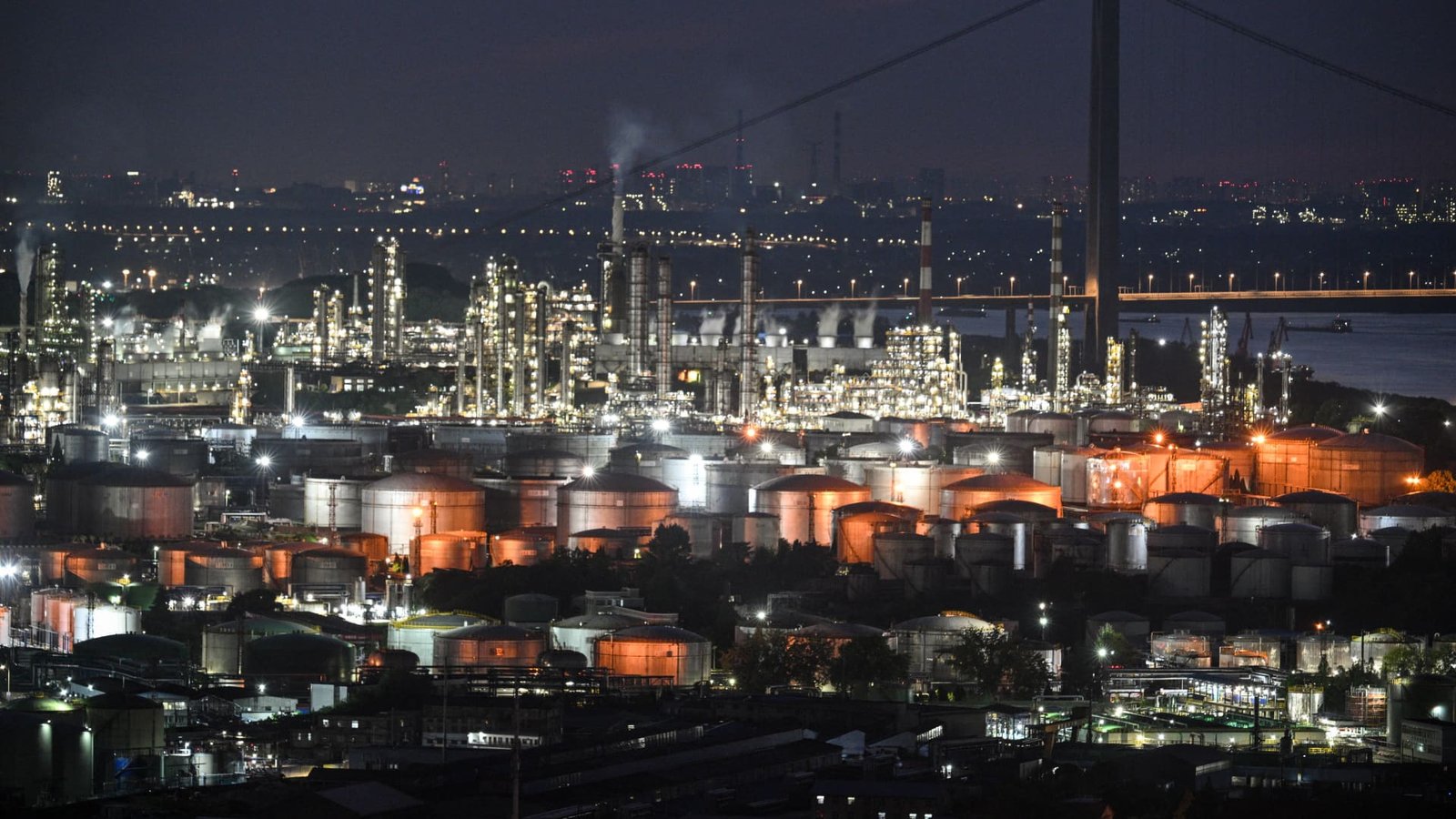
Pictured here is the crude oil refinery Sinopec Jinling Petrochemical Plant in Nanjing, in China’s eastern Jiangsu province on May 8, 2026.
Hector Retamal | Afp | Getty Images
BEIJING — The U.S. is threatening to cut businesses that help Iran evade sanctions off from the American financial system. It puts China’s banks in an uncomfortable position: Beijing can reject the demands, but its biggest lenders still have strong incentives to preserve access to U.S. dollars.
U.S. Treasury Secretary Scott Bessent announced on Monday that any entity facilitating “money laundering or sanctions evasion on behalf of Iran risks being cut off from the U.S. financial system.” It was part of the “Economic D-Day” against Iran announced by U.S. President Donald Trump.
When asked specifically about Chinese banks, Bessent said: “If they facilitate transactions and are part of the ecosystem that turns Iranian oil into money, into repression, they will be targeted.”
China said Tuesday it would “take all necessary measures” to protect itself.

“China has made clear on many occasions its firm opposition to illicit unilateral sanctions that have no basis in international law or the authorization of the UN Security Council,” a Chinese foreign ministry spokesperson said on Tuesday in response to questions.
Before the war, China bought around 90% of Iran’s exported oil — about 12% of China’s total crude imports — making it Iran’s largest trading partner, per analysts at the U.S.-China Economic and Security Review Commission in March.
Dubbed “Operation Economic Outcast,” the expanded U.S. sanctions identified several China-based companies and individuals as having allegedly assisted the Iranian military.
The U.S. said it would give countries a timeline to shut down identified activities, but didn’t share dates publicly. When CNBC asked about communication regarding the timeline, China’s foreign ministry said it was closely monitoring the situation and reiterated that Beijing would protect its interests.
It’s tough talk as a summit between Trump and Chinese President Xi Jinping is looming.
But analysts emphasize China will do what it can to stay in the U.S. dollar financing system. The U.S. has raised the bar for China and other countries that want to use the greenback — boosting their incentive to diversify. And the complexities of the U.S.-China economic rivalry make an “Economic D-Day” a tough order for the Trump administration.
How China’s CIPS offers a hedge to the dollar
Peter Alexander, Shanghai-based managing director of advisory Z-Ben, told CNBC that China’s Cross-Border Interbank Payment System (CIPS) showed it was trying to diversify from dollar-centered finance, without abandoning it altogether.
The People’s Bank of China began building the CIPS in 2012 — the same year the U.S. Treasury sanctioned China’s relatively small Bank of Kunlun over illicit Iran activities. Its transactions have picked up since the Russia-Ukraine war in 2022, and generally grown this year, according to official figures.
The system lists 210 direct participating institutions globally, mostly affiliates of state-owned Chinese banks.
Alexander also said that Argentina and Australia this month renewed bilateral currency swap agreements with China that enable the exchange of tens of billions of dollars’ worth of Chinese yuan between the countries’ central banks.
“The emerging financial system isn’t necessarily one in which countries abandon the USD,” Alexander said. “It is a geopolitical hedging instrument.”
The dollar’s dominance
The U.S. dollar still accounted for over half of global payments in July, while China’s yuan ranks fifth at 3.1%, according to Swift, the secure bank messaging system that underpins international banking. That’s down from over 4% in early 2025.
In trade finance, the U.S. dollar accounted for nearly 80% that month, while China’s yuan ranked second at 8.4%, the Swift data showed.
“China definitely wants to stay in the dollar system which benefits its trade engine, but that doesn’t mean it will do everything [to] comply with expanding U.S. sanctions,” Tianchen Xu, senior economist at the Economist Intelligence Unit, told CNBC.
He said he expected China to use rare earth controls and other measures to retaliate against sanctions on major Chinese businesses.
But the U.S. also wants access to critical minerals that China has, incentivising it to keep the relationship stable.
Trump and Xi are still due to meet next month
Trump and China’s Xi are expected to meet in the U.S. late next month, following Trump’s visit to Beijing in May. Eurasia Group’s China director Dan Wang said the U.S. doesn’t want to derail the summit.

“The core of China-U.S. relation is more about [the] Taiwan situation … [the] China-Iran tie is not nearly as close as outsiders have imagined,” she said, noting Beijing has essentially halted state-backed infrastructure investment since 2018.
Removing a major Chinese bank from the SWIFT system would significantly increase devaluation pressure on the Chinese yuan, which is “not acceptable” to Beijing, she told CNBC’s “The China Connection” on Tuesday.
The U.S. dollar index has strengthened since the Iran war began on Feb. 28, up by about 1.5%.
The Chinese yuan has gained nearly 2% against the U.S. dollar in that time, and more than 3% against the euro.
Earlier this year, China helped broker initial peace talks between Iran and the U.S. in Pakistan.
But analysts at the time cautioned that Beijing had neither the capability nor inclination to pressure either side into negotiating.
“Beijing hasn’t even begun to play hard ball with America,” Alexander said.
As for the U.S. response, “the question isn’t what could be done,” he told CNBC in an email, “the question is whether anything WILL be done.”