

Close Menu

    Subscribe to Updates

    Get the latest news information from worldwide businesses.

    What's Hot

    Lovable just backed a company that’s looking to bring vibe coding to hardware

    May 15, 2026

    Eurovision 2026: Delta Goodrem sends Australia to the grand final with note-perfect performance | Eurovision 2026

    May 15, 2026

    Lawmakers push for domestic shipbuilding fixes as US Navy explores overseas options

    May 15, 2026
    Facebook Instagram YouTube LinkedIn X (Twitter)
    Trending
    • Lovable just backed a company that’s looking to bring vibe coding to hardware
    • Eurovision 2026: Delta Goodrem sends Australia to the grand final with note-perfect performance | Eurovision 2026
    • Lawmakers push for domestic shipbuilding fixes as US Navy explores overseas options
    • Regulator bars 366 foreign-flagged ships from hiring Indian seafarers
    • Father drove wife and young children to safety after being shot in head
    • 6.6 Lakh Students to Appear Under New ‘Best-of-Two’ System
    • ‘Ted Lasso’ Is Coming Back—Here Are All the Filming Locations You Can Visit Right Now
    • Musk v. Altman closing arguments
    Newspublicly
    • About Us
    • Advertise & Partner with us
    • Pitch Your Story
    • Contact Us
    Facebook Instagram LinkedIn X (Twitter)
    Subscribe
    • Home
    • World News
      • Asia
      • India
      • USA
      • UK & Europe
      • Middle East
    • Economy & Business
      • Global Economy
      • Corporate & Industry
      • Finance & Markets
      • Policy & Trade
    • Technology
      • Gadgets & Devices
      • Software & Apps
      • AI & Machine Learning
      • Robotics & Automation
    • Health & Medicine
      • Fitness & Nutrition
      • Research & Innovation
      • Disease & Treatment
      • Doctors, Clinics & Patient Care
    • Travel & Tourism
    • Automobile
      • Electric & Hybrid Vehicles
      • Auto Industry Insights
    • Sports
    • More
      • Education
      • Real Estate
      • Environment & Climate
      • Space & Astronomy
      • War & Conflicts
    Newspublicly
    Home»Health & Medicine»Disease & Treatment»Charles Richet and his Nobel-winning work on severe allergic reactions
    Disease & Treatment

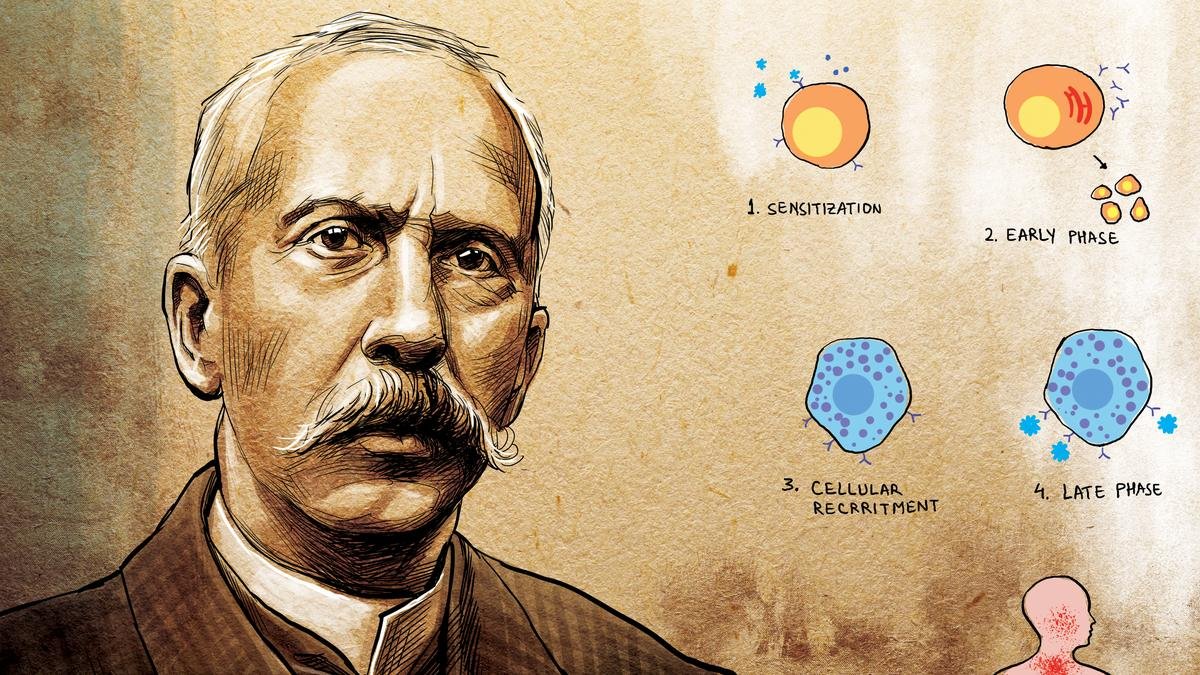
    Charles Richet and his Nobel-winning work on severe allergic reactions

    digitalixcomm@gmail.comBy digitalixcomm@gmail.comMay 14, 2026No Comments4 Mins Read0 Views
    Share
    Facebook Twitter LinkedIn Copy Link WhatsApp


    The 1913 Nobel Prize in Physiology or Medicine was awarded to Charles Richet “in recognition of his work on anaphylaxis.”His research uncovered a paradoxical reaction in which the body’s defenses, instead of protecting it, could overreact with severe consequences. This discovery became a cornerstone of immunology and the study of allergic diseases.

    In the late nineteenth and early twentieth centuries, medicine was advancing rapidly in understanding infections and immunity, but certain reactions remained mysterious. Doctors and researchers observed that both people and animals could suddenly develop difficulty breathing, collapse, or even fatal reactions after exposure to substances that had previously caused little harm. These responses were unpredictable and could not be explained by the existing understanding of how the immune system worked. Without understanding these reactions, treatments for toxins, vaccines, and other medical interventions carried significant risk, and there was no framework to prevent or manage severe allergic responses.

    Early life

    Charles Robert Richet was born on August 26, 1850, in Paris, France. He came from a medical family –his father, Alfred Richet, was a surgeon and professor. Besides immunology, he also studied subjects including physiology, psychology, and neuroscience. He studied medicine at the University of Paris, where he developed a fascination with physiology, toxins, and the body’s defensive mechanisms. Early in his career, Richet focused on understanding how animals responded to poisons and venoms, often observing that repeated exposure sometimes caused reactions far more severe than the first encounter.

    These observations sparked his interest in systematically studying what he would later define as anaphylaxis. Richet spent years performing controlled experiments to uncover the principles behind these dangerous immune responses.

    Richet’s major contribution

    Richet’s breakthrough came in 1902 through experiments with marine toxins, in collaboration with French physiologist, Paul Portier. They exposed dogs to jellyfish and sea anemone venoms. While an initial dose often produced mild effects, subsequent exposures sometimes provoked violent reactions, including shock and death.

    Richet documented these outcomes and recognised a distinct physiological phenomenon: anaphylaxis. He named it from the Greek “ana-” (opposite of) and “phylaxis” (protection), emphasising that the immune system could react in a harmful, rather than protective, way.

    This discovery explained previously puzzling severe allergic reactions and became the first systematic description of hypersensitivity. Richet’s work showed that the immune system could overreact, providing the basis for understanding allergies, severe drug reactions, and other immune-mediated conditions. When Richet first described anaphylaxis in 1902, scientists largely believed the immune system only protected the body. His experiments revealed the opposite could also happen –the body’s own defenses could trigger sudden, deadly reactions after a second exposure to a substance.

    Research contributions

    Beyond describing anaphylaxis, Richet’s research laid the groundwork for safer medical practices. His findings informed the development of allergy testing, immunotherapy, and emergency interventions such as epinephrine treatment for life-threatening reactions. He also influenced the broader field of immunology, helping scientists understand that immune responses can be both protective and pathological.

    Richet continued to study physiological reactions and toxins throughout his career, contributing to general knowledge of the nervous and circulatory systems. However, his work on anaphylaxis remained his best recognised achievement.

    Impact on medicine

    Charles Richet’s discovery fundamentally changed the understanding of the immune system. Today, anaphylaxis is recognised as a medical emergency, and protocols for its management directly reflect Richet’s insights. Treatments, preventive measures, and patient education in allergy care all trace back to his work.

    His research also influenced the study of autoimmune diseases and other conditions in which the immune system causes harm. By revealing that the body’s defenses can sometimes overreact, Richet opened the door to safer therapies, vaccines, and clinical practices that anticipate and prevent harmful immune responses.

    Charles Richet passed away on December 4, 1935, but his legacy endures. His experiments and documentation provided a framework for modern immunology, saving lives through a deeper understanding of allergic and hypersensitivity reactions.

    Published – May 10, 2026 08:10 am IST


    Source link

    Author

    • digitalixcomm@gmail.com

      NewsPublicly.com is News & Articles Platform that creating SEO-focused articles on travel, lifestyle, and digital trends.

    digitalixcomm@gmail.com
    • Website

    NewsPublicly.com is News & Articles Platform that creating SEO-focused articles on travel, lifestyle, and digital trends.

    Related Posts

    Webinar on allied health and nursing to be held on May 11

    May 14, 2026

    Physical activity has stalled for 20 years, hurting health and climate

    May 14, 2026

    Could hantavirus be the new emerging pathogen in Kerala?

    May 14, 2026
    Leave A Reply Cancel Reply

    Demo
    Top Posts

    “Inside Gemini Robotics 1.5: How Robots Learn to Reason & Act

    November 22, 202524 Views

    How US Tariffs Are Reshaping the Global Growth Landscape?

    November 21, 202518 Views

    Pakistani Journalist Laughing at Tejas Fighter Jet Crash at Dubai Airshow Sparks Massive Outrage Worldwide

    November 23, 202517 Views

    Vibe-Coding Boom: How Non-Coders Build Apps With AI Agents

    November 22, 202515 Views
    Don't Miss

    Lovable just backed a company that’s looking to bring vibe coding to hardware

    May 15, 20262 Mins Read0 Views

    Lovable, the AI-powered app-building platform, has backed a Danish hardware startup, Atech, that wants to…

    Eurovision 2026: Delta Goodrem sends Australia to the grand final with note-perfect performance | Eurovision 2026

    May 15, 2026

    Lawmakers push for domestic shipbuilding fixes as US Navy explores overseas options

    May 15, 2026

    Regulator bars 366 foreign-flagged ships from hiring Indian seafarers

    May 15, 2026
    Stay In Touch
    • Facebook
    • Twitter
    • Instagram
    • YouTube
    • LinkedIn
    • WhatsApp

    Subscribe to Updates

    Get the latest creative news from SmartMag about art & design.

    Demo
    NEWSPUBLICLY
    Facebook X (Twitter) Instagram LinkedIn

    Home

    • About Us
    • Leadership
    • Advertise & Partner With Us
    • Pitch Your Story
    • Media Kit & Pricing
    • Career
    • FAQs

    Guidelines

    • Editorial & Submission
    • Partnership
    • Advertising & Sponsor
    • Intellectual Property Policy
    • Community & Comment
    • Security & Data Protection
    • Send Your Opinion

    Quick Links

    • Cookie Policy
    • Payment & Billing Terms
    • Refund & Cancellation
    • Copyright Policy
    • Complaint & Support
    • Sitemap
    • Contact Us

    Subscribe Us

    Get the latest news and updates!

    Copyright © 2026 Newspublicly (DIGITALIX COMMUNICATION). All Rights Reserved.
    • Privacy Policy
    • Terms of Use
    • Disclaimer