

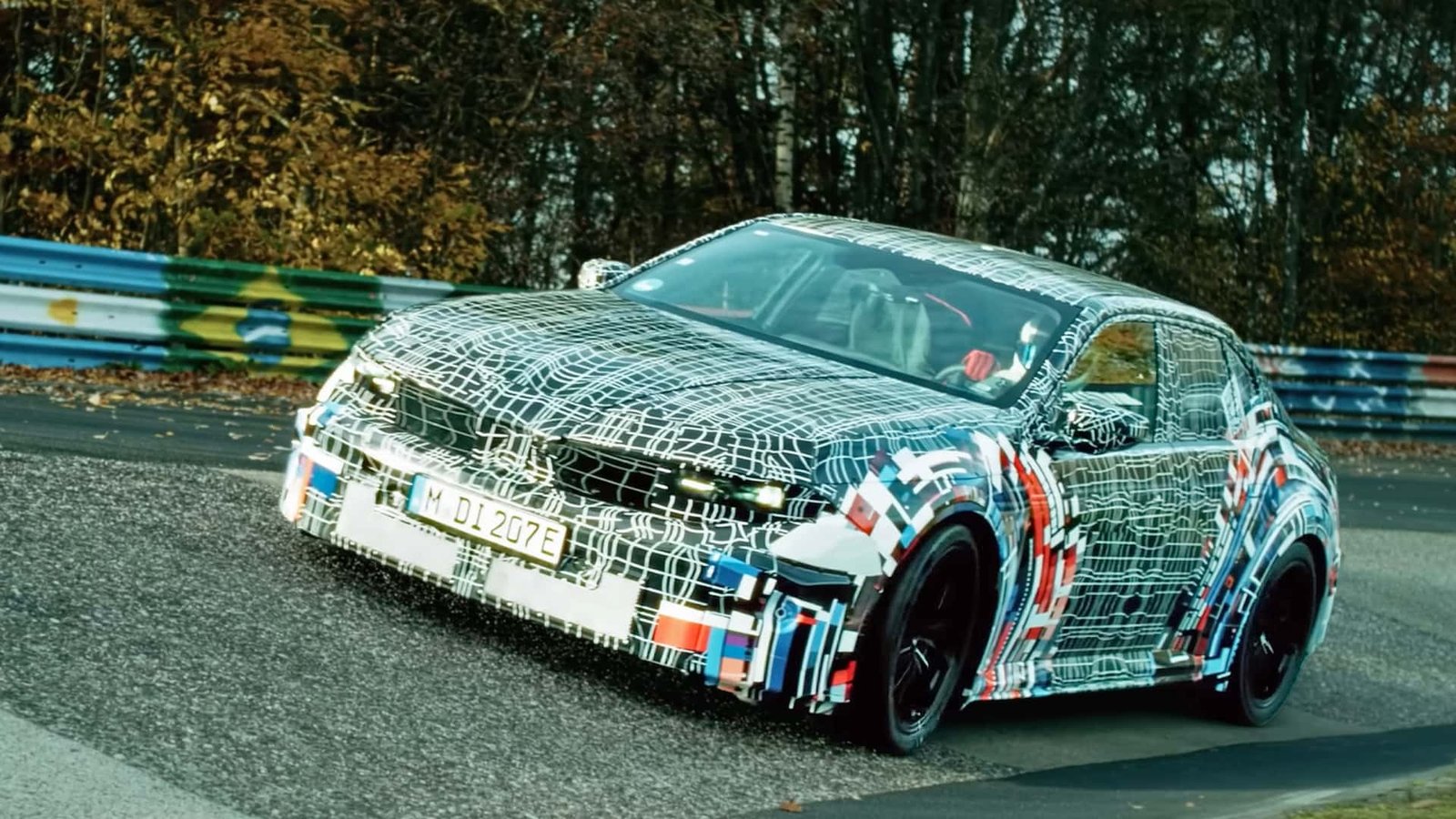
- BMW says the EV M3’s sound must help drivers judge speed, not just add drama.
- It won’t copy a V8, V10 or straight-six, but BMW studied them to understand emotion.
- Real e-motor sounds are used as a base, then enriched to avoid a flat EV drone.
BMW admits fast electric vehicles have one major problem. Sure, they have brutal acceleration, but without the acoustic feedback drivers are used to, it can be hard to judge speed around a track. That’s a problem it’s trying to solve with its upcoming electric M3.
In a previous video giving us a peek at the M3 EV’s development, BMW showed engineers recording three of its most iconic M cars. I assumed it was recording them to repurpose their acceleration sounds for the new, otherwise silent electric M3. But in a new video, BMW has revealed that it had no plans to use the actual sounds in the production car.
It turns out that BMW was studying the sounds to find out why many people find them so appealing, and using those learnings to create a more compelling, artificial note for its EV performance cars. What resulted sounds very exciting and aggressive, with hints of a combustion engine, but its own unique high-pitched sound.

Its goal is not to trick you into believing you’re in an actual combustion car, but create something unique. It’s a different approach than the one used in cars like the Hyundai Ioniq 5 N and the upcoming Mercedes-AMG GT 4-Door, with its fake V-8 and ‘magic’ vibrating seats.
In other words, BMW is not trying to make the electric M3 pretend it has pistons. It is trying to understand what about great combustion engines elicits powerful emotions, then translate that into something that simulates what produces the feeling, rather than a full, actual engine. It seems a bit convoluted, but it certainly doesn’t sound bad.
When analyzing the V-10 engine note, one of the engineers remarks that it sounds very flat and boring at a constant 6,000 rpm. So even the mighty S85 engine has less-than-ideal notes, and BMW M wanted the sound it created for the M3 EV to be free of such dead spots and just sound exciting throughout the simulated rev range.
One thing that’s unclear from the video is how you’ll interact with the “gears.” EVs typically have only one forward gear, with some having a second cog, but some automakers have chosen to simulate multiple gear shifts in their EVs. It sounds like BMW may go that route, just to add to the drama of accelerating the quad-motor M3. At the three-minute mark in the video, the engineer driving the car can be seen pulling on the right paddle on the steering wheel while driving on track, which could have been for an “upshift.”
BMW also wants to create a sense of progression as the car accelerates and speed builds. This means the sound will change as you go through the simulated gears, becoming more intense the faster you go. One of the things the engineers wanted to avoid was a drone, as some high-performance combustion engines exhibit at certain constant rpms, while also including hints of an electric motor sound (recorded from the car’s own drive units, like the Ferrari Luce).
The main idea behind all of this is that the sound has to serve the driver and give reference points and feedback. BMW is testing the M3 EV around the Nurburgring, where having audible reference points, like going up or down through the gears in a combustion car, is key to having an intuitive understanding of how fast you’re going without constantly looking at the speedometer.
And these audible reference points will be needed even more in the electric M3 than in the combustion model, because the EV will be much quicker and more brutal in its power delivery. Regardless of whether you will have control over the fake gears or not, BMW is really trying to make the M3 EV as exciting as it can, and it’s not following the common recipe for it. I can’t wait to see if it works.