

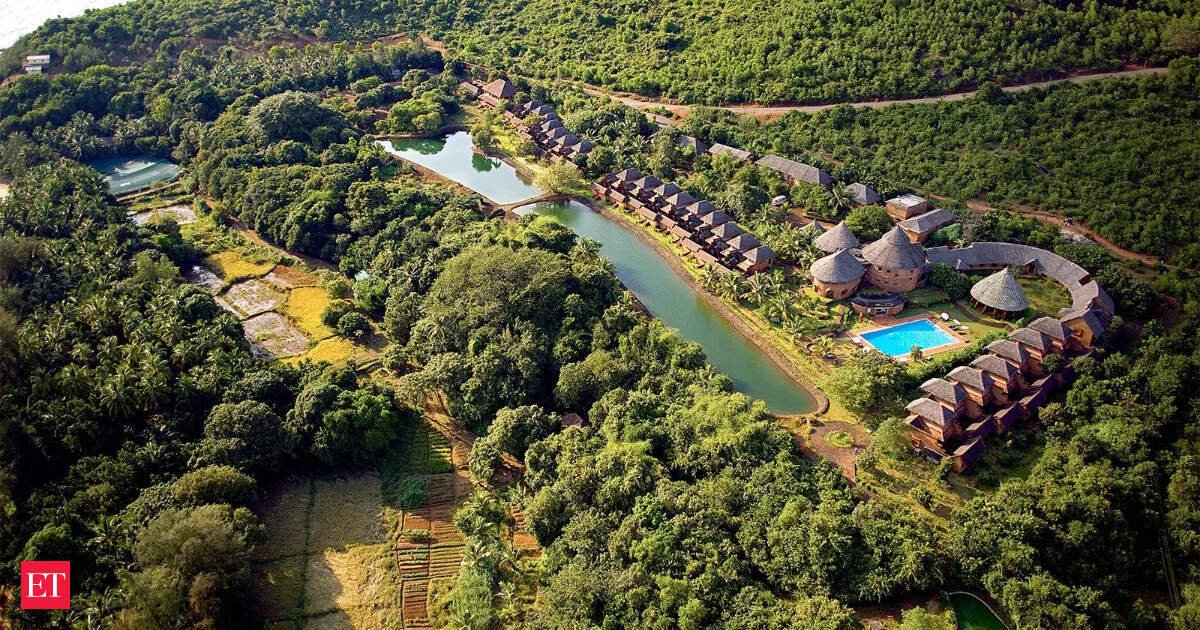
Across India’s premium travel market, such experiences are becoming increasingly central to what hospitality companies sell. Luxury travellers are seeking more than plush rooms and high-thread-count linens, industry executives say. They want curated journeys that promise wellness, cultural immersion, adventure or personal transformation, often woven into the destination itself.
The next big race in India’s luxury hospitality industry is not being fought over room inventory.
It is being fought over experiences.
Top hospitality companies, including ITC Hotels and Radisson Hotel Group, were quoted by PTI, saying demand for high-end domestic leisure travel remains strong, with travellers gravitating towards premium experiences within India that offer greater convenience and certainty.

Nikhil Sharma, Managing Director & COO, South Asia, Radisson Hotel Group, said the company is seeing measurable gains from domestic travel demand.
“We are witnessing a strong summer travel season across our India portfolio, with overall occupancy levels up 5 per cent compared to the same period last year. Leisure destinations, in particular, have emerged as key growth drivers, with average occupancies currently trending close to 75 per cent, and weekends witnessing even stronger demand.””The summer travel season is progressing well, with booking trends across our leisure portfolio remaining encouraging and demand tracking ahead of the same period last year in several destinations,” said Anil Chadha, Managing Director, ITC Hotels to PTI.
While overseas travel continues to hold strong appeal among wealthy Indians, luxury hotel operators say a growing number of travellers are opting for domestic destinations amid concerns over global instability and unpredictable travel conditions.
“While affluent Indian travellers continue to maintain strong long-term interest in international travel, near-term geopolitical uncertainty, airline disruptions and elevated travel costs have encouraged many consumers to increasingly explore premium domestic alternatives,” The Leela Palaces, Hotels and Resorts CEO Anuraag Bhatnagar said.
Luxury chains are expanding aggressively, wellness tourism is booming, and entrepreneurs from outside hospitality are entering the sector in search of the next long-term growth story.
Among them is Paul P. John, chairman of Paul John Indian Single Malt Whisky, who is quietly building a hospitality platform that extends well beyond traditional hotels.
From whisky to wellness
John’s hospitality journey began more than two decades ago, long before experiential luxury became an industry buzzword.
“Hospitality started around 2000, when I decided that I didn’t want to depend only on the alcohol business long term,” he said.
“Initially, it was more passion-driven than business-driven. I wanted to create something I personally enjoyed and something that people could experience.”
At the time, the move looked like diversification. Today, it appears increasingly aligned with where luxury hospitality is headed.
As India’s premium consumer economy expands, hospitality is emerging as a natural extension for companies operating in adjacent lifestyle categories such as food, beverages, wellness and luxury experiences.
The goal is not simply to offer accommodation. It is to create an ecosystem around how affluent consumers travel, eat, relax and spend their leisure time.
The new luxury playbook
For decades, luxury hospitality largely revolved around standardisation.
Guests expected a familiar experience whether they checked into a five-star hotel in Mumbai, London or Singapore.
But travellers are increasingly looking for something different.
Operators across the sector are investing in local culture, wellness, nature-based experiences and destination-specific programming that cannot be replicated elsewhere.
John believes that is where the next phase of hospitality growth lies.
“My focus is on creating experiences that are connected to the destination and local culture,” he said.
Chasing authenticity
The emphasis on local immersion marks a departure from the traditional luxury model.
While international hotel chains continue to benefit from scale and global loyalty programmes, smaller operators increasingly see authenticity as their competitive advantage.
“Large hotel chains often follow standardised formats. Whether you stay at one property or another, the experience can feel very similar because the properties are designed through a standard template,” John said.
“I’m trying to create something more authentic and connected to the local culture.”
That sentiment is resonating across the industry.
Luxury hospitality brands are increasingly building experiences around local cuisine, indigenous wellness practices, cultural heritage and nature-based tourism. The objective is to create destinations rather than simply operate hotels.
Building an ecosystem
Perhaps the most interesting aspect of the strategy is how hospitality is converging with other premium lifestyle businesses.
John sees a direct connection between building a luxury whisky brand and building a hospitality company.
“In the single malt business, a big challenge has been educating consumers on how to appreciate premium whisky properly,” he said.
“We’ve spent years building experiences around that through tasting sessions and curated programs like ‘Liquid on the Lips’. Similarly, in hospitality, we are also trying to educate customers about experiential luxury rather than transactional luxury.”
That philosophy is increasingly shaping hospitality across the sector.
Hotels are becoming platforms for wellness, culinary experiences, wine tourism, cultural exploration and premium lifestyle consumption. The room itself is becoming just one component of a broader experience.
The wellness opportunity
Among the fastest-growing segments within luxury hospitality is wellness.
What was once a complementary service has evolved into a standalone travel category, with travellers increasingly planning holidays around rejuvenation, preventive health and holistic experiences.
John sees significant potential in the space.
“We already have wellness centres, Ayurvedic treatments and spa offerings at some properties,” he said.
“Wellness is definitely an area we are focusing on more seriously going forward because it naturally fits into experiential hospitality.”
The trend mirrors broader industry investments in wellness-led resorts, longevity retreats and nature-focused destinations.
While an eventual public listing remains a possibility, John says the priority is building scale first, potentially reaching around 1,500 rooms before considering such a move.
More than a hotel
The larger story extends beyond one entrepreneur or one company.
Across India’s luxury hospitality landscape, the industry’s centre of gravity is shifting.
The future is unlikely to belong solely to operators with the largest room inventory or the most recognisable loyalty programme. Increasingly, it may belong to those that can combine hospitality with wellness, culture, gastronomy, nature and lifestyle.
In that world, luxury is no longer defined by the room.
It is defined by the experience.