

Close Menu

    Subscribe to Updates

    Get the latest news information from worldwide businesses.

    What's Hot

    Moment fuel storage lid flies off Moscow refinery during drone attack – video

    June 18, 2026

    PM Modi Invites Global Collaboration at VivaTech 2026, Promoting India as a Tech and AI Hub | India News

    June 18, 2026

    Gilgo Beach killer Rex Heuermann had ‘Dexter’-style kill room at home

    June 18, 2026
    Facebook Instagram YouTube LinkedIn X (Twitter)
    Trending
    • Moment fuel storage lid flies off Moscow refinery during drone attack – video
    • PM Modi Invites Global Collaboration at VivaTech 2026, Promoting India as a Tech and AI Hub | India News
    • Gilgo Beach killer Rex Heuermann had ‘Dexter’-style kill room at home
    • Bihar BEd CET 2026 Result: Result to be out on June 19 at biharcetbed-brabu.in | Education News
    • ‘It’s quite a bit more than we expected’: Satellite reveals immense scale of GPS signal tampering
    • Why General Motors Is Betting on Sodium-Ion Batteries
    • Heartbreaking Advice: WWE Legend John Cena
    • Here’s how AAA is now getting into e-bikes
    Newspublicly
    • About Us
    • Advertise & Partner with us
    • Pitch Your Story
    • Contact Us
    Facebook Instagram LinkedIn X (Twitter)
    Subscribe
    • Home
    • World News
      • Asia
      • India
      • USA
      • UK & Europe
      • Middle East
    • Economy & Business
      • Global Economy
      • Corporate & Industry
      • Finance & Markets
      • Policy & Trade
    • Technology
      • Gadgets & Devices
      • Software & Apps
      • AI & Machine Learning
      • Robotics & Automation
    • Health & Medicine
      • Fitness & Nutrition
      • Research & Innovation
      • Disease & Treatment
      • Doctors, Clinics & Patient Care
    • Travel & Tourism
    • Automobile
      • Electric & Hybrid Vehicles
      • Auto Industry Insights
    • Sports
    • More
      • Education
      • Real Estate
      • Environment & Climate
      • Space & Astronomy
      • War & Conflicts
    Newspublicly
    Home»More»Space & Astronomy»Astronomers solve the mystery of black holes’ delayed cosmic ‘burps’
    Space & Astronomy

    Astronomers solve the mystery of black holes’ delayed cosmic ‘burps’

    AdminBy AdminJune 18, 2026No Comments4 Mins Read0 Views
    Share
    Facebook Twitter LinkedIn Copy Link WhatsApp


    Supermassive black holes are notoriously messy when devouring a star, but they can also linger over their meals, letting out massive radio “burps” months or even years after their cosmic feast appears finished.

    Now, scientists tracking these events have found there is no one-size-fits-all model for how black holes digest stellar material. Speaking Monday (June 15) at the 248th meeting of the American Astronomical Society in California, Kate Alexander, an astronomer at the University of Arizona who has been studying these events, said the behavior depends instead on their shifting dietary phases.

    “Sometimes, after it seems like they are done eating, they may get indigestion and they may let out a large radio ‘burp,'” Alexander said during a press conference on Monday. “These late-time radio burps can appear when the black hole eats too fast or eats too slowly, so you should always eat the right speed if you want to avoid indigestion.”

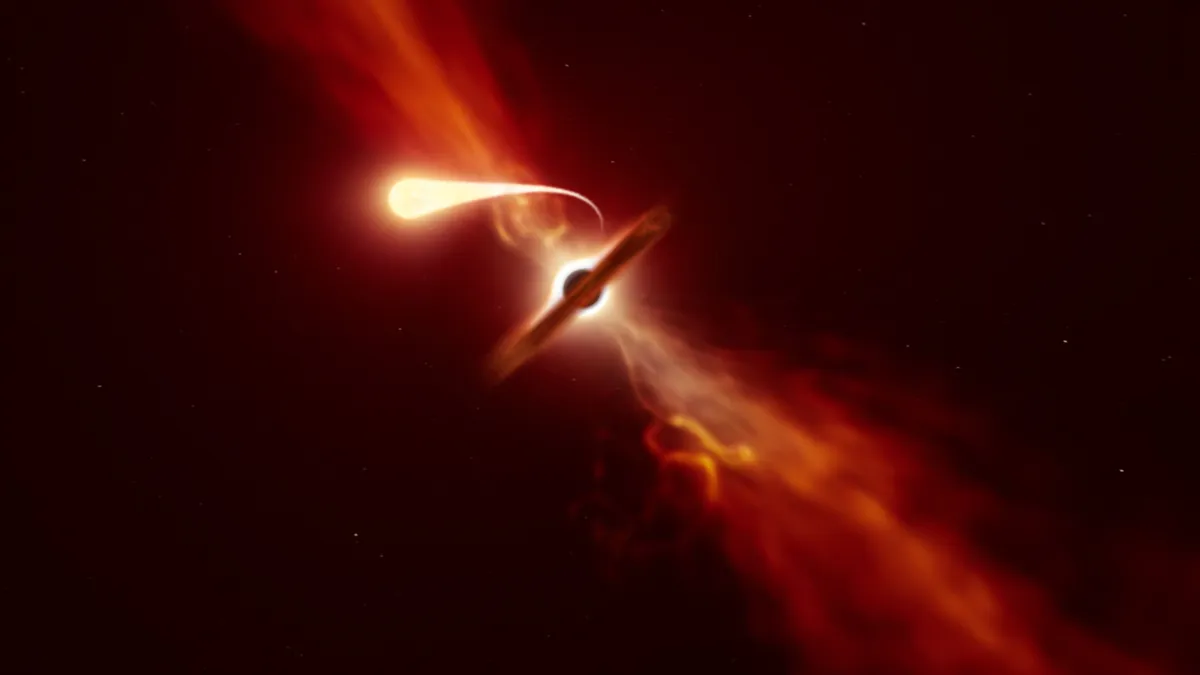
    Her recent research focuses on Tidal Disruption Events, or TDEs, which are cosmic catastrophes that occur when an unlucky star wanders too close to a supermassive black hole. As the star nears the behemoth, intense gravitational fields shred it into a spaghetti-like stream of gas debris in a process known as “spaghettification.”

    Because these events are rare, occurring roughly once every 100,000 years in any given galaxy, astronomers must monitor a large number of galaxies just to spot them. Historically, targeted radio follow-up of these disruptions ceased if no emission was detected within the first year or so, leaving their long-term behavior unstudied.


    You may like

    “When we first started looking at them, we just stopped looking,” she said. “But, it turns out that we should have kept looking, because this is often when some of the most really interesting things are happening.”

    Over the past six years, astronomers have been using the Karl G. Jansky Very Large Array (VLA) telescope in New Mexico to conduct the first large-scale, systematic radio observations of several dozen nearby TDEs. A 2024 paper, by radio astronomer Yvette Cendes of the University of Oregon and co-authored by Alexander, first reported that roughly 40% of all TDEs are detected in radio months to years after the initial disruption, long after the visible light has dimmed.

    Space

    Now, published this year in The Astrophysical Journal, the new study led by Alexander sets out to explain why these long-dormant systems reactivate. To solve the mystery, the researchers combed through decades of data, analyzing 91 TDE candidates discovered between 1990 and 2019 before narrowing their focus to a gold-standard sample of 31 events with comprehensive, multiwavelength tracking.

    By blending VLA radio data with archival optical and ultraviolet observations, plus fresh follow-up X-ray measurements, the team mapped how much gas the black holes actually consumed at any given point in time. Matching that feeding timeline against the exact moments the radio flares emerged revealed precisely how fast the black holes were eating when they unleashed their outflows, Alexander explained during the press briefing.
    a bright red jet of light shooting in two directions in space

    An illustration of a star being spaghettified by a black hole. (Image credit: ESO/M. Kornmesser)

    The data revealed that these delayed flares ignite at two opposite extremes, either while the black hole is rapidly overgorging on gas, or after its feeding rate has slowed to a crawl. In both scenarios, a fraction of the incoming gas is flung outward instead of being fully consumed, the team found. This expelled material then slams into the gas surrounding the black hole, triggering particle-accelerating shock waves that produce the radio emissions — effectively creating the cosmic “burps.”


    What to read next

    This cosmic feeding mechanic operates identically across all scales, working the exact same way whether the black hole is a relative lightweight or a behemoth millions of times more massive than our sun, Alexander noted.

    “For those of us who are astrophysicists,” she said, “this is really cool because we are now starting to understand how physics operates in these very different mass regimes.”

    The team also found that TDEs destined to flare up later leave a distinct chemical fingerprint in their early optical spectra in the form of helium emission lines. This signature indicates that the star’s shredded debris is taking its time settling into a tidy, ingestible disk around the black hole — virtually guaranteeing a delayed case of cosmic indigestion, said Alexander.

    “These are the black holes that are having longer lasting meals,” she said.

    Based on these findings, the team suggests that a window of two to six years post-discovery is the most productive timeframe to hunt for these late-rising radio signals.

    Ultimately, the team says the predictive chemical blueprint could serve as an invaluable screening tool. By filtering out the quiet eaters early on, astronomers can maximize highly competitive telescope time, focusing precious resources on the black holes most likely to put on a late-stage show.


    Source link

    Author

    • Admin

      NewsPublicly.com is News & Articles Platform that creating SEO-focused articles on travel, lifestyle, and digital trends.

    Admin
    • Website

    NewsPublicly.com is News & Articles Platform that creating SEO-focused articles on travel, lifestyle, and digital trends.

    Related Posts

    ‘It’s quite a bit more than we expected’: Satellite reveals immense scale of GPS signal tampering

    June 18, 2026

    NASA’s Perseverance rover just ran a marathon on Mars. Could you do the same?

    June 18, 2026

    One of these twin stars has likely been snacking on exoplanets

    June 17, 2026
    Leave A Reply Cancel Reply

    Demo
    Top Posts

    The Blue Moon rises on May 30— Where and when to see the second full moon of the month

    May 30, 202640 Views

    New SOCOM rifle allows barrel swapping and cartridge changes

    June 1, 202633 Views

    “Inside Gemini Robotics 1.5: How Robots Learn to Reason & Act

    November 22, 202525 Views

    525 pounds of cocaine seized after Nebraska K9 alerts troopers on I-80

    May 28, 202624 Views
    Don't Miss

    Moment fuel storage lid flies off Moscow refinery during drone attack – video

    June 18, 20261 Min Read0 Views

    Footage shows the moment an explosion at an oil refinery in Moscow caused a fuel…

    PM Modi Invites Global Collaboration at VivaTech 2026, Promoting India as a Tech and AI Hub | India News

    June 18, 2026

    Gilgo Beach killer Rex Heuermann had ‘Dexter’-style kill room at home

    June 18, 2026

    Bihar BEd CET 2026 Result: Result to be out on June 19 at biharcetbed-brabu.in | Education News

    June 18, 2026
    Stay In Touch
    • Facebook
    • Twitter
    • Instagram
    • YouTube
    • LinkedIn
    • WhatsApp

    Subscribe to Updates

    Get the latest creative news from SmartMag about art & design.

    Demo
    NEWSPUBLICLY
    Facebook X (Twitter) Instagram LinkedIn

    Home

    • About Us
    • Leadership
    • Advertise & Partner With Us
    • Pitch Your Story
    • Media Kit & Pricing
    • Career
    • FAQs

    Guidelines

    • Editorial & Submission
    • Partnership
    • Advertising & Sponsor
    • Intellectual Property Policy
    • Community & Comment
    • Security & Data Protection
    • Send Your Opinion

    Quick Links

    • Cookie Policy
    • Payment & Billing Terms
    • Refund & Cancellation
    • Copyright Policy
    • Complaint & Support
    • Sitemap
    • Contact Us

    Subscribe Us

    Get the latest news and updates!

    Copyright © 2026 Newspublicly (DIGITALIX COMMUNICATION). All Rights Reserved.
    • Privacy Policy
    • Terms of Use
    • Disclaimer