

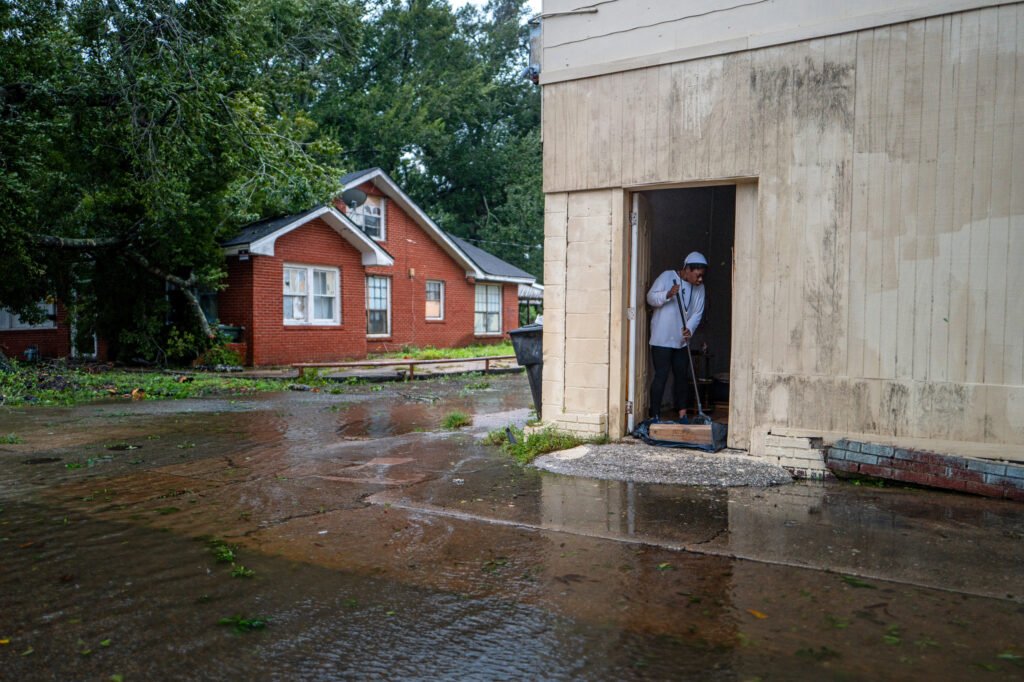
The shoreline of Louisiana has never been still or fixed, though recent generations have treated it as such.
Since the last ice age roughly 20,000 years ago, around when people arrived in what is now the United States, sea levels have repeatedly reshaped aspects of the Gulf Coast. But today, human-caused warming is accelerating that ancient process, pushing Louisiana’s dynamic shoreline into conflict with cities, roads, ports and levees built to contain and stabilize nature.
A new study in Nature Sustainability argues that this history is a guide to what comes next. Coastal Louisiana, the authors write, is ground zero for coastal climate adaptation: a place where rising seas and sinking land are already reshaping where people live, and where planning for movement could offer more agency than crisis-driven displacement.
“We have got to remember that when people first came to North America 20,000 years ago, there had already been a lot of climate change,” said Jesse Keenan, a co-author of the paper and professor of sustainable real estate and urban planning at Tulane University. “There’s been a lot of sea level rise in the region, and Indigenous populations have always moved with that shoreline.”
In geologic time, he added, “New Orleans has been there for just a blip. We’ve got to get it out of our heads that this is terra firma.”
The physical stakes are still stark. Southern Louisiana is facing a convergence of rising seas, wetland erosion, stronger storms and land subsidence, much of it worsened by decades of oil and gas canals cut through the coast. The state contains what theIPCC has identified as the world’s most exposed coastal zone, where the shoreline is projected to move more than 30 miles inland of New Orleans.
By comparing today’s warming trajectory with the last interglacial period roughly 125,000 years ago, when global temperatures were similar and seas were much higher, the new study estimates that the region could eventually face three to seven meters of sea-level rise and lose as much as three-quarters of its remaining coastal wetlands.
Keenan emphasizes that the point is not to forecast a sudden disappearance, but to widen the planning lens: if the coast is already moving, Louisiana has a chance to decide how people, infrastructure and economies move with it.
The danger is assuming everyone has the same ability to act on that choice. Social mobility, he said, depends on financial mobility— which means adaptation cannot simply tell people to move to safer ground. It has to move opportunity, too: jobs, industries, schools and affordable housing beyond the form of voluntary buyouts, a common managed-retreat tool in which governments purchase flood-prone homes and return the land to open space.
“Outmigration is often framed as tragedy or failure, but in some cases it signals agency,” said Brianna Castro, a co-author of the paper, who highlights that this is a chance to plan around choices people are already making.
Nearly all of Louisiana’s coastal zone has lost residents since 2000, and since Hurricane Katrina in 2005, about a quarter of Orleans Parish’s population has left the area, while more than half of rural Cameron Parish has relocated.
“If you build jobs and you build homes, specifically affordable homes, [on] safer ground, people will come,” said Castro, who is a professor of urban sustainability at Yale University’s School of the Environment.
The opportunity, she argues, is to make those moves possible before crisis forces them on harsher terms—with schools, housing and work in places where communities can carry culture forward rather than be scattered by disaster. New Orleans at its core, she said, is not confined to its current footprint.
This story is funded by readers like you.
Our nonprofit newsroom provides award-winning climate coverage free of charge and advertising. We rely on donations from readers like you to keep going. Please donate now to support our work.
“We’re not going to ‘lose’ New Orleans,” she said. “New Orleans has an incredibly rich local culture, and that will carry across the lake.” What must change, she argued, is the assumption that a moving coast can be met with immovable systems.
That idea resonates beyond Louisiana. Vivek Shandas, a professor of earth, environment and society at Portland State University who was not involved in the study, said the paper widens the frame from emergency response to long-term adaptation.
“We’ve been resettling for hundreds of thousands of years as a species,” Shandas said. “I think we’ve gotten really complacent with thinking that once we’ve set up a place and invested in it that it has to be like that forever. But the Earth is a very dynamic and incredibly fluid system.”
For that reason, he said, Louisiana is a “bellwether” for the rest of the country—a place where planners, policymakers and communities can study what adaptation strategies work before the same pressures intensify elsewhere.
“It’s super important for people to recognize that what we’re ultimately calling for in this paper is a public, private, and civic engagement with adaptation policy, planning and practice,” said Keenan.
The study points to immediate action projects, including reviving the canceled Mid-Barataria Sediment Diversion—a $3-billion coastal restoration project designed to reconnect the Mississippi River with the Barataria Basin, the rapidly disappearing wetland area on the west bank of the river south of New Orleans—and advancing the Breton diversion on the other side of the Mississippi River.
Unlike dredging, which moves sediment once and deposits it in place, river diversions are designed to restore a more continuous flow of sediment into wetlands, mimicking the processes that built the delta over thousands of years. Dredged material can create land, Keenan said, but it does not sustain the same root systems and ecological processes as a living riverine system.
“We’ve got a big challenge here, but this isn’t about the challenge. This is about the opportunity,” he said. “You catch more flies with honey than vinegar. There is so much economic opportunity to engage with people and to build things. Data centers won’t give people more jobs, but adapting to climate change just might.”
About This Story
Perhaps you noticed: This story, like all the news we publish, is free to read. That’s because Inside Climate News is a 501c3 nonprofit organization. We do not charge a subscription fee, lock our news behind a paywall, or clutter our website with ads. We make our news on climate and the environment freely available to you and anyone who wants it.
That’s not all. We also share our news for free with scores of other media organizations around the country. Many of them can’t afford to do environmental journalism of their own. We’ve built bureaus from coast to coast to report local stories, collaborate with local newsrooms and co-publish articles so that this vital work is shared as widely as possible.
Two of us launched ICN in 2007. Six years later we earned a Pulitzer Prize for National Reporting, and now we run the oldest and largest dedicated climate newsroom in the nation. We tell the story in all its complexity. We hold polluters accountable. We expose environmental injustice. We debunk misinformation. We scrutinize solutions and inspire action.
Donations from readers like you fund every aspect of what we do. If you don’t already, will you support our ongoing work, our reporting on the biggest crisis facing our planet, and help us reach even more readers in more places?
Please take a moment to make a tax-deductible donation. Every one of them makes a difference.
Thank you,