

MAJURO, Marshall Islands—Perched on the bow of an aluminum landing craft, Anne Cohen gazed a few yards ahead of the vessel toward a yellow robot gliding across the emerald Majuro lagoon.
The unmanned surface vehicle, called Yellowfin, was quickly becoming one of the coral researcher’s most dependable guides in these Central Pacific waters.
“She’s the best dive buddy,” said Cohen, a tenured scientist at the Woods Hole Oceanographic Institution in Cape Cod. Programmed to navigate to a precise set of coordinates, the robot cut through small swells like a tiny sailboat without a mast, directing Cohen toward a destination she had traveled thousands of miles to revisit.
When the robot finally paused, hovering in place, Cohen recognized it as her cue. Somewhere below should be a patch of reef she’d been observing over the last few years, and she was eager to see how it was faring. Each visit carried a growing weight of uncertainty.
Since 2023, record-breaking marine heat waves have swept through the tropics, fueling the most severe global coral bleaching event ever recorded. More than 80 percent of the world’s reefs have been impacted in at least 83 countries and territories. Corals have been so stressed by the extreme temperatures, they’ve expelled the tiny algae living inside their tissues that provide them with food and their brilliant hues, leaving them pale, ghostly and struggling to survive. Many have not recovered.
Cohen hoped the reef beneath her might be different.
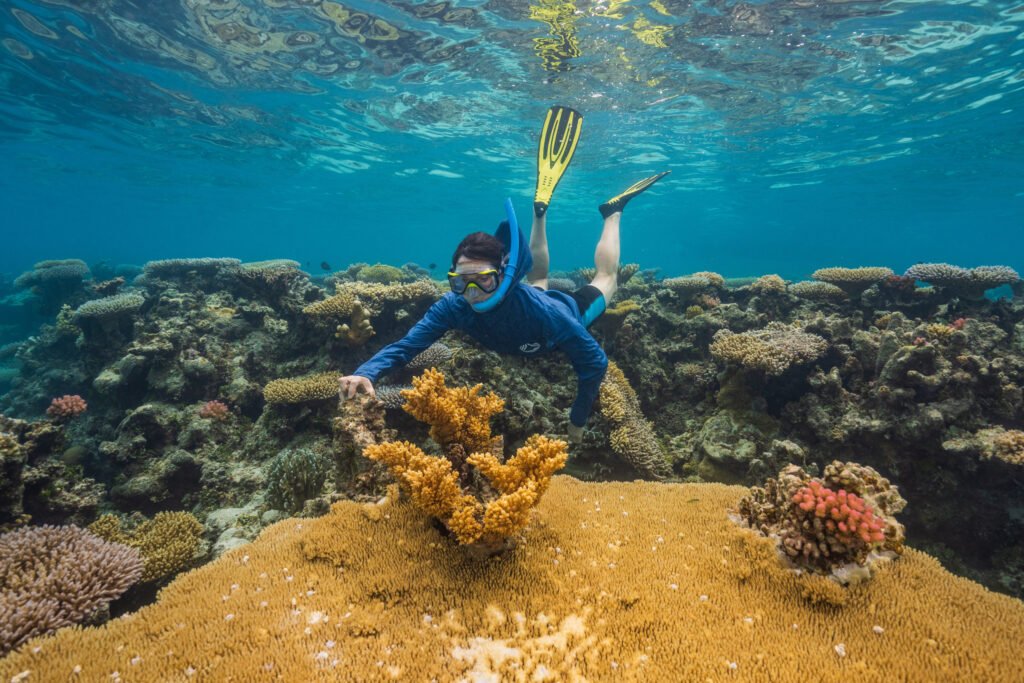
She yanked on her black and yellow snorkel fins, spit into her mask so it wouldn’t fog underwater and slid off the boat, her slight frame barely making a splash. Within seconds of peering into the blue, she let out a squeal muffled by her snorkel, astonished at the scene unfolding beneath her.
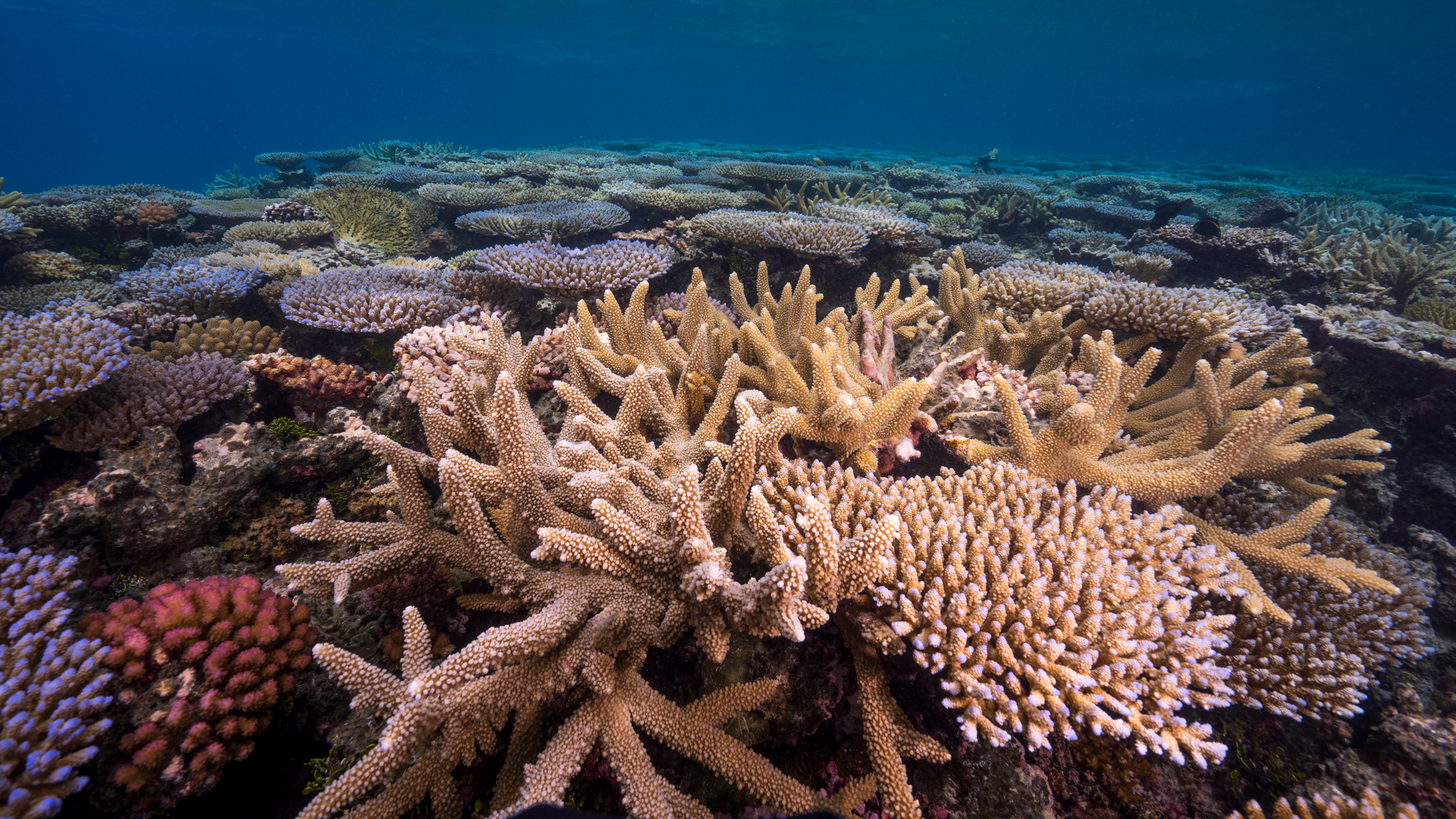
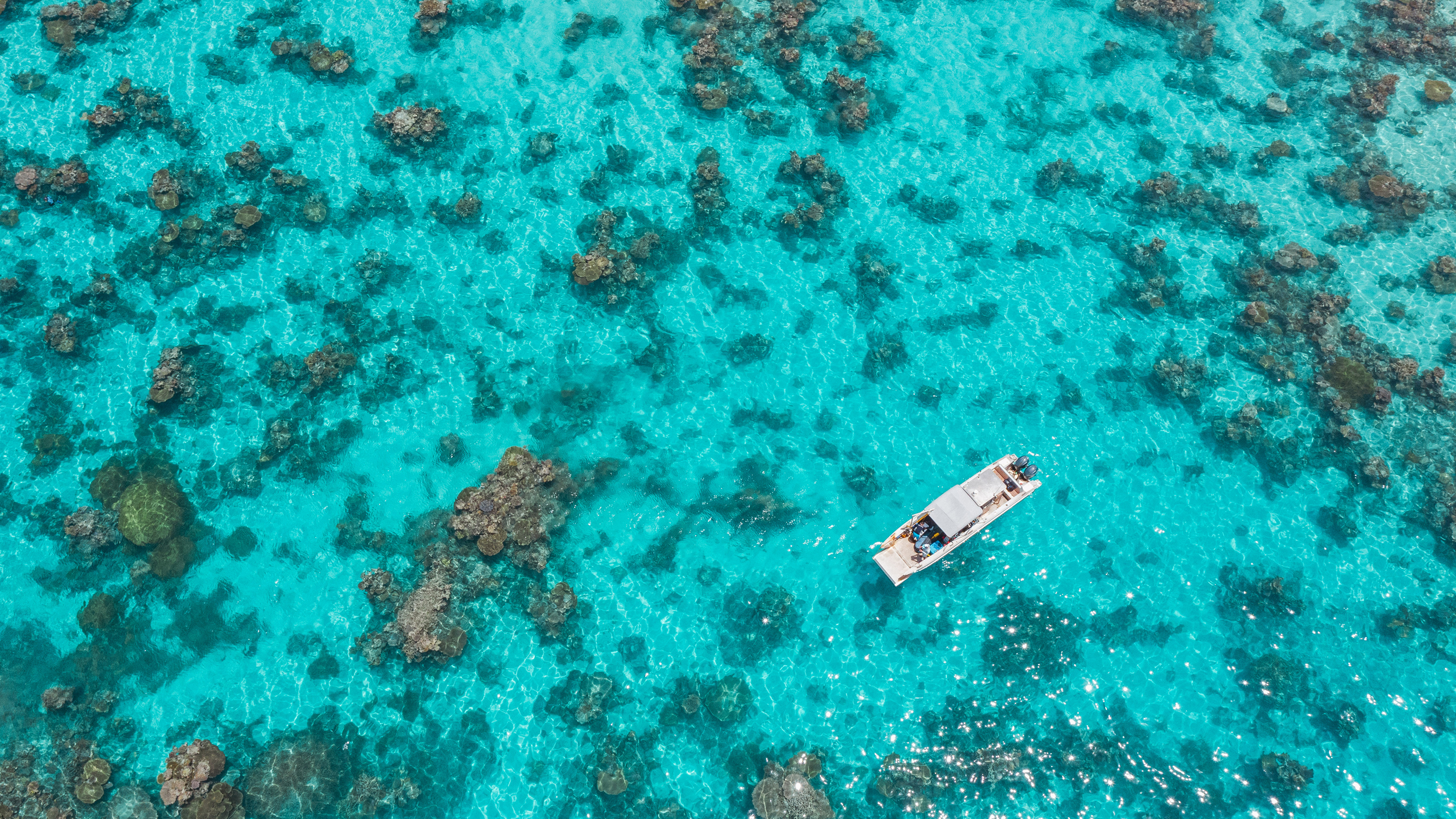
Towering pinnacles of chestnut-colored tabletop corals rose from the sandy seafloor like trees, their broad plate-like canopies sheltering fish hiding in their shadows. Dense thickets of staghorn corals stretched in every direction, their golden antler-like branches twisting across a sprawling reef extending as far as the eye could see, bursting with shades of mustard yellow, pink and lavender pastels.
“It’s like a wonderland,” Cohen said, popping her head above the surface, beaming. “I feel like Alice.”
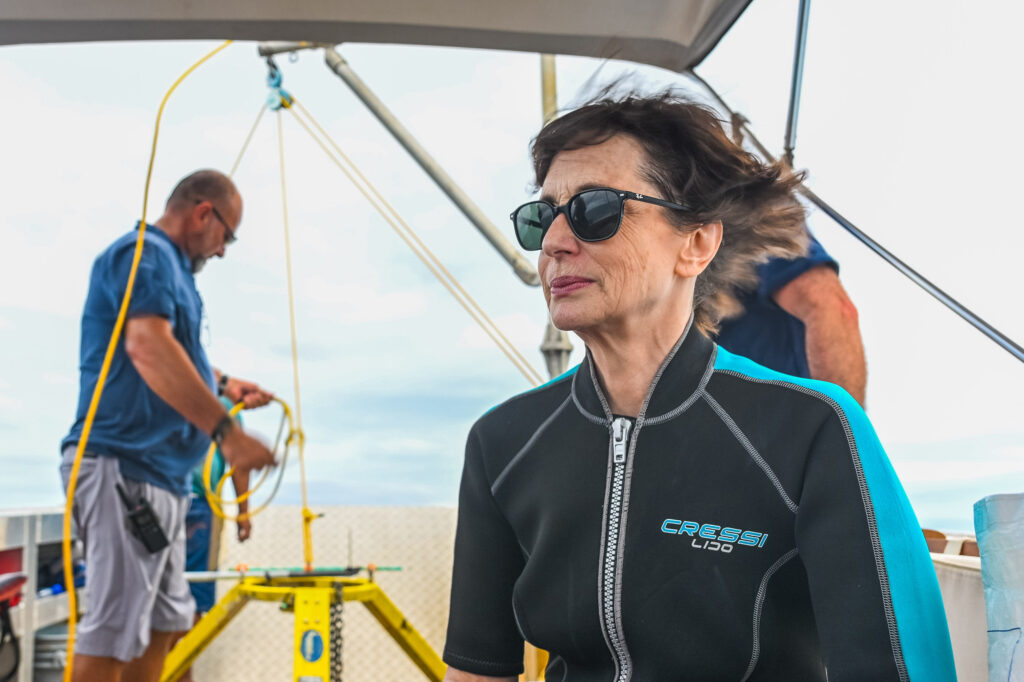
In today’s oceans, the scene felt almost surreal, said Cohen, 62, who has spent the last 30 years studying coral reefs and the impacts of climate change on marine environments.
But it was a confirmation of something she had long believed: that even as hotter temperatures devastate coral reefs, some still possess an extraordinary ability to endure. She was determined to find out how.
Unlocking the secrets behind their resilience, she said, could one day help scientists and conservationists restore, or even cultivate, reefs better equipped to survive a warming planet.
Searching for Super Reefs
Over the last decade, a significant part of Cohen’s research has focused on tracking down these reefs that are somehow defying the odds.
In 2018, she started a project dedicated to this search called Super Reefs, named after a number of reefs she’d encountered around the world that seemed to be thriving even while others nearby bleached or died.
“We saw these corals that were behaving as if there was no heat wave at all,” she recalled. “I kind of felt like there was Superman or Superwoman coming in there and flexing their muscles, being super, super strong.”
Three years later she launched a joint global initiative with The Nature Conservancy and Stanford University aimed at not only finding heat-tolerant communities, but also protecting them.
Even the hardiest of reefs are not invincible, she said.
Coastal development projects such as ports or harbors that require dredging can bury corals beneath sediment. Agricultural runoff, sewage and plastic pollution introduce harmful pathogens and excess nutrients that spark coral disease or toxic algal blooms that suffocate the tiny animals. Bottom trawling—a fishing method that drags weighted nets across the seafloor—can crush entire reefs, while dynamite fishing can shatter centuries-old coral colonies in seconds.
“That would be like taking a sledgehammer to crush a hermit crab,” Cohen said.
Already, the world has lost more than half of its coral reefs to the combined pressures of climate change and other human activity. Some scientists warn that without significant intervention, more than 90 percent of tropical reefs could disappear in the next 25 years.
The goal of the new Super Reefs initiative was to specifically identify coral strongholds in places where governments had already demonstrated an invested interest in creating marine-protected areas—designated zones in the ocean where human activities are limited or prohibited to safeguard critical ecosystems.
Belize, Hawaii and the Marshall Islands fit the bill. All had plans to create or strengthen already established marine-protected areas when the project launched.
“There are so many potential super reefs out there that we don’t even know exist. We have to go find them.”
— Anne Cohen, Woods Hole Oceanographic Institution
This was important, Cohen said. She didn’t want to collect data just for the sake of it. She wanted to make sure the research her team conducted could inform practical decisions related to where and how to protect super reefs. The next challenge was narrowing their search.
Not every reef that shows signs of resilience is a super reef.
By definition, Cohen said, super reefs have to have scientifically proven capabilities of surviving hotter temperatures over time, either because they have genetically adapted to extreme heat or because local ocean conditions like cooler currents have shielded them. They also have to be able to potentially reseed other reefs.
“If we can protect these more climate-resilient reefs and make sure that they are protected from other human impacts like pollution or dredging or other things, then we’re securing those more heat-resistant strains for the future until we can really get global warming under control,” said Lizzie McLeod, global ocean director at The Nature Conservancy, who supported Cohen in the initial stages of the Super Reefs project.
Over the last few years, the Super Reefs team has identified resilient reefs in each of its target locations. But Cohen is convinced they have only scratched the surface.
“There are so many potential super reefs out there that we don’t even know exist,” she said. “We have to go find them.”
In the Marshall Islands, Cohen hopes some of these reefs might eventually become part of something larger. For years, she’d been dreaming of creating a vast network of protected super reefs that would span multiple Pacific island nations and be linked by ocean currents so that their offspring could help replenish reefs throughout the region.
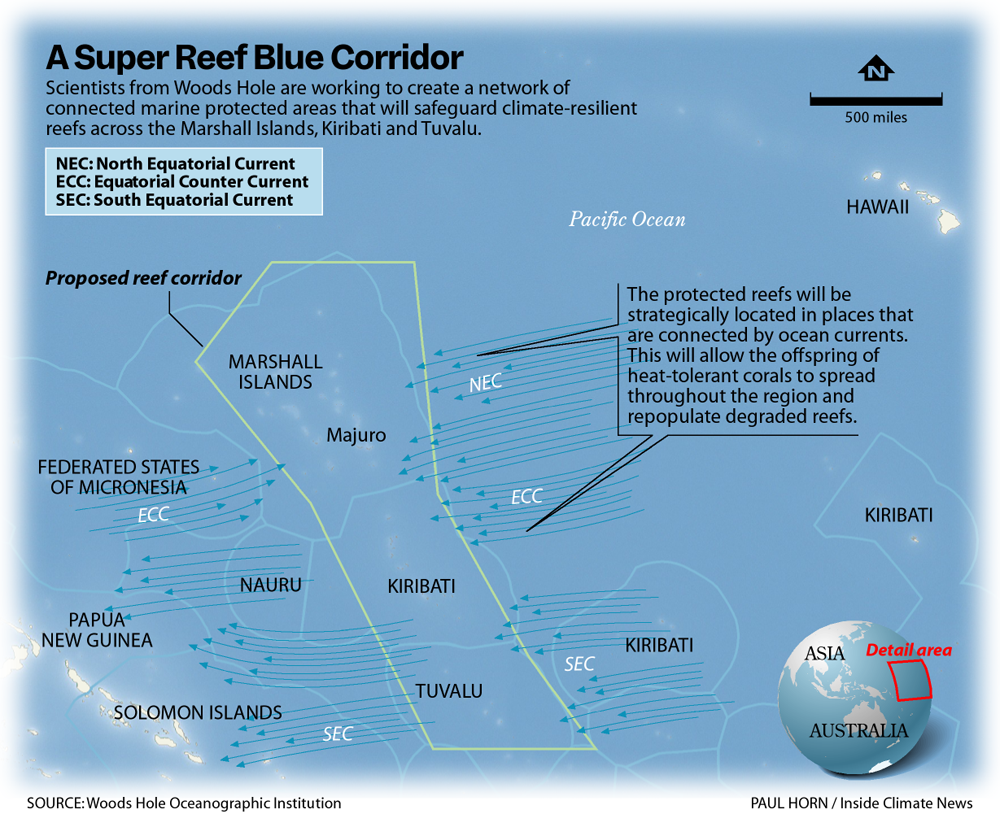
“We want to create the first ‘super reef blue corridor’ across millions of square kilometers of ocean, connecting the Marshall Islands, Kiribati and Tuvalu,” she said.
In April, Cohen visited the Marshall Islands to formally pitch her idea and test new technology she believed could dramatically accelerate the search for super reefs in the Pacific.
A Nation Built on Coral
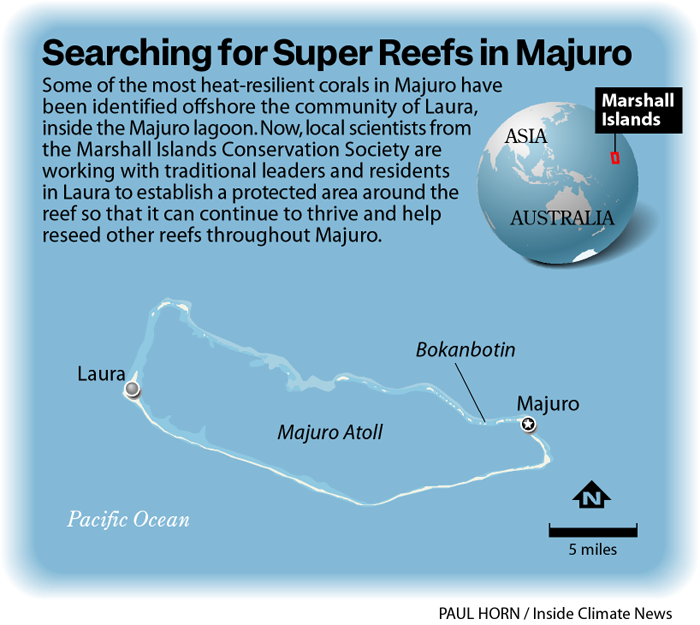
It was her seventh trip to the Pacific nation made up of 29 low-lying atolls and five islands. Majuro—the capital of the Marshall Islands—was one of those atolls, consisting of more than 60 tiny islands that encircle a lagoon spanning more than 100 square miles.
Each visit, she was struck by how intimately the Marshallese peoples’ lives are connected to coral. It formed the very foundation beneath their feet.
“Everything that you see, all the sand, all the land, is all made of coral,” Cohen said. “We wouldn’t be here without it.”
Long before people settled on these atolls, ancient corals built them over millions of years, slowly growing around the rims of volcanoes that eventually sank beneath the sea, leaving rings of reef encircling shallow turquoise lagoons. Over time, broken coral skeletons, rubble and sand accumulated into the thin ribbons of land where Marshallese communities have lived for thousands of years, in many places only a few feet above sea level.
Now, many of these are facing existential threats due to climate change.
A 2021 World Bank analysis shows 40 percent of existing buildings in Majuro are endangered by rising sea levels driven by global warming. Several of them are local schools.
“We’re the first to go with the sea level rise,” said Anthony M. Muller, the Marshall Islands’ minister of natural resources and commerce, speaking from his office overlooking the Majuro lagoon, where giant commercial fishing vessels flying flags from China, Panama, Liberia and Hong Kong sat anchored offshore.
For the Marshallese people, the prospect of losing coral reefs to climate change is also deeply unsettling, said Dua Rudolph, deputy director of the Marshall Islands Conservation Society (MICS), a Majuro-based non-government organization that has been collaborating with the Super Reefs team since 2020.
The majority of Marshallese people, he said, rely on fishing for subsistence or their livelihoods. And those fish depend on the reefs. It’s their home, source of food and spawning grounds. “When the reef leaves, the fish leave also,” Rudolph said. “People are going to start going hungry.”
Already, he said, many reefs throughout Majuro have experienced periods of extensive bleaching. He’d seen it firsthand while conducting in-water surveys to monitor reef health in recent years, especially in 2024, during the last El Niño event—a climate pattern that typically occurs every two to seven years and is often associated with intense marine heat waves.
The majority of Majuro’s formerly “pristine” reefs turned white, they were so stressed, he said. “To see it at that scale was pretty sad.”
So when Cohen first reached out to him via email about the possibility of working together to find and protect coral refugia defying such trends, he thought it sounded almost too good to be true—practically a “fairy tale,” he said.
It felt like this was an opportunity, he said, to “fight back” the “one big enemy that we’ve all been facing.”
Science for Action
To begin searching for Majuro’s super reefs, Cohen worked with Woods Hole oceanographers Weifeng Zhang and Yan Jia to build a computer model that could simulate a decade’s worth of temperatures, currents and wave energy throughout the atoll’s lagoon. The goal was to pinpoint Majuro’s hottest waters—places where any surviving corals would likely possess an unusual ability to withstand extreme heat.
To test the model, Cohen asked Rudolph’s team to deploy underwater temperature loggers and current sensors on reefs throughout the Majuro lagoon. They identified several sites of interest, but one in particular stood out just offshore a community on the southwestern edge of Majuro, named Laura. There, the water temperature appeared to run nearly two degrees hotter than much of the rest of the capital, Cohen said.
Then Rudolph’s team from MICS collected samples from a variety of coral species at each site to test for heat tolerance with scientists from the Resist, Recover and Rebuild group at Stanford University, which studies how corals adapt to climate change.
Together, they built their first coral-testing lab on a local dock using picnic coolers, aquarium heaters, chillers and temperature controllers. Inside the coolers, they exposed the collected coral fragments to carefully controlled bursts of heat “designed to mimic the extreme temperatures reefs experience during hot days at low tide,” said marine biologist Stephen Palumbi, who oversees the coral recovery program at Stanford University’s Hopkins Marine Station. It soon became apparent, he said, which corals bleached quickly under heat stress and which ones could endure.
By the end of the experiments, Palumbi said they were able to rank which corals appeared most capable of surviving extreme heat and pinpoint where they came from. True to what Cohen’s model had indicated, some of the toughest were from Laura, inside the Majuro lagoon.
Rudolph and his team at MICS, along with staff from The Nature Conservancy, have since shared these findings with the community of Laura, with the hopes of building support for creating a locally managed marine area around the super reef identified off their shores. The effort is being guided by a process called Reimaanlok—Marshallese for “looking to the future”—a community-led conservation framework that brings together local leaders, landowners and residents to determine whether and how an area should be protected based on both traditional knowledge and modern science.
“The Reimaanlok process is designed to ensure conservation areas are community-led, culturally appropriate and sustainable over the long term,” said Alicia Edwards, the protected areas’ network coordinator for the Marshall Islands Marine Resources Authority, the government agency responsible for managing the country’s marine resources and fisheries.
At first, Rudolph said, some leaders were hesitant. The idea of limiting fishing in any area did not sit well in a community of about 900 people—almost all of whom are fishers.
The super reef site is a common fishing ground. At night, community members wade along the shallow reef flat using spears and machetes to snag fish and octopus, oftentimes crushing fragile corals beneath their feet without knowing it, said Jina David, a local councilman in Laura who has been advocating for the proposed protected area. Fishing boats regularly drop their heavy anchors onto the reef too, he said.
But after explaining the science and reasoning behind the idea of creating a protected area around the reef, Rudolph said, some attitudes have begun to shift, especially after learning that it would not only benefit Laura residents long-term, but likely other communities too.
“We don’t just do things that would benefit only one or two people,” Rudolph said of Marshallese culture. “More often, you see communities agreeing on things that will benefit more people.”
Research has shown that reducing fishing pressure and other human disturbances inside marine protected areas can help fish populations rebound and even spill into surrounding areas. Coral reefs that retain their diversity and ecological balance are also generally better equipped to recover from the impacts of climate change such as coral bleaching, said Edwards.
Cohen’s team had also found evidence that Laura’s super reef could serve as a source of recovery for the broader atoll. Using ocean current data to model where coral larvae released from the reef would likely travel, they found that the offspring from Laura’s most resilient reef could spread throughout Majuro, potentially helping populate distant reefs with the next generation of heat-tolerant corals.
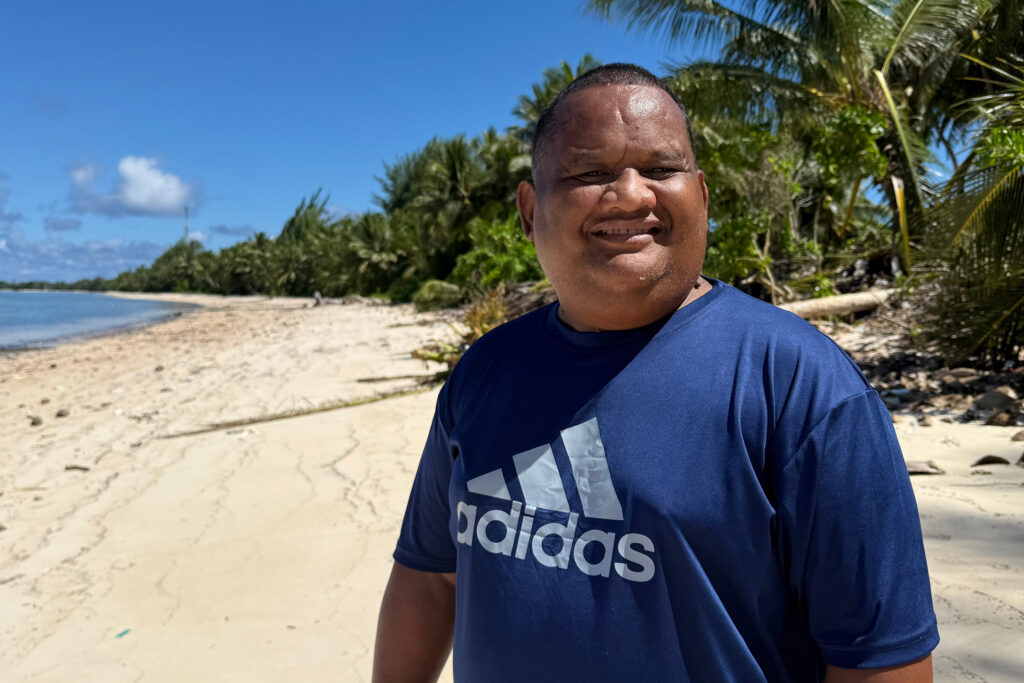
Still, David said, it will probably be at least two years before the community comes to consensus to protect Laura’s super reef.
“We’re going to have to find a way to convince people this is something we really need,” he said. Otherwise, “we might overfish and kill everything here. Nothing would be left for the future generation.”
Just beyond his beachside home, David had already observed a once thriving reef disappear.
“We don’t do fishing out here on our beach because all the corals on this side of the island have been dying,” he said. “If you go snorkeling here, you will hardly see any live coral.”
He worries the situation will only worsen as ocean temperatures continue to rise. “The water is heating up,” he said. “It’s hot, actually, to the touch.”
Science for Scale
For Cohen, the case of Laura was proof that the Super Reefs strategy could work. Scientists can identify reefs that could withstand extreme heat and generate the data communities and governments need to make informed conservation decisions.
But this case study also underscored a larger challenge. Finding just a handful of reefs in Majuro had taken years of modeling and lab experiments. And testing a coral’s heat tolerance in a cooler is just the beginning of understanding its threshold, Cohen said.
To identify the strongest of super reefs, she said, she needed to be able to monitor vast areas of reef year after year to see how they respond to heat waves in their natural environment.
“We want to do it bigger, better, faster,” said Cohen. But, she added, “We need new tools.”
That’s where Yellowfin comes in.
Originally, the vehicle had been built by Cohen’s colleague, Peter Traykovski—a coastal oceanographer and engineer at Woods Hole—to map underwater seascapes and track erosion along shifting coastlines using sonar. But Cohen asked Traykovski to adapt it for her research by mounting a GoPro beneath its hull so it could continuously take photographs as it surveyed a coral reef.
Yellowfin can now capture up to 20,000 images while surveying 40 miles of reef in a single day.
Woods Hole oceanographer Peter Traykovski originally built the robot named Yellowfin to measure coastline erosion. More recently, he adapted the vehicle to survey coral reefs by attaching a GoPro camera to its hull. , which can be used to detect corals that are bleaching and those resisting the heat. Credit: Tim Briggs
That’s far more than a team of divers can cover in weeks using traditional coral monitoring methods, which require researchers to swim or dive along a reef to assess the state of its health, Cohen said.
“Nobody can do that,” she said of Yellowfin’s capabilities. “Not even if you had a team of 100 divers.”
By conducting multiple surveys year after year of the same reef and comparing the images from each of those, Cohen said she can easily identify areas that have bleached, died or recovered. She can also pinpoint which coral colonies seem completely unphased by higher temperatures.
“You’ve got corals in the same area with very different responses to heat, and that’s what Yellowfin is finding,” she said. And it’s doing it fast. “We can do this over huge areas, very easily and in a very short amount of time.”
But the system is still a work in progress. This past trip to Majuro was, in part, an opportunity to refine and practice using the technology, so they could be assured that when the next heat wave hits, Yellowfin can be deployed without any glitches, Traykovski said.
To do that, Cohen and Traykovski spent multiple days returning to the reef Cohen had described as a “wonderland” early on in the expedition. It was the perfect testing ground for Yellowfin to survey a large area of reef and for Cohen to collect samples of corals that showed promising signs of resilience, she said. She could see from past years’ photos that some sections that had bleached had since recovered.
This story is funded by readers like you.
Our nonprofit newsroom provides award-winning climate coverage free of charge and advertising. We rely on donations from readers like you to keep going. Please donate now to support our work.
One afternoon, seated at the back of the boat with a laptop and remote controller in hand, Traykovski guided Yellowfin along a series of GPS waypoints, sending the bright yellow vessel back and forth across the reef in precise “lawnmower” patterns.
“Heads up,” he yelled to Cohen and other snorkelers in the water. “Watch out for Yellowfin.”
As it cruised by, it continued snapping two photographs every second of the seafloor below. Each image was tagged with GPS coordinates, which would allow researchers to return to the same section of reef, or even the same coral colony, during future expeditions.
Previously, Cohen would scan these images manually after each trip, spending hours on end looking for corals that stood out because of their ability to resist or recover from heat stress.
Recently, her team at the Cohen Lab at Woods Hole has begun training AI models to analyze these images automatically.
They are also using Yellowfin images to create detailed three-dimensional models of the reef to get a better idea of how the depth, angle or orientation of individual coral colonies may affect how much heat they are exposed to.
“With 3-D models we can see how a coral’s position relative to the coral next door can influence its survival during a heat wave,” Cohen said. “This information is not captured from the 2-D top-down images created by Yellowfin and may explain why some bleach and others don’t.”
When Yellowfin finished its survey, Traykovski then directed it to start finding particular corals Cohen wanted to check on.
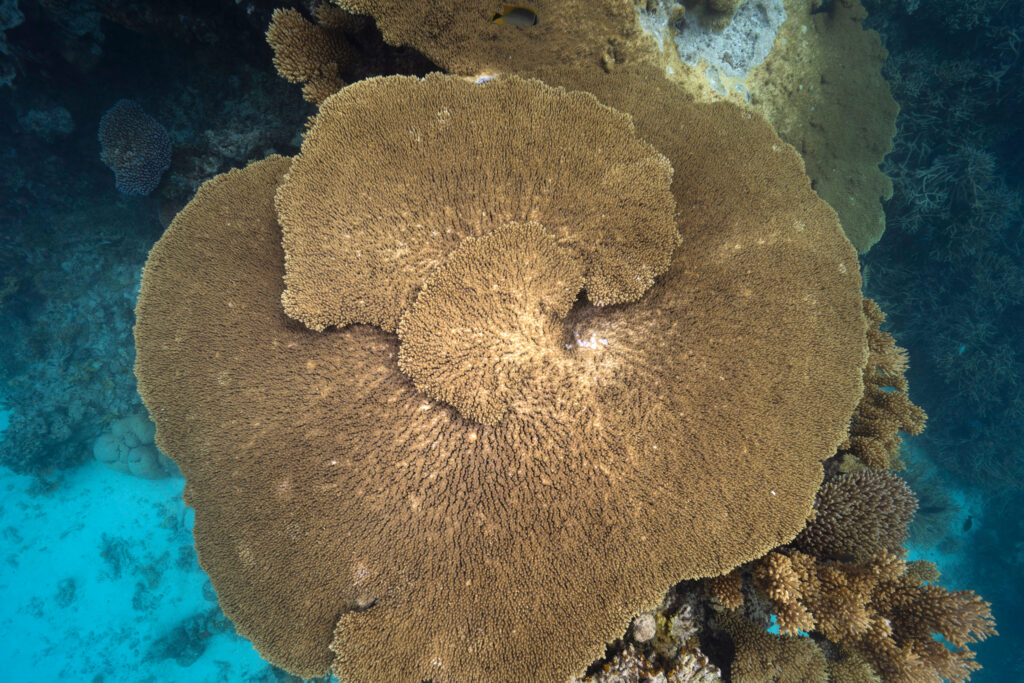
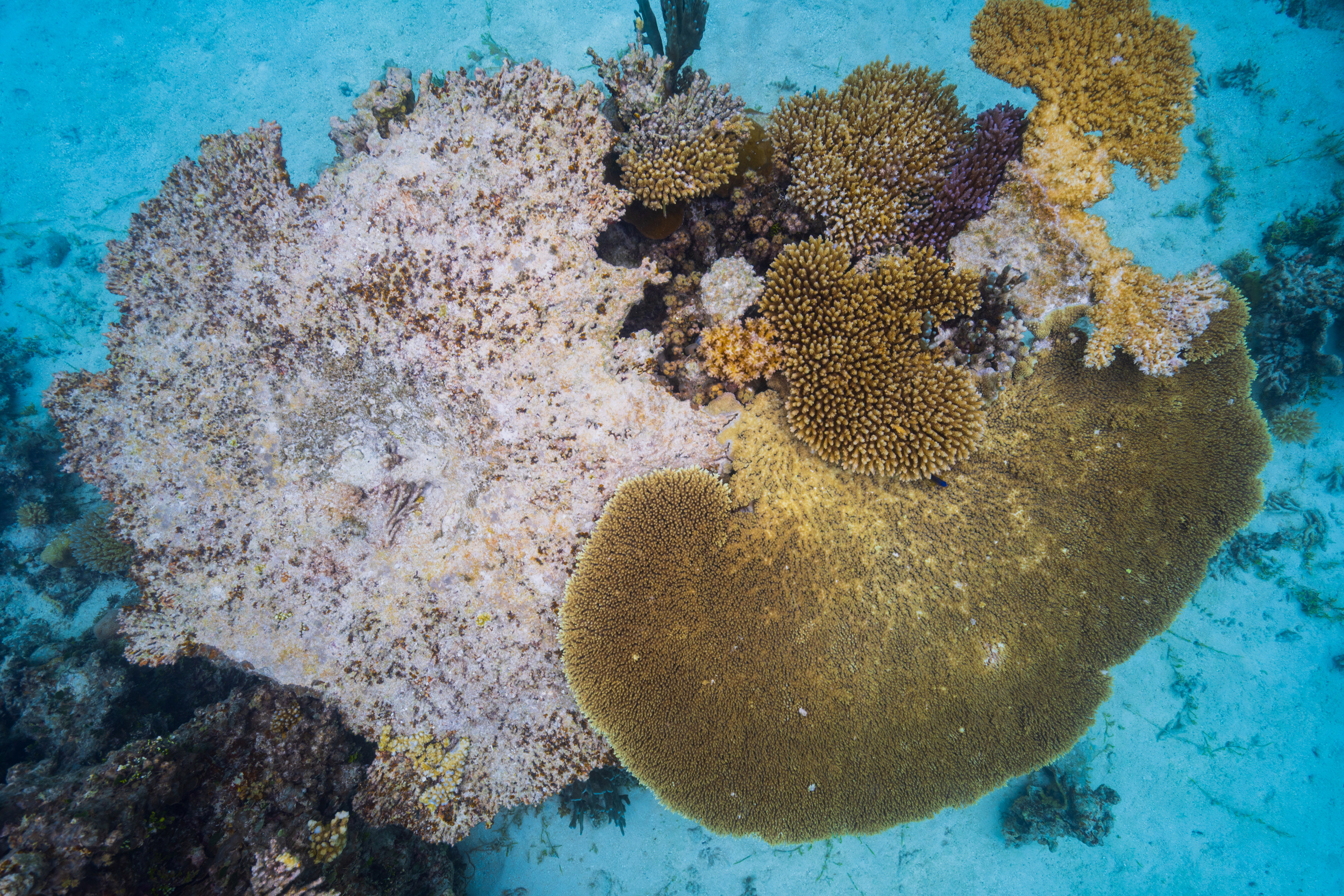
She was especially interested in tabletop corals that form large circular flat-topped platforms on the reef, some bigger than a queen-sized bed. Their broad canopies provide shelter for countless fish and other marine creatures, making them some of the most iconic and ecologically important species in the Marshall Islands. They’re also notoriously sensitive to heat stress and are often among the first corals to bleach, she said.
She carried laminated photos of some of the corals Yellowfin had helped photograph in previous surveys to bring underwater with her so she could examine how they were doing now compared to then.
“Both of these pictures were taken here in the Marshall Islands in 2024,” she said, showing off one of the laminated pages. “What you can see in each picture is one coral that’s bleached and the other—exactly the same species—that’s not bleached. That’s not sick. That’s absolutely healthy, almost like it’s been immunized or vaccinated against the heat.”
That contrast was what fascinated her.
Why had one coral succumbed to heat stress while the other remained healthy, she wondered. Did it possess a genetic trait that made it more tolerant of heat? Or was it actually a different species that only looked similar? Cohen suspected there was far more genetic diversity among tabletop corals than scientists have previously documented in Majuro.
A few moments later, Yellowfin slowed to a stop. “They should be right there,” Traykovski said, pointing to the robot hovering at the surface.
Still, spotting them underwater wasn’t always straightforward, Cohen told AJ Alik, a fisheries officer at MICS who was on board to help for the day. A coral that had bleached, died or broken apart might look nothing like it did in the photographs, she explained.
As she prepared to enter the water, Cohen studied her laminated images for clues, searching for landmarks near the corals that she could look for on the reef, if necessary, to confirm she was in the right place.
But after freediving down about 10 feet below the yellow robot, Cohen quickly found what she was looking for. She popped her head up to breathe. “I think that’s it.”
One of the two massive tabletops was still alive, to her relief.
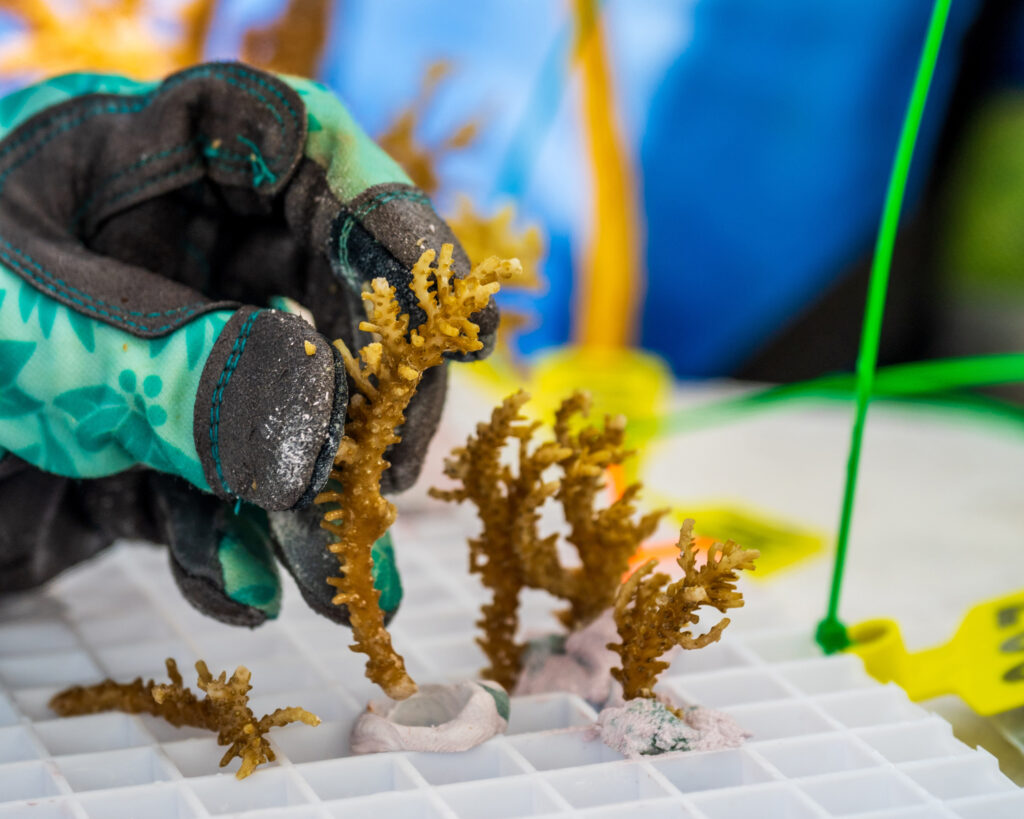
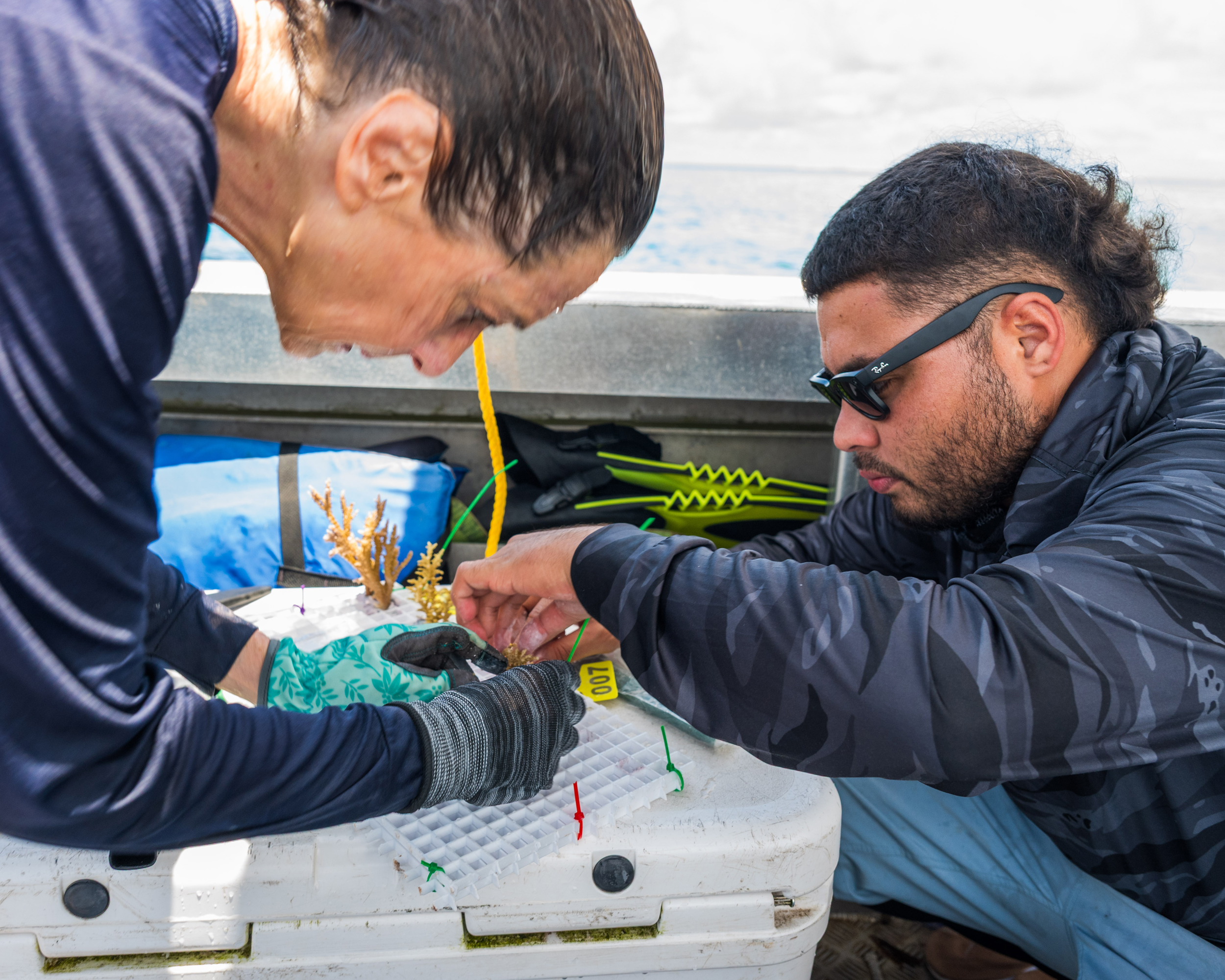
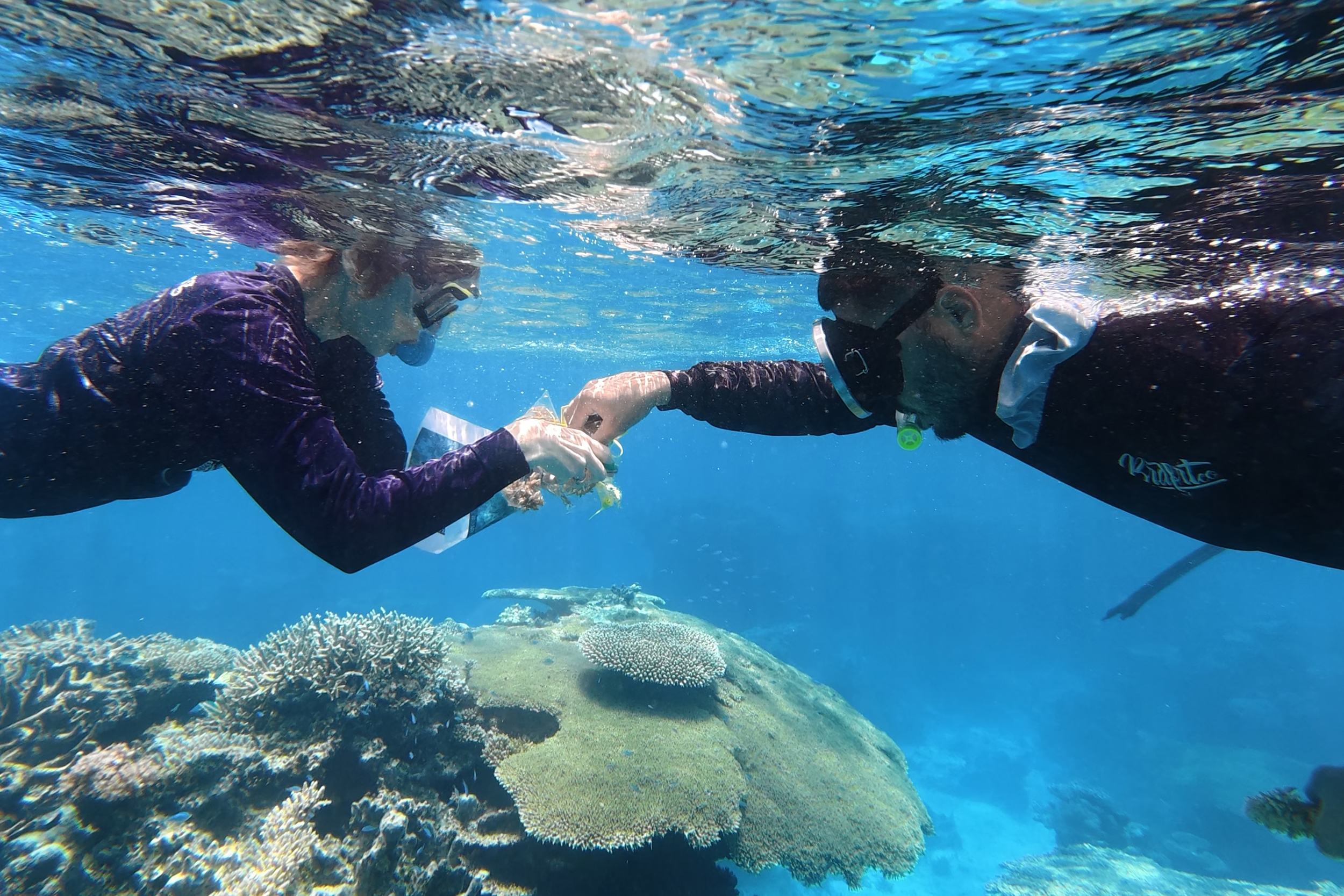
Then, Alik and Cohen dove down again together to clip a small fragment from the living coral. They tagged the colony with an identification number and attached a matching label to the sample bag so the fragment could later be traced back to the colony it came from.
Later, Cohen would send the samples to collaborators at James Cook University in Australia for genetic analysis, along with others she’d collected on this expedition from tabletop corals that had bleached—according to Yellowfin’s photos—but now seemed recovered, as well as from seemingly healthy corals persisting alongside neighbors showing signs of heat stress. If researchers could identify the traits associated with heat tolerance, Cohen said, they could return to those same corals later on and use them in future reef restoration efforts.
Rebuilding Resilient Reefs
Globally, coral researchers and conservationists have dedicated enormous efforts re-planting fragments of corals on damaged and depleted reefs with hopes that they will help build a new reef. But in general, Cohen said, the long-term success rate of these initiatives is not very high. Many of the corals they’ve been planting are the same ones vulnerable to bleaching elsewhere, she said.
Effective restoration, she said, must employ the help of corals that can take the heat.
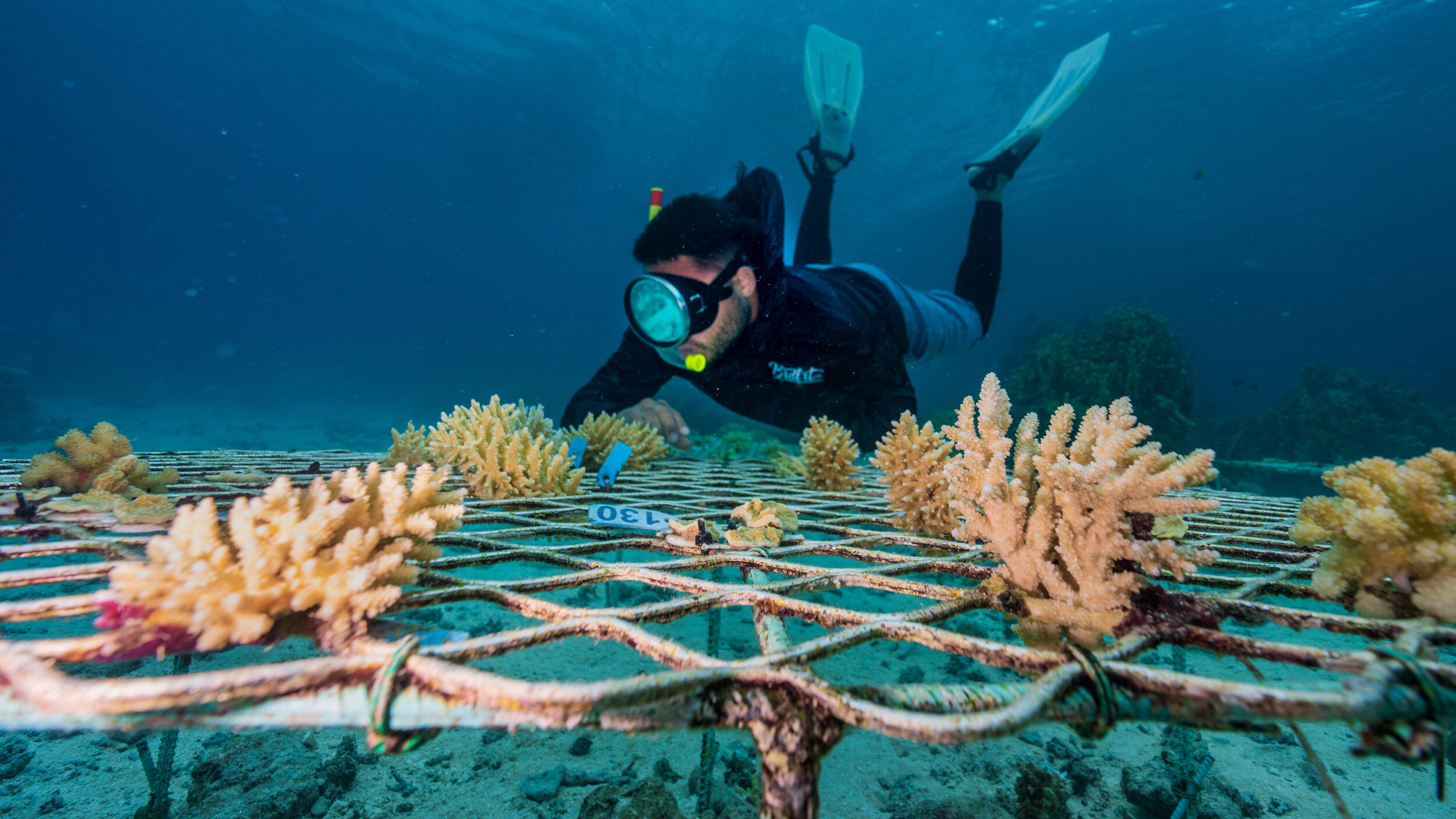
That approach—using scientifically proven heat-resilient corals to rebuild damaged reefs—is very new, said Palumbi. While scientists have spent around a decade testing corals for heat tolerance, only recently have they begun applying those findings to restoration.
“The idea of using them as a supply chain for restoration projects is something that really grew out of the Super Reefs project,” Palumbi said.
Alik and his colleagues at MICS are in the early stages of experimenting with this approach by planting small underwater plots of corals that they tested with Palumbi for heat tolerance. In time, Alik said, those colonies could become a nursery of sorts—a source of coral fragments that could be used in larger restoration efforts in Majuro, and possibly beyond.
A Super Reef Blue Corridor
It was time to think bigger, Cohen said.
To really give reefs a greater chance of enduring more frequent and severe heat waves, it would not be enough to protect a few super reefs here and there in isolation, she said. They needed to be connected.
On a hot humid Sunday afternoon, she presented her idea to several Marshallese authorities in charge of managing the country’s marine resources and a group of teachers and high school students from Majuro who had come to learn about super reefs.
They gathered on Bokanbotin, a small island about a 10-minute boat ride away from downtown Majuro owned by a local family that had established the waters around the island as a legally recognized marine protected area. Recently, Cohen had begun working with the island’s owner, Sherwood Tibon, to build a small science lab and education center where local children could learn about coral reefs. Eventually, she hopes Bokanbotin will become one of the primary research hubs for her next initiative.
Having grown up in South Africa, Cohen told the group she had long been inspired by protected wildlife corridors there, which give elephants, lions, wildebeest and other animals the freedom to roam, migrate and breed across landscapes and neighboring country borders to ensure they sustain healthy, genetically diverse populations.
More recently, conservationists have started to advocate for the protection of “blue corridors”—migratory pathways used by marine megafauna, such as whales and sharks, to travel between different habitats used to feed, mate or give birth to their young.
Now, Cohen wanted to create something similar, but specifically for heat-tolerant corals—a “super reef blue corridor.”
Nowhere else was there such a thing yet, she said. She believed the Marshall Islands had an opportunity to help create the first.
This corridor, she said, would include a network of protected super reefs and restoration sites, where she envisioned heat-tolerant corals being planted like underwater “forests,” throughout the Marshall Islands, Kiribati and Tuvalu. Most importantly, she added, each of the selected sites would be strategically connected by ocean currents to encourage interbreeding of these resilient animals.
“We need to create maximum opportunity for them to create this oceanic shield of heat tolerance,” she said.
It would be like a “super highway” for “super corals,” she said, where their eggs and sperm would have the best chance of meeting to produce more “super babies.”
Coral larvae can drift hundreds of miles from their parents before settling on a reef for the rest of their lives.
It was an ambitious idea, she said, that would require political support and significant financial backing—about $10 million by her estimate—as well as community buy-in. Not every super reef can be cordoned off to fishing and other activities, she said.
“People need to live. People need to eat. They need to fish.” It would be critical, she said, to consult with and co-design any protected areas in this corridor with communities that would be impacted, as is being done in Laura.
But overall the idea seemed feasible, the Marshall Islands Marine Resources Authority’s Edwards said. “The idea of creating a multi-national network of marine-protected areas connecting resilient reefs across the Marshall Islands, Kiribati and Tuvalu is a very promising concept,” she said.
Other experts agree. “Protecting source reefs and well-placed stepping stones between them can maintain dispersal networks that can share heat-tolerant adaptations and provide new coral larvae to help degraded reefs recover,” said Emily Darling, director of coral reefs at the Wildlife Conservation Society. “Accounting for connectivity between high-integrity, climate-resilient reefs multiplies their conservation value across an entire region.”
Once established, Cohen said, this first Super Reef corridor could serve as a proof of concept for creating similar protected networks around the globe.
Future corridors might be created between Indonesia, the Philippines and Malaysia, she said, or India, the Maldives and the Chagos Islands in the Indian Ocean.
Ultimately, she said, the success of these networks would depend on countries’ willingness to collaborate and select which reefs they would prioritize. Her role, as she sees it, is to deliver the scientific data to inform those choices. She wants to ensure that resources are directed where they can have the greatest impact—as quickly as possible.
“This is an urgent mission,” she said.
Forecasters recently warned that El Niño conditions have formed once again in the tropical Pacific and are expected to strengthen by this fall.
In the coming months, Cohen said, “We have a pretty strong chance of having a heat wave in the Marshall Islands.” She was already having nightmares of it ravaging the vibrant reefs she’d just visited.
“It’s just a horrible feeling,” she said, gazing out toward a shallow reef offshore Bokanbotin.
But she wanted to be there when it hit. She had already started to plan her return trip to the Marshall Islands before she left.
“We want to be there in the peak of that heat wave to send Yellowfin out and see how the corals are doing,” she said. “I have a pretty good idea which corals will resist because we’ve seen them do it before. But we need to make sure.”
About This Story
Perhaps you noticed: This story, like all the news we publish, is free to read. That’s because Inside Climate News is a 501c3 nonprofit organization. We do not charge a subscription fee, lock our news behind a paywall, or clutter our website with ads. We make our news on climate and the environment freely available to you and anyone who wants it.
That’s not all. We also share our news for free with scores of other media organizations around the country. Many of them can’t afford to do environmental journalism of their own. We’ve built bureaus from coast to coast to report local stories, collaborate with local newsrooms and co-publish articles so that this vital work is shared as widely as possible.
Two of us launched ICN in 2007. Six years later we earned a Pulitzer Prize for National Reporting, and now we run the oldest and largest dedicated climate newsroom in the nation. We tell the story in all its complexity. We hold polluters accountable. We expose environmental injustice. We debunk misinformation. We scrutinize solutions and inspire action.
Donations from readers like you fund every aspect of what we do. If you don’t already, will you support our ongoing work, our reporting on the biggest crisis facing our planet, and help us reach even more readers in more places?
Please take a moment to make a tax-deductible donation. Every one of them makes a difference.
Thank you,

Oceans Correspondent
Teresa Tomassoni is an environmental journalist covering the intersections between oceans, climate change, coastal communities and wildlife for Inside Climate News. Her previous work has appeared in The Washington Post, NPR, NBC Latino and the Smithsonian American Indian Magazine. Teresa holds a master’s degree in Journalism from the Craig Newmark Graduate School of Journalism. She is also a recipient of the Stone & Holt Weeks Social Justice Reporting Fellowship. She has taught journalism for Long Island University and the School of the New York Times. She is an avid scuba diver and spends much of her free time underwater.