

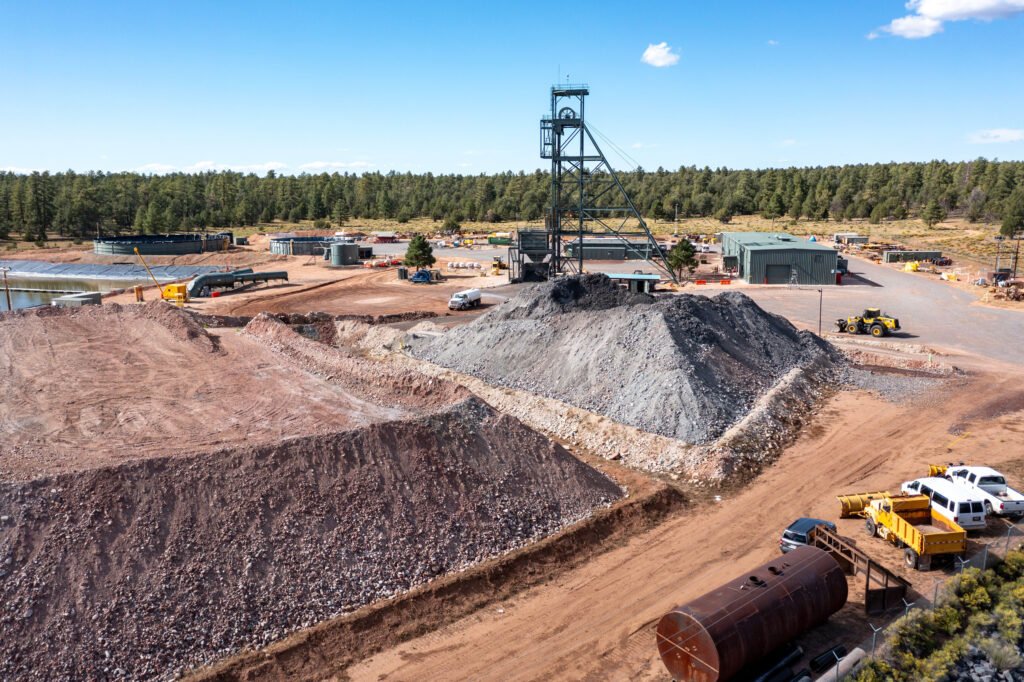
A monitoring well at the site of a uranium mine operating in a national monument nine miles from the Grand Canyon’s south rim has been detecting rising arsenic levels since 2025. Four times, those arsenic levels exceeded the Arizona well’s permitted alert levels.
Now, the Arizona Department of Environmental Quality (ADEQ) is approving an application from the company, Energy Fuels Resources Inc., to raise both the well’s alert levels for arsenic and the limit of the toxic metal in the aquifer detected at the well by 10 percent in a modification to the mine’s Aquifer Protection Program permit. The approved changes would raise the alert level from 0.04 milligrams per liter (mg/L) to 0.05 mg/L and increase the allowable arsenic concentration from 0.05 mg/L to 0.055 mg/L.
Local tribes and environmentalists say the decision threatens the region’s water quality and the public’s ability to be alerted to groundwater issues at the mine. Independent hydrogeologists who spoke to Inside Climate News say the approval ignores scientific evidence the contamination could spread across the regional aquifer around the Grand Canyon, a possibility that needs more study before a decision is made to raise the permissible levels of arsenic.
“It’s as if [ADEQ] are just shills for the mining company,” said Laura Crossey, an emeritus professor of earth science at the University of New Mexico, who for decades has researched the hydrogeology of the Grand Canyon.
Monitoring groundwater contaminants works similarly to the “canary in a coal mine” that once warned miners of toxic gases, Crossey said. Raising the monitoring well’s arsenic levels would be like swapping out the canary for a bird that doesn’t die as quickly from toxic air, she said.
Energy Fuels is one of the biggest players in the U.S.’s renewed interest in nuclear energy, operating multiple uranium mines, with others actively going through permitting to open. It also operates the country’s only operating uranium mill, the White Mesa facility in Utah that processes ore into yellow cake, where the company has previously asked Utah regulators to raise groundwater contaminant limits.
Last month, the Department of Defense announced a $725 million conditional loan commitment for Energy Fuels to scale up its domestic processing of rare earth elements at the mill site. And one of its proposed mine sites in New Mexico, the Roco Honda project, has been added to the Trump administration’s fast-tracked permitting process, despite being within the boundaries of the Mount Taylor Traditional Cultural Property, a site sacred to several tribes in the region.
Regulatory Gaps
ADEQ and the company claim the arsenic issue at the Pinyon Plain mine is natural, and not due to the mining. In its application, the company attributes the rising arsenic levels to its groundwater pumping causing a “cone of depression” around the well that is drawing in water with more naturally occurring arsenic from further reaches of the aquifer. Hitting the alert limit requires an investigation into what is causing the rising arsenic levels, more frequent monitoring and potential action to prevent it from reaching the aquifer quality limit.
“When you look at the laws that establish the Aquifer Protection Permit (APP) program, it is very specific that it regulates discharges of a pollutant from a facility. It doesn’t regulate when the movement of water liberates pollutants, and that’s important,” Randall Matas, ADEQ’s acting Water Quality Division director, told Inside Climate News. “If we did regulate that … anybody that did anything that could change movement of water in Arizona would need one of these costly APP permits.”
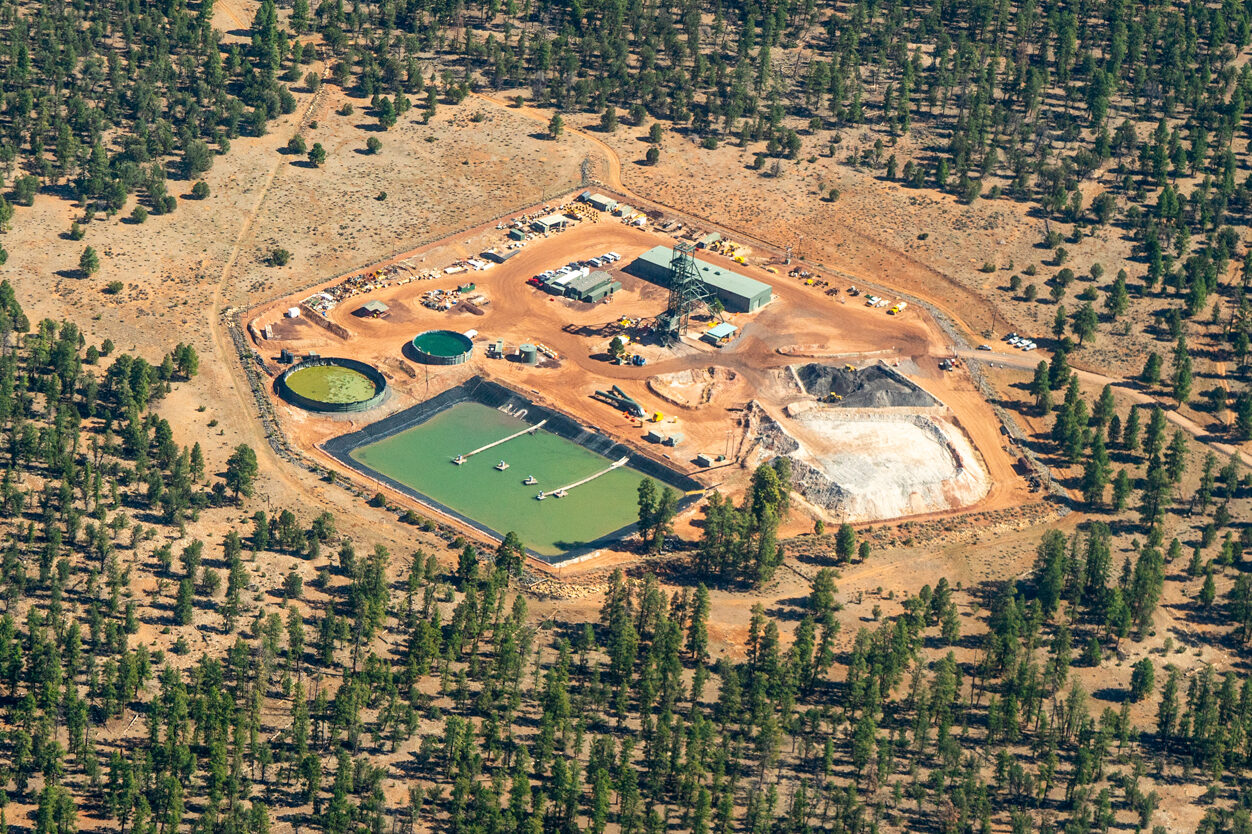
The mine’s shaft contains not just uranium, but scores of other minerals, like arsenic, explained Karl Karlstrom, another emeritus professor of earth science at the University of New Mexico. Those minerals are found in low-oxygen settings but are exposed to oxygenated water by the mine’s operations, he said, mobilizing them to increase the levels of arsenic and other contaminants in the aquifer.
But the APP program is not designed to regulate a mine’s effects on the flow of an aquifer that can lead arsenic levels to rise. Instead, Matas said, it’s for protecting aquifers from direct discharges from operations like a mine, and the decision to raise the limit is due to how the permit works.
“Facilities that are regulated by APP permits are not responsible for naturally occurring arsenic,” Matas said. “In this instance, because we have that hydraulic sink, and we can see that arsenic moving from off-site to onsite, it’s very clear that this is not arsenic moving out from the mine, this is arsenic moving toward the mine due to natural arsenic being liberated as that water moves.”
Recent research led by Karlstrom and Crossey on the Grand Canyon’s groundwater system documented a dye tracer quickly traveling great distances between the upper Coconino aquifer and the deeper, regional Redwall-Mauv aquifer, showing that they are connected in many parts of the region. The study brought renewed attention to the possibility of groundwater contamination at the mine site and led to reviews by the U.S. Geological Survey and Environmental Protection Agency, which found more research is needed to understand if the mine site poses a threat to the region’s water quality.
The water at the monitoring well is far beyond the EPA’s safe drinking limits for contaminants like arsenic, lead and uranium. If it spreads to the deeper, regional aquifer that many communities rely on, it could pose significant health threats, experts, environmentalists and local tribes warned.
ADEQ’s action sets a path for industry to exceed regulatory limits and then ask to raise those limits, experts warned.
Curtis Moore, a spokesman for Energy Fuels, said in a statement that the change is a “routine, minor amendment to reflect natural fluctuations in background levels of arsenic” and that this is a “very common” issue at mining operations.
Moore said advocacy groups are distorting the science to scare local tribes and community stakeholders, and that the researchers behind the science they cite are paid by the groups. (Neither Crossey, Karlstrom or other hydrogeologists who sent comment to ADEQ have ever worked for or been paid by environmental groups like the Grand Canyon Trust or by local tribes).
Rep. Adelita Grijalva, who represents Arizona’s 7th congressional district to the south of the Grand Canyon, wrote to ADEQ to request that they deny Energy Fuels’ application to raise the alert limit.
“If an operator wants to change the environmental protections,” she told Inside Climate News, “they should be able to demonstrate with clear scientific evidence, not by somebody who’s been hired by the mine to give you the story. It’s about ensuring that public health is never treated as an afterthought.”
Matas said ADEQ is confident the permit will protect drinking water. Data at the mine site, he said, shows the water there is contained, though he said more studies are needed to understand the regional hydrogeology, which is why the agency has partnered with the USGS to study the issue. The agency is committed to continue working with the community, he said, and noted that after tribal consultation, ADEQ put out a public notice about the proposal to raise the limits.
The Havasupai tribe and local government argue that public notice alone was not enough, and a public comment period was necessary given the risk to local drinking water. ADEQ defined the change as a minor amendment that did not require a public comment period.
“We felt as a county board of supervisors that the health and safety of people comes first,” said Patrice Horstman, chair of the board of supervisors for Coconino County. “But given the fact that there are experts that are questioning this, at a minimum, the health and safety would require us to have public comment.”
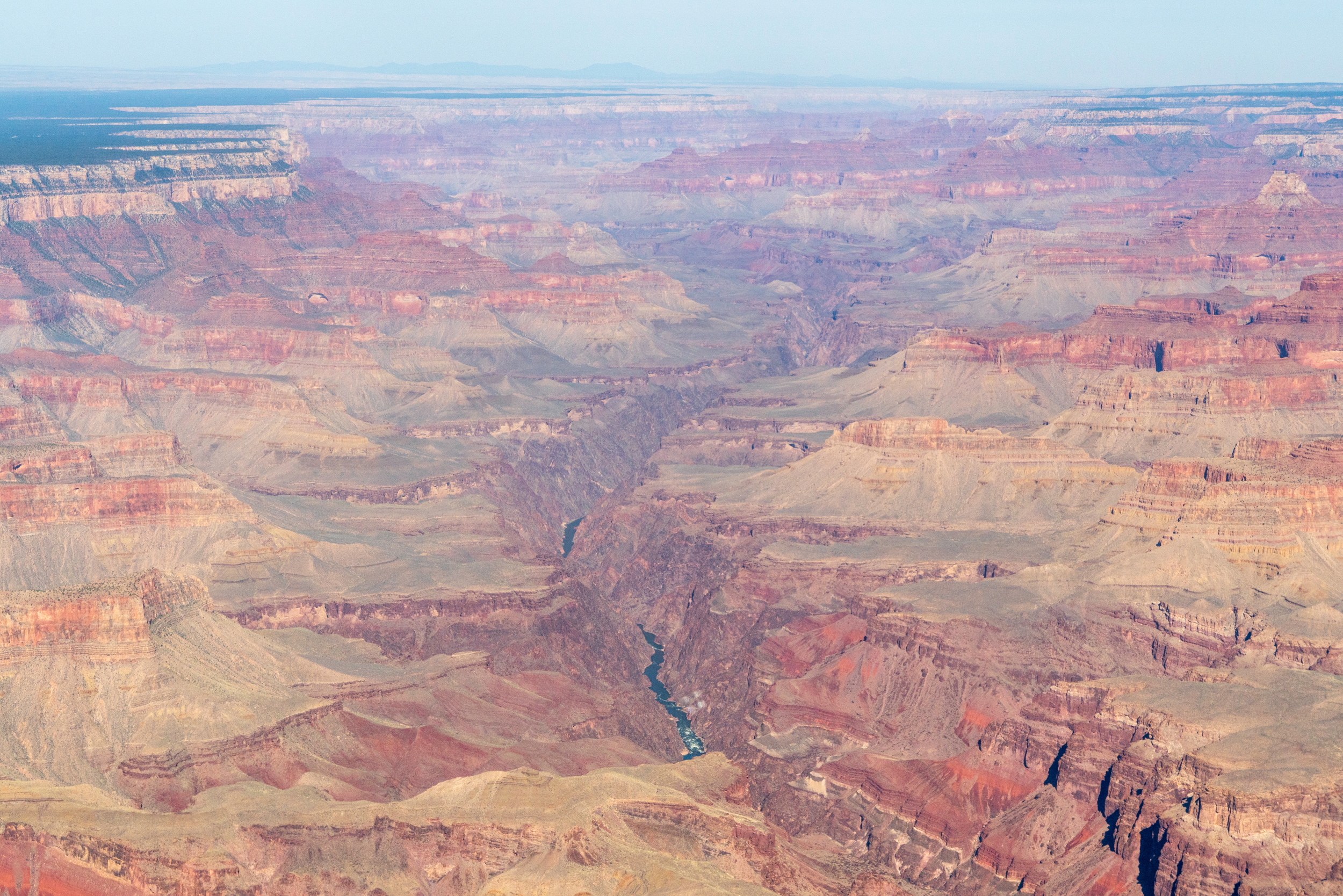
For decades, the Havasupai have opposed the mine, which is situated near a site sacred to the tribe. The tribe’s reservation is in the Grand Canyon, and its only source of water is Havasu Creek, which is directly fed by the regional Redwall-Mauv aquifer. The tribe’s leaders said they were shocked by ADEQ’s action and its failure to provide any initial public notice and no public comment period.
“As the original Guardians of this sacred place, we have a solemn responsibility to protect the springs, aquifers, and waters that give life not only to our people, but to one of the world’s greatest natural wonders,” Havasupai Tribal Chairwoman Melinda Yaiva said in a statement. “Today’s decision by the Arizona Department of Environmental Quality is a profound attack on the Tribe’s inherent responsibility to guard and protect the waters of the Grand Canyon.”
A Mine’s Controversial History
The Pinyon Plain mine was one of the first uranium mines to re-open at the end of 2023, following an uptick in prices due to a renewed global interest in expanding nuclear power and the dwindling supply from Russia following its invasion of Ukraine in 2022. The U.S. imposed sweeping sanctions on the country, but not for uranium until 2024.
Misael Cabrera, who signed off on Energy Fuels’ Aquifer Protection Permit for the mine in 2022, when he was director of ADEQ, now works for the company as their senior vice president of environment, safety and sustainability.
This story is funded by readers like you.
Our nonprofit newsroom provides award-winning climate coverage free of charge and advertising. We rely on donations from readers like you to keep going. Please donate now to support our work.
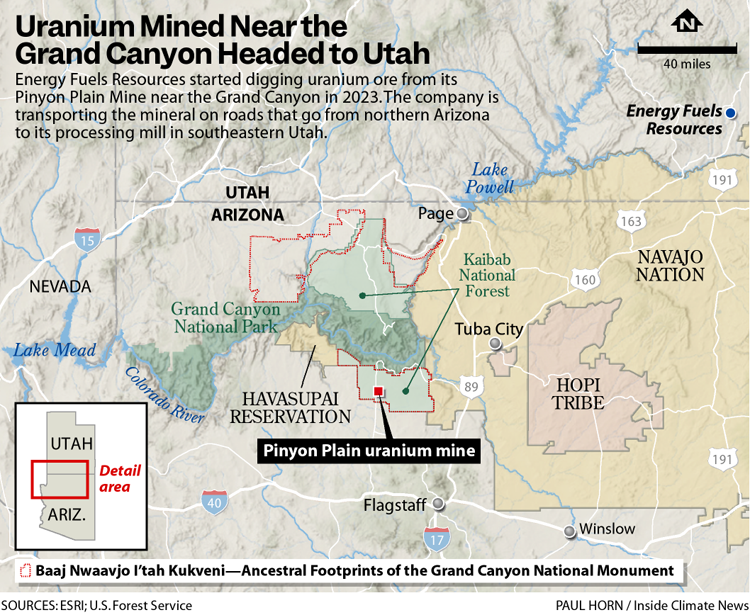
The mine has been controversial since its inception. It was first approved by federal regulators in 1986, but low uranium prices and lawsuits kept it shuttered for decades. The Havasupai Tribe has long fought the mine due to its proximity to Red Butte, a sacred site for the tribe. And the mine is located within the Baaj Nwaavjo I’tah Kukveni – Ancestral Footprints of the Grand Canyon National Monument.
The site contains a single mine shaft extending 1,470 feet down to the uranium deposits, which are found in mineral-rich rock formations known as breccia pipes. To access the ore, more than 80 million gallons of groundwater were removed from the aquifer below the mine. Since the mine began extracting ore, arsenic levels in the water have risen to 3,443 times the safe limit for drinking water, uranium concentrations reached 3,040 times that limit and lead rose to 593 times the safe drinking water limit.
Mining for uranium in the Four Corners region is nothing new—and the environmental and health impacts were largely left for Indigenous communities to live with. From 1944 to 1986, for example, mining activities left more than 500 abandoned mines and an enormous amount of uranium waste in various regions of Navajo land, and tribal members continue to have increased rates of cancer, autoimmune and cardiovascular diseases caused by the pollution remaining.
“It starts to feel like the regulatory agency is not preventing pollution—they’re permitting pollution.”
— Amber Reimondo, the Grand Canyon Trust
Communities here know what can happen when things go wrong, and are still living with the impacts of the last uranium boom, said Amber Reimondo, the energy director at the Grand Canyon Trust, a nonprofit advocating for protection of the Grand Canyon and Colorado Plateau, who was the first to spot Energy Fuels application to amend its aquifer protection permit and notify the Havasupai Tribe.
“When the mining company says it’s normal, it’s like, ‘Yeah, that’s the problem,’” she said. “And for it to be allowed, I mean, it starts to feel like the regulatory agency is not preventing pollution—they’re permitting pollution.”
Contamination Burdens the Four Corners
This is the first time Energy Fuels has requested and received approval to raise the contaminant level at the Pinyon Plain mine. But it’s not the first time the company has had a similar issue that resulted in a state agency raising its regulatory limits.
Across the border in Utah, Energy Fuels’ White Mesa Mill stores radioactive waste in five tailings impoundments across 275 acres just outside the Ute Mountain Ute reservation. The state of Utah has raised the allowable levels of several health-threatening contaminants at monitoring wells for the mill’s tailings ponds several times. And the mine and mill combination poses another threat.
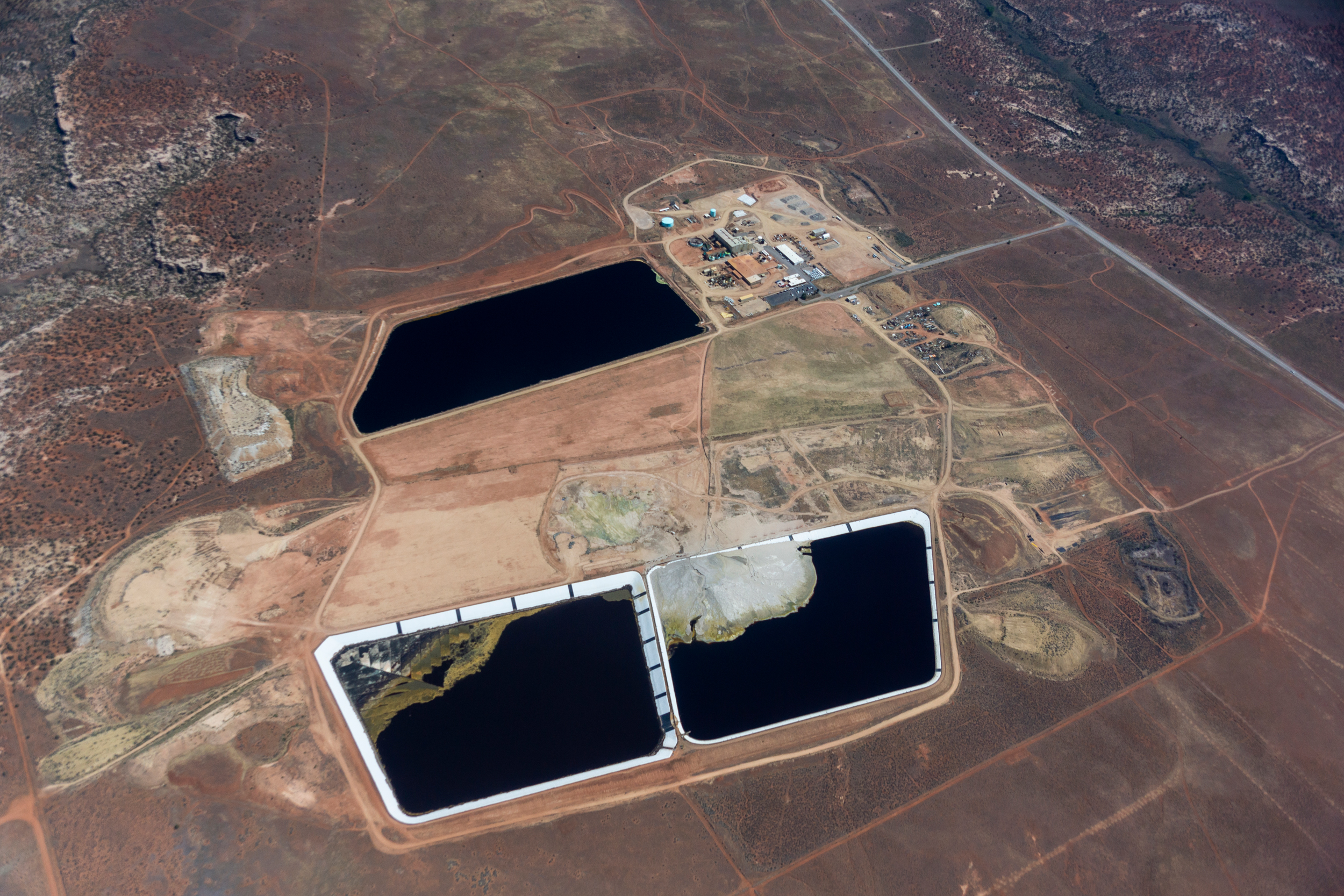
The mill processes the uranium mined at the Pinyon Plain mine, which is trucked on a 300-mile route across the land of the Navajo Nation, the Hopi tribe, the Kaibab and Coconino National Forests and Bear’s Ears National Monument.
Coconino County in Arizona has raised concerns about the impacts of transporting uranium along the route since Pinyon Plain began extraction in late 2023. In May, one of the trucks crashed. Though no radiation leaks were detected, it was the type of event local community members feared; days later, at a rally protesting the mine and mill, demonstrators stopped and defaced a truck hauling ore for the company.
“How is this going to be managed to ensure the health and safety and welfare,” asked Horstman, the county supervisor. “Not just of people who work there but those along the route for bringing the ore through to its processing plant in Utah?”
The mill has dozens of monitoring wells, each with different standards for contaminants, that were developed in 2004—more than two decades after it began operations.
Levels have fluctuated at the various well sites, and some have exceeded state standards. One of the wells is situated between two of the mill’s tailing sites and, since 2010, its levels of selenium, sulfate and total dissolved solids have increased multiple times. In 2021, Utah raised the well’s allowable levels of selenium by 68.7 percent, sulfate by 86.65 percent, total dissolved solids by 61.52 percent and uranium by 64.84 percent.
Scott Clow, the environmental programs director for the Ute Mountain Ute, said the tribe has long expressed concern over the increasing levels of contaminants and the state’s decision to raise the limits. Though the contamination has not spread, the tribe worries the mill may eventually affect local springs, as well as their drinking water.
The tribe is not opposed to energy development, itself an active player in both the oil and solar industries, or nuclear power, he said, but have long criticized the excessive impacts of extraction to power nuclear facilities on the Four Corners region.
“How much uranium pollution can this area take?” he asked. “There’s so many sites that still need to be cleaned up, and we’re just going all in on this facility in Utah that is the driver on a lot of those pollutant issues.”
About This Story
Perhaps you noticed: This story, like all the news we publish, is free to read. That’s because Inside Climate News is a 501c3 nonprofit organization. We do not charge a subscription fee, lock our news behind a paywall, or clutter our website with ads. We make our news on climate and the environment freely available to you and anyone who wants it.
That’s not all. We also share our news for free with scores of other media organizations around the country. Many of them can’t afford to do environmental journalism of their own. We’ve built bureaus from coast to coast to report local stories, collaborate with local newsrooms and co-publish articles so that this vital work is shared as widely as possible.
Two of us launched ICN in 2007. Six years later we earned a Pulitzer Prize for National Reporting, and now we run the oldest and largest dedicated climate newsroom in the nation. We tell the story in all its complexity. We hold polluters accountable. We expose environmental injustice. We debunk misinformation. We scrutinize solutions and inspire action.
Donations from readers like you fund every aspect of what we do. If you don’t already, will you support our ongoing work, our reporting on the biggest crisis facing our planet, and help us reach even more readers in more places?
Please take a moment to make a tax-deductible donation. Every one of them makes a difference.
Thank you,

Reporter, Phoenix
Wyatt Myskow covers drought, biodiversity and the renewable energy transition throughout the Western U.S. Based in Phoenix, he previously reported for The Arizona Republic and The Chronicle of Higher Education. Wyatt has lived in the Southwest since birth and graduated from Arizona State University with his bachelor’s degree in journalism.

Fellow
Maya McDaniel is a fellow at Inside Climate News, currently based in Western Colorado. She is a junior at Swarthmore College, majoring in Environmental Studies with a focus on biology. She is interested in the impacts of climate change on the American Southwest, especially wildfire risk and the Colorado River water crisis.