

Close Menu

    Subscribe to Updates

    Get the latest news information from worldwide businesses.

    What's Hot

    India paves way for return of merchant fees on digital payments

    August 4, 2026

    Government invites online applications from August 17-31 to get recognised as GATCs

    August 4, 2026

    Trump says US-Iran talks continue, warns Tehran faces 'last chance'

    August 4, 2026
    Facebook Instagram YouTube LinkedIn X (Twitter)
    Trending
    • India paves way for return of merchant fees on digital payments
    • Government invites online applications from August 17-31 to get recognised as GATCs
    • Trump says US-Iran talks continue, warns Tehran faces 'last chance'
    • From Spain to Poland: Where does Ukraine's EU bid have the most support?
    • Cars that ‘talk’ to each other: India’s proposal for safer roads from 2028 | India News
    • Cracker Barrel fans want Sunrise Sampler and classic sides back on menu
    • 5 Reasons Roman Reigns might be appearing in AAA
    • ‘Was really hoping that no one will get to know.’
    Newspublicly
    • About Us
    • Advertise & Partner with us
    • Pitch Your Story
    • Contact Us
    Facebook Instagram LinkedIn X (Twitter)
    Subscribe
    • Home
    • World News
      • Asia
      • India
      • USA
      • UK & Europe
      • Middle East
    • Economy & Business
      • Global Economy
      • Corporate & Industry
      • Finance & Markets
      • Policy & Trade
    • Technology
      • Gadgets & Devices
      • Software & Apps
      • AI & Machine Learning
      • Robotics & Automation
    • Health & Medicine
      • Fitness & Nutrition
      • Research & Innovation
      • Disease & Treatment
      • Doctors, Clinics & Patient Care
    • Travel & Tourism
    • Automobile
      • Electric & Hybrid Vehicles
      • Auto Industry Insights
    • Sports
    • More
      • Education
      • Real Estate
      • Environment & Climate
      • Space & Astronomy
      • War & Conflicts
    Newspublicly
    Home»More»Space & Astronomy»Are aliens running out of places to hide? It turns out we’ve searched much more of the galaxy than we realized
    Space & Astronomy

    Are aliens running out of places to hide? It turns out we’ve searched much more of the galaxy than we realized

    AdminBy AdminAugust 4, 2026No Comments5 Mins Read0 Views
    Share
    Facebook Twitter LinkedIn Copy Link WhatsApp


    When people grow impatient at the lack of success in the search for alien life, researchers often point to how few of the Milky Way’s 100 billion stars or so have been searched so far. But it may be that the search for extraterrestrial intelligence (SETI) has surveyed more stars than astronomers had realized.

    Louisa Mason, a PhD student at the University of Manchester, had a recent epiphany that astronomers have actually searched much more of our galaxy for radio signals than we thought. Mason came to the conclusion by using a specific simulation of the Milky Way, called the Besançon Galactic Model, and then comparing it to surveys of the sky conducted by the Green Bank and Parkes radio telescopes. Based on star catalogues, it was calculated that the two telescopes had seen 288,315 stars seen in 1,327 observations of the sky. However, by applying the Besançon Galactic Model, Mason discovered that the survey had actually included more than 6.1 million stars, most too faint to be obvious.

    “One of the most exciting things about this work is realizing that we’ve surveyed many more stars than initially thought,” Mason said in a statement. “Even a very small observation can contain a huge number and diversity of stars that we might never have intended to study.” But while Mason’s calculations show that we’ve actually surveyed many more of those stars than we realized, there’s no need to grow disheartened by the lack of a detection.

    When a radio telescope points towards a target star, it isn’t just listening to that star, but is also eavesdropping on all the other stars in the field of view. This is very useful for a practice called commensal SETI, whereby a SETI instrument piggybacks on a radio telescope’s usual day-to-day observations.

    Typically, the number of stars in a radio telescope’s field of view is estimated by comparing it to detailed star catalogues such as those compiled by the European Space Agency’s Gaia mission. However, these catalogues are limited because they only include stars bright enough to be seen; there are many more stars too faint to be seen by our optical and infrared telescopes. Yet if a radio telescope is pointed in their direction, it could still detect a radio signal from them even if we cannot see the star.


    You may like

    Although the search may be bigger in terms of the number of stars, it is still very small in terms of the time spent listening to each star, and is still limited in the radio frequency range covered. We could very easily have missed a signal by observing between broadcasts, or at the wrong frequency.

    So Mason has also looked to expand the range of radio frequencies that can be searched. Ever since modern SETI began in 1960, the bulk of SETI searches have focused on a frequency range known as the ‘water hole’, between the emission frequency of atomic hydrogen at 1,420 MHZ, and hydroxyl (a molecule composed of one atom of hydrogen and one atom of oxygen) at 1,666 MHz. The name ‘water hole’ comes about because if you combine hydrogen with hydroxyl you get a water molecule (two hydrogen atoms and one oxygen atom).

    Space

    One of the reasons the water hole has been so favored is because radio waves in this frequency range are not absorbed by Earth’s atmosphere. Furthermore, a lot of astronomy is conducted around the hydrogen frequency, so there’s a good chance of a coincidental SETI detection. Plus, aliens might recognize the importance of water to life and the symbolism of transmitting in that frequency range.

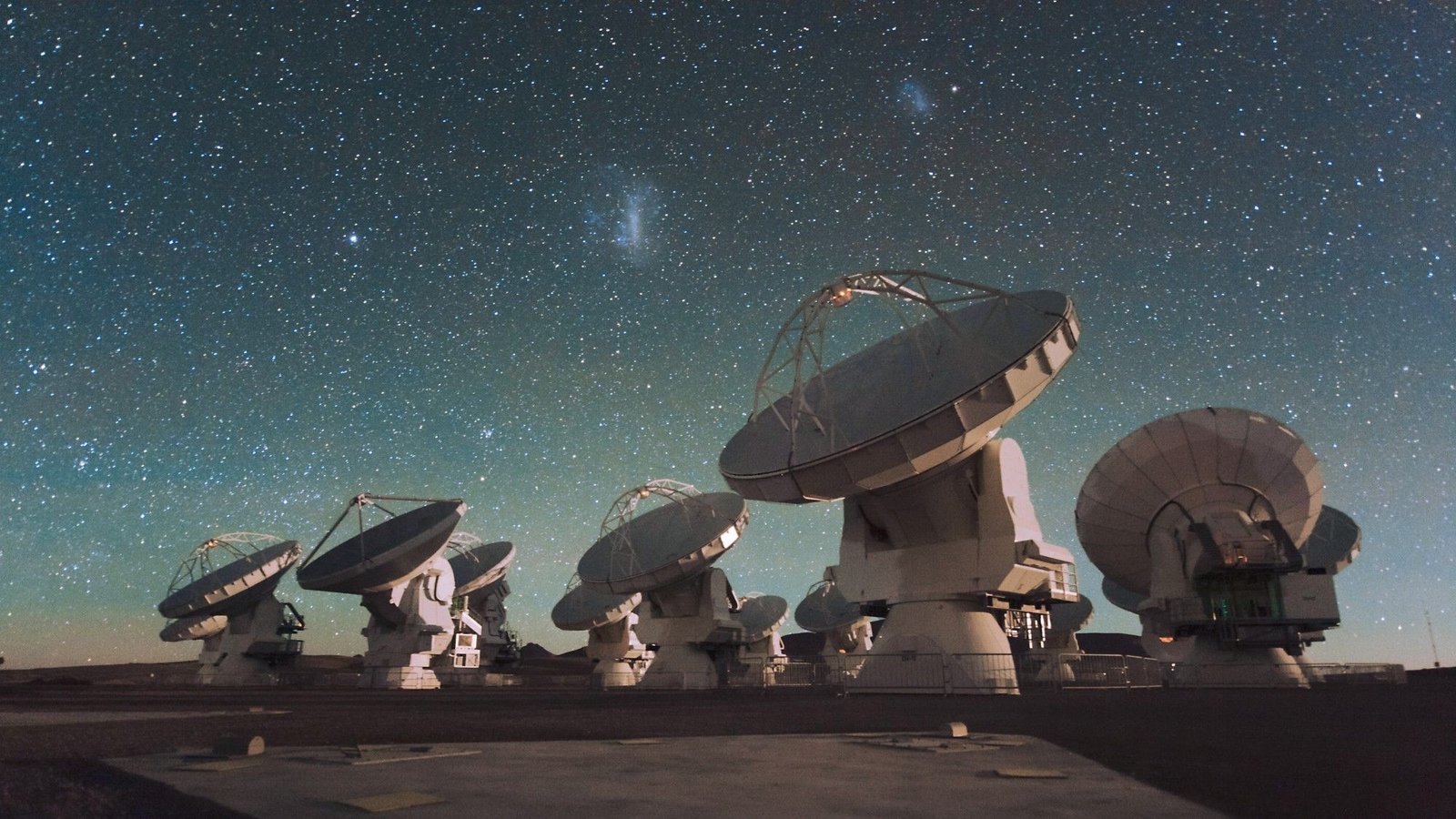
    However, there are many other frequencies that could be looked at, and in that vein Mason has conducted the first ever SETI search with ALMA, the Atacama Large Millimeter/submillimeter Array in Chile.

    a dozen large round radio antenna dishes point upwards into a starry night sky

    Antennas of the Atacama Large Millimeter/submillimeter Array (ALMA) in Chile. (Image credit: ESO/C. Malin)

    “For decades, SETI researchers have concentrated on a relatively small part of the radio spectrum,” said Mason. “We wanted to ask what might happen if we looked somewhere very different.”


    What to read next

    Mason didn’t perform new observations with ALMA, but searched a small amount of archive data for any narrowband signals that could easily have been missed. ALMA operates at shorter radio wavelengths and therefore correspondingly higher frequencies than most regular radio telescopes.

    One of the advantages of looking at higher frequencies is that they suffer less from dispersion, which is when lower frequency waves interacting with electrons in space are delayed and arrive at their destination a little later than higher frequencies, therefore distorting the signal overall.

    Although Mason didn’t come up with any promising new signals in her ALMA search, she remains optimistic about using higher frequencies.

    “The millimeter and submillimeter radio bands remain almost completely unexplored for SETI, so this is really about opening up a new area of parameter space to search,” she said.

    Mason presented her work at the Royal Astronomical Society’s National Astronomy Meeting in Birmingham in July. The research is also described in two papers – one on the ALMA survey, the other on the Besançon Galactic Model, in Monthly Notices of the Royal Astronomical Society.


    Source link

    Author

    • Admin

      NewsPublicly.com is News & Articles Platform that creating SEO-focused articles on travel, lifestyle, and digital trends.

    Admin
    • Website

    NewsPublicly.com is News & Articles Platform that creating SEO-focused articles on travel, lifestyle, and digital trends.

    Related Posts

    Is a $50 used telescope worth it? I bought one to find out!

    August 4, 2026

    Watch the sun in H-alpha with the Sky-Watcher Heliostar 76mm

    August 4, 2026

    CNN dives into how Elon Musk and Jeff Bezos are backing NASA’s race to the moon against China (exclusive clip)

    August 3, 2026
    Leave A Reply Cancel Reply

    Demo
    Top Posts

    The Blue Moon rises on May 30— Where and when to see the second full moon of the month

    May 30, 202640 Views

    New SOCOM rifle allows barrel swapping and cartridge changes

    June 1, 202633 Views

    “Inside Gemini Robotics 1.5: How Robots Learn to Reason & Act

    November 22, 202527 Views

    525 pounds of cocaine seized after Nebraska K9 alerts troopers on I-80

    May 28, 202624 Views
    Don't Miss

    India paves way for return of merchant fees on digital payments

    August 4, 20262 Mins Read0 Views

    NEW DELHI/MUMBAI: India has moved a step closer to reintroducing merchant fees on transactions made…

    Government invites online applications from August 17-31 to get recognised as GATCs

    August 4, 2026

    Trump says US-Iran talks continue, warns Tehran faces 'last chance'

    August 4, 2026

    From Spain to Poland: Where does Ukraine's EU bid have the most support?

    August 4, 2026
    Stay In Touch
    • Facebook
    • Twitter
    • Instagram
    • YouTube
    • LinkedIn
    • WhatsApp

    Subscribe to Updates

    Get the latest creative news from SmartMag about art & design.

    Demo
    NEWSPUBLICLY
    Facebook X (Twitter) Instagram LinkedIn

    Home

    • About Us
    • Leadership
    • Advertise & Partner With Us
    • Pitch Your Story
    • Media Kit & Pricing
    • Career
    • FAQs

    Guidelines

    • Editorial & Submission
    • Partnership
    • Advertising & Sponsor
    • Intellectual Property Policy
    • Community & Comment
    • Security & Data Protection
    • Send Your Opinion

    Quick Links

    • Cookie Policy
    • Payment & Billing Terms
    • Refund & Cancellation
    • Copyright Policy
    • Complaint & Support
    • Sitemap
    • Contact Us

    Subscribe Us

    Get the latest news and updates!

    Copyright © 2026 Newspublicly (DIGITALIX COMMUNICATION). All Rights Reserved.
    • Privacy Policy
    • Terms of Use
    • Disclaimer