

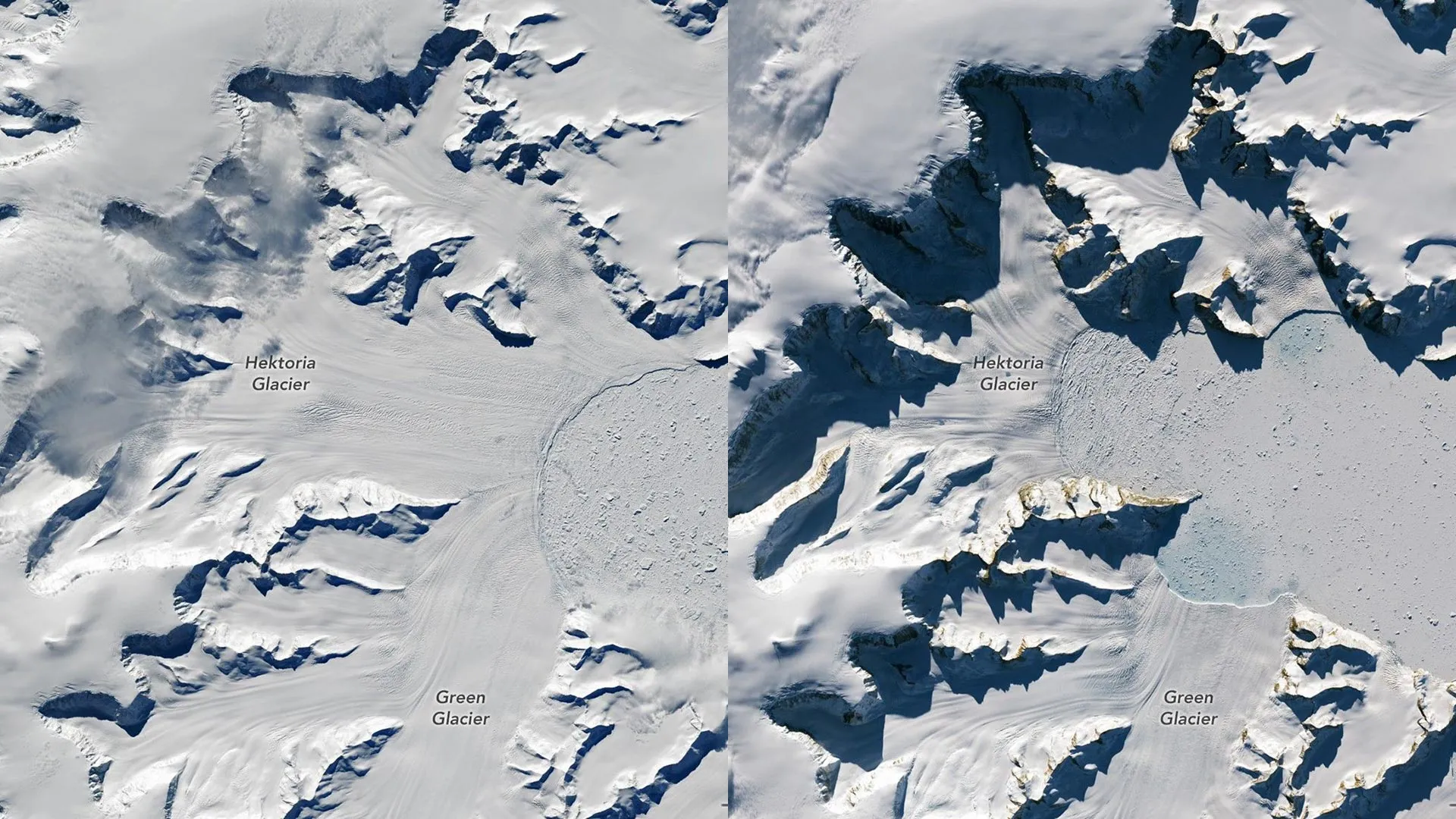
Antarctica’s Hektoria Glacier underwent an astonishing collapse between early 2022 and spring 2023, retreating at a pace rarely seen in modern observations. In just 15 months, the glacier lost roughly 25 kilometers (15 miles) in length. During one especially dramatic two month period, the glacier’s terminus pulled back by more than 8 kilometers (5 miles), marking the fastest retreat of grounded glacial ice ever recorded in modern history.
Scientists recently analyzed the event using multiple types of remote sensing data and concluded that the glacier’s shape and structure played a major role in the rapid collapse. Hektoria Glacier, located on the Antarctic Peninsula, begins on land and extends into the ocean, where its outer section forms a floating mass of ice known as an “ice tongue.” Researchers found that the glacier lost not only this floating ice tongue, but also a large section of grounded ice resting on a flat area of bedrock. That grounded ice loss directly contributes to sea level rise.
Although Hektoria is relatively small compared to some of Antarctica’s massive glaciers, scientists warn that similar processes affecting larger glaciers could have far greater consequences worldwide.
Record Glacier Retreat Captured From Space
Satellite images reveal the enormous scale of ice loss at Hektoria Glacier on the eastern Antarctic Peninsula. The most recent clear Landsat image covering the full area was captured about a year after the dramatic retreat occurred because cloud free imagery from the previous March was unavailable.
According to the study, Hektoria’s terminus remained mostly stable after the sudden retreat, though nearby Green Glacier continued to shrink.
The story behind Hektoria’s collapse actually began more than two decades earlier. In 2002, the Larsen B ice shelf rapidly shattered and collapsed. That ice shelf had acted as a stabilizing barrier for Hektoria and neighboring glaciers. After its disappearance, the glaciers in the region began thinning and retreating over the following years.
By 2011, landfast sea ice in the Larsen B embayment near Hektoria’s terminus had expanded enough to provide temporary support, allowing the glacier to slowly advance once again.
Sea Ice Loss Triggered Rapid Collapse
That stability did not last. In January 2022, the landfast sea ice in the embayment suddenly broke apart, likely due to powerful ocean swells that destabilized the region. Once that support vanished, Hektoria Glacier quickly began changing again.
Over the course of the austral summer, the floating ice tongue steadily broke apart through repeated calving events, leading to a retreat of roughly 16 kilometers.
The glacier temporarily stabilized during the 2022 austral winter. However, satellite laser measurements, including data from NASA’s ICESat-2 (Ice, Cloud, and Land Elevation Satellite-2) mission, showed the glacier was continuing to thin beneath the surface during that time.
Scientists Identify Buoyancy Driven Ice Loss
Researchers later determined that the remaining ice was still grounded during the 2022 austral spring based on earthquakes detected beneath the glacier. Their analysis showed that the ice rested across a broad, relatively flat section of bedrock known as an ice plain.
This type of terrain can allow seawater to move beneath the glacier during high tide, temporarily lifting sections of ice off the ground. When the ice becomes thin enough, large portions can suddenly detach and break away at once.
Scientists believe this process, known as buoyancy-driven calving, triggered the glacier’s second phase of retreat. During that stage, Hektoria lost an additional 8 kilometers in length.
NASA Satellites May Help Track Future Glacier Collapse
“New platforms, such as the NISAR and SWOT satellites developed by NASA and partners, may aid in understanding rapid changes in glaciers.”
Naomi Ochwat, a glaciologist at the University of Innsbruck and lead author of the study, is now examining whether other glaciers may face similar risks. As temperatures continue rising around the Antarctic Peninsula, more glaciers are losing their protective ice tongues and becoming tidewater glaciers, meaning their termini rest directly on the seabed. This glacier type is also common in Alaska and Greenland.
Ochwat and study co author Ted Scambos, a senior research scientist at the University of Colorado Boulder, said new satellite technologies could significantly improve scientists’ understanding of rapid glacier retreat.
The NISAR (NASA-ISRO Synthetic Aperture Radar) satellite, for example, can measure movement across land and ice surfaces with accuracy down to the centimeter. Scambos said its observations will be “very useful for structural evaluations of Hektoria and other glaciers in the region.”
“In addition to NISAR,” Ochwat added, “I’m particularly interested in learning what SWOT can tell us about rapid glacier changes.”
The SWOT (Surface Water and Ocean Topography) satellite was primarily designed to measure detailed changes in Earth’s water surfaces. Scientists are now also exploring how it can be used to study the cryosphere, including ice shelves and sea ice.
Hektoria Glacier May Continue a Slower Retreat
Scientists believe the most dramatic phase of Hektoria Glacier’s collapse may now be over. Future retreat is expected to continue more slowly as the glacier loses mass and elevation.
Scambos said he would not be surprised to see the glacier’s movement continue slowing in the years ahead.
“The glacier has lost so much elevation and mass that it simply can’t continue to maintain the same output,” he said. “It’s on its way to being a fjord, not a glacier.”