

Close Menu

    Subscribe to Updates

    Get the latest news information from worldwide businesses.

    What's Hot

    Retailers’ body flags rise in illicit trade, seeks curbs on e-commerce practices

    June 10, 2026

    SpaceX is launching a historic IPO — but its biggest risk has nothing to do with rockets

    June 10, 2026

    India’s outward FDI commitments fall 49% month-on-month to $4.49 bn in May: RBI data

    June 10, 2026
    Facebook Instagram YouTube LinkedIn X (Twitter)
    Trending
    • Retailers’ body flags rise in illicit trade, seeks curbs on e-commerce practices
    • SpaceX is launching a historic IPO — but its biggest risk has nothing to do with rockets
    • India’s outward FDI commitments fall 49% month-on-month to $4.49 bn in May: RBI data
    • Faithful line streets as Pope Leo to bless Sagrada Família on centenary of Gaudí’s death | Pope Leo XIV
    • German air show opens under shadow of Iran war, fighter project collapse
    • Evening news wrap: Iran ‘reviews’ US negotiations following strikes; MP withdraws proposed two-child rule for government jobs & more | India News
    • Top takeaways from primary elections in Maine and South Carolina and more top headlines
    • IGNOU launches PhD programmes, applications till July 10
    Newspublicly
    • About Us
    • Advertise & Partner with us
    • Pitch Your Story
    • Contact Us
    Facebook Instagram LinkedIn X (Twitter)
    Subscribe
    • Home
    • World News
      • Asia
      • India
      • USA
      • UK & Europe
      • Middle East
    • Economy & Business
      • Global Economy
      • Corporate & Industry
      • Finance & Markets
      • Policy & Trade
    • Technology
      • Gadgets & Devices
      • Software & Apps
      • AI & Machine Learning
      • Robotics & Automation
    • Health & Medicine
      • Fitness & Nutrition
      • Research & Innovation
      • Disease & Treatment
      • Doctors, Clinics & Patient Care
    • Travel & Tourism
    • Automobile
      • Electric & Hybrid Vehicles
      • Auto Industry Insights
    • Sports
    • More
      • Education
      • Real Estate
      • Environment & Climate
      • Space & Astronomy
      • War & Conflicts
    Newspublicly
    Home»More»Space & Astronomy»Annular solar eclipse 2027 —everything you need to know about the ‘ring of fire’ on Feb. 6
    Space & Astronomy

    Annular solar eclipse 2027 —everything you need to know about the ‘ring of fire’ on Feb. 6

    AdminBy AdminJune 10, 2026No Comments6 Mins Read0 Views
    Share
    Facebook Twitter LinkedIn Copy Link WhatsApp


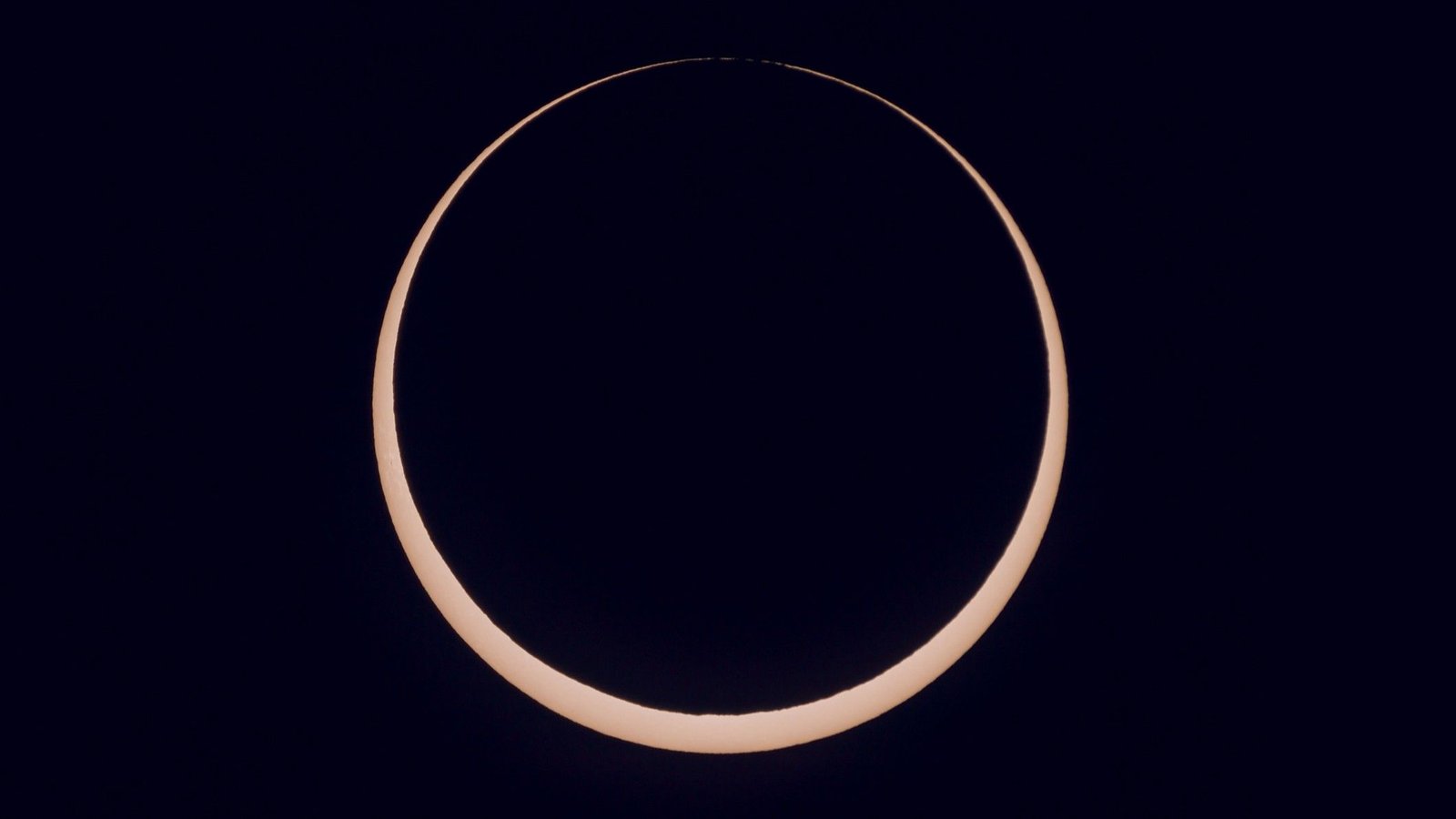
    An annular solar eclipse will occur on Feb. 6, 2027, when the moon’s cone-shaped central shadow will not quite reach Earth. The result will be a ‘ring of fire’ visible to those within a broad path across southern Chile, Argentina and coastal parts of West Africa.

    At the point of greatest eclipse in the Pacific, the moon will cover 93% of the sun’s disk, leaving a relatively large bright ring visible for 7 minutes and 51 seconds. That makes it one of the longest annular solar eclipses this decade.

    During an annular solar eclipse, it is NEVER safe to look directly at the sun without solar eclipse glasses designed for solar viewing. Read our guide on how to observe the sun safely.

    This annular solar eclipse has a long and broad path, rising southwest of Easter Island (Rapa Nui) in the south Pacific Ocean and setting in the Gulf of Guinea, West Africa.

    map showing the path of annularity across South America and the west coast of Africa.

    The global path of the ‘ring of fire’ annular solar eclipse on Feb. 6, 2027. (Image credit: Created and annotated by Jamie Carter using MapHub.net. Source: Esri, Maxar, GeoEye, Earthstar Geographics, CNES/Airbus DS, USDA, USGS, AeroGRID, IGN, and the GIS User Community. Eclipse path from Xavier Jubier.))

    That journey is 9,011 miles (14,501 kilometers), with the path between 180-220 miles (289-355 km) wide. The path of annularity crosses southern parts of Chile, Argentina, Uruguay and (a tiny sliver of) Brazil in South America. After crossing the Atlantic, the northern edge of the path just makes land in the Côte d’Ivoire, Ghana, Togo, Benin and Nigeria.


    You may like

    The Path of Annularity: South America

    Eclipse chasers wanting to observe annularity high in the sky while on land should head to Chile or Argentina, with the latter having a better chance of a clear sky. The path crosses northern Patagonia, a region of wide skies, low population, and — crucially in February — a generally favorable climate.

    Map showing the path of annularity across south america.

    The path of the ‘ring of fire’ annular solar eclipse through South America on Feb. 6, 2027. (Image credit: Created and annotated by Jamie Carter using MapHub.net. Source: Esri, Maxar, GeoEye, Earthstar Geographics, CNES/Airbus DS, USDA, USGS, AeroGRID, IGN, and the GIS User Community. Eclipse path from Xavier Jubier.)

    As it reaches Chile’s Pacific coast, the “ring of fire” will sit around 50° above the northeast, but this region of mountains and fjords is both logistically challenging and likely cloudy. Average February cloud cover along the centerline in Chile is typically around 65%, while just across the mountains in a classic rain-shadow zone in Argentina’s Patagonian plains, cloud cover drops to as low as 30%, according to meteorologist Jay Anderson on Eclipsophile.com.

    Space

    Standout locations in the rain-shadow include El Maitén (which is being favored by eclipse tour groups), Esquel and Trevelin, where annularity occurs just before midday. There’s a similarly small chance of cloud on Argentina’s Atlantic coast, with potential observing locations including Las Grutas on the San Matias Gulf and, south of Buenos Aires, the lush Laguna La Brava.

    Although the path brushes Uruguay (just missing Montevideo), and nicks Brazil (just missing Rio de Janeiro), once the centerline of the path of annularity leaves Argentina, it doesn’t make landfall again.

    The Path of Annularity: Africa

    map showing the path of annularity across west africa

    The path of the ‘ring of fire’ annular solar eclipse in the Gulf of Guinea, West Africa, on Feb. 6, 2027.  (Image credit: Created and annotated by Jamie Carter using MapHub.net. Source: Esri, Maxar, GeoEye, Earthstar Geographics, CNES/Airbus DS, USDA, USGS, AeroGRID, IGN, and the GIS User Community. Eclipse path from Xavier Jubier.)

    After crossing the South Atlantic, the path of annularity makes its final landfall in West Africa, reaching Côte d’Ivoire, Ghana, Togo, Benin and Nigeria.


    What to read next

    Here, the eclipse unfolds late in the day, with the “ring of fire” hanging low in the western sky as it approaches the horizon. At Abidjan, Côte d’Ivoire, the sun will be 7.7° above west-southwest just 30 minutes before sunset, though a potentially orange-golden “ring of fire” will last for just a fleeting moment. Other potential observing locations include Cape of Three Points in Ghana for a long annular phase just six degrees above the horizon, as well as the capital city, Accra, where it’s just four degrees up. Lomé in Togo, Cotonou in Benin and Lagos in Nigeria will see the annular phase moments before sunset.

    Although statistics show cumulus cloud cover in this region to be common, much of it dissipates by late afternoon, according to Anderson, with sea-breeze winds from the Atlantic — as well as “eclipse cooling” — potentially helping. As such, there’s around a 90% chance of a clear sky in this region for a spectacular sunset “ring of fire.” A much bigger problem, however, could come from Saharan dust, with reduced clarity likely.

    Why does the 2027 ‘ring of fire’ last so long?

    deep red solar eclipse with the sun appearing as a thin crescent.

    A ‘ring of fire’ annular solar eclipse close to sunset will be seen from the Gulf of Guinea on Feb. 6, 2027.  This image was captured during an annular eclipse in May 2012, Lubbock, Texas. (Image credit: Willoughby Owen via Getty Images)

    The Feb. 6, 2027 annular solar eclipse is unusually long, with its maximum phase lasting up to 7 minutes 51 seconds just off the coast of Brazil — far longer than most annular eclipses, and significantly longer than the totality phase during a total solar eclipse.

    The reason is geometry. Annular eclipses happen when the moon is near apogee, its farthest point from Earth, making it appear slightly too small to cover the sun. Instead of a brief blackout, the moon takes longer to cross the sun’s face, leaving a bright ring visible throughout. The moon reaches apogee three days before Feb. 6, 2027.

    That duration is extended because Earth is near perihelion in early January, when the sun appears marginally larger than average. A smaller apparent moon and a larger apparent sun combine to lengthen the event.

    Even so, 2027 is not a record-breaker. Under a near-perfect alignment, annularity can theoretically last up to about 12 minutes and 29 seconds. The longest this century occurred on Jan. 15, 2010, when the ring of fire persisted for just over 11 minutes.

    Additional resources

    Want to look further ahead? You can find a concise summary of solar eclipses out to 2030 on NASA’s eclipse website. Read more about solar and lunar eclipses on EclipseWise.com, a website dedicated to predictions of eclipses. See beautiful maps on eclipse cartographer Michael Zeiler’s GreatAmericanEclipse.com and interactive Google Maps on Xavier Jubier’s eclipse website. You can find climate and weather predictions by meteorologist Jay Anderson on eclipsophile.com.

    Bibliography

    Anderson, J. Annular Solar Eclipse February 6, 2027. Retrieved May 5, 2026, from https://eclipsophile.com/ase-2027/

    Bakich, M. and Zeiler, M. (2022). Atlas Of Solar Eclipses 2020-2045.

    Espenak, F. Solar Eclipse Prime Page: Annular Solar Eclipse of 2027 Feb 06. Retrieved May 5, 2026, from: https://eclipsewise.com/oh/ec2027.html#SE2027Feb06A

    Jubier, X. (n.d.). Solar eclipses: Interactive Google Maps. Retrieved May 5, 2026, from http://xjubier.free.fr/en/site_pages/SolarEclipsesGoogleMaps.html

    Time and Date. (n.d.). 17 February 2026 Annular Solar Eclipse. Retrieved May 5, 2026, from https://www.timeanddate.com/eclipse/solar/2026-february-17

    Related: What’s the difference between a total solar eclipse and an annular solar eclipse?


    Source link

    Author

    • Admin

      NewsPublicly.com is News & Articles Platform that creating SEO-focused articles on travel, lifestyle, and digital trends.

    Admin
    • Website

    NewsPublicly.com is News & Articles Platform that creating SEO-focused articles on travel, lifestyle, and digital trends.

    Related Posts

    NASA is building a new space telescope to search for life on nearby planets. What would it have seen on ancient Earth?

    June 10, 2026

    Strange ‘spacetime crystals’ could give birth to tiny black holes

    June 10, 2026

    These record-breaking black hole winds could create a category 79 hurricane on Earth

    June 9, 2026
    Leave A Reply Cancel Reply

    Demo
    Top Posts

    The Blue Moon rises on May 30— Where and when to see the second full moon of the month

    May 30, 202640 Views

    New SOCOM rifle allows barrel swapping and cartridge changes

    June 1, 202632 Views

    “Inside Gemini Robotics 1.5: How Robots Learn to Reason & Act

    November 22, 202525 Views

    525 pounds of cocaine seized after Nebraska K9 alerts troopers on I-80

    May 28, 202624 Views
    Don't Miss

    Retailers’ body flags rise in illicit trade, seeks curbs on e-commerce practices

    June 10, 20263 Mins Read0 Views

    Guwahati, The Federation of Retailers Association of India (FRAI) on Wednesday raised concern over the…

    SpaceX is launching a historic IPO — but its biggest risk has nothing to do with rockets

    June 10, 2026

    India’s outward FDI commitments fall 49% month-on-month to $4.49 bn in May: RBI data

    June 10, 2026

    Faithful line streets as Pope Leo to bless Sagrada Família on centenary of Gaudí’s death | Pope Leo XIV

    June 10, 2026
    Stay In Touch
    • Facebook
    • Twitter
    • Instagram
    • YouTube
    • LinkedIn
    • WhatsApp

    Subscribe to Updates

    Get the latest creative news from SmartMag about art & design.

    Demo
    NEWSPUBLICLY
    Facebook X (Twitter) Instagram LinkedIn

    Home

    • About Us
    • Leadership
    • Advertise & Partner With Us
    • Pitch Your Story
    • Media Kit & Pricing
    • Career
    • FAQs

    Guidelines

    • Editorial & Submission
    • Partnership
    • Advertising & Sponsor
    • Intellectual Property Policy
    • Community & Comment
    • Security & Data Protection
    • Send Your Opinion

    Quick Links

    • Cookie Policy
    • Payment & Billing Terms
    • Refund & Cancellation
    • Copyright Policy
    • Complaint & Support
    • Sitemap
    • Contact Us

    Subscribe Us

    Get the latest news and updates!

    Copyright © 2026 Newspublicly (DIGITALIX COMMUNICATION). All Rights Reserved.
    • Privacy Policy
    • Terms of Use
    • Disclaimer