

- Google is giving Android Auto a full refresh.
- The smartphone mirroring system will now automatically adapt to the shape of the car’s screen.
- This means no more black borders, even on round, trapezoidal, or odd-shaped displays.
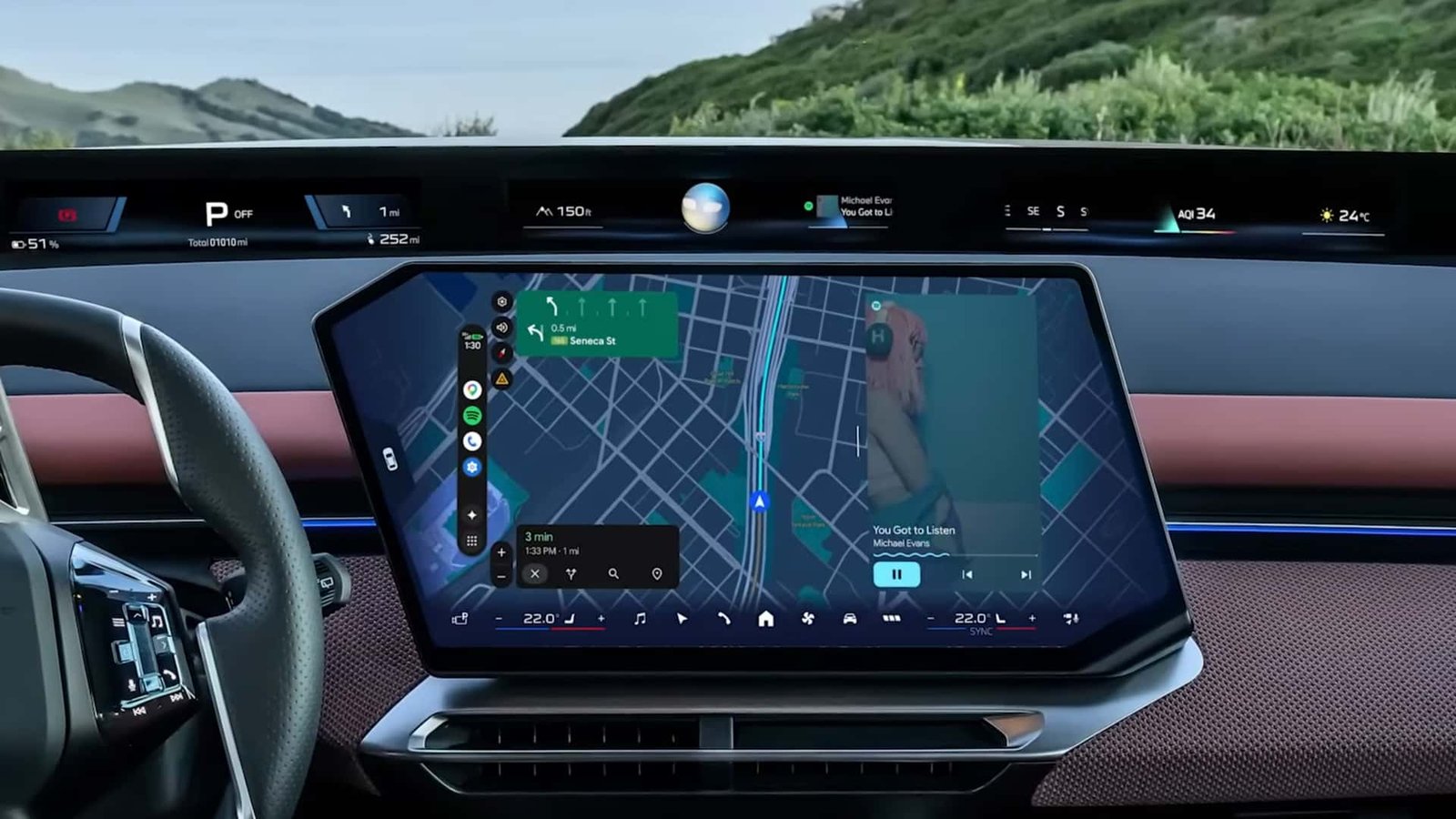
Android Auto, Google’s smartphone mirroring system that competes directly with Apple’s CarPlay, is getting a big overhaul. For the first time since its introduction 11 years ago, Android Auto will fill the entire screen of the car, no matter the display’s shape.
The American tech giant showcased the new auto-adapting feature on a round Mini screen, the irregular display of a Lucid Air, and the BMW iX3’s trapezoidal center touchscreen. On all of them, Google Maps was an edge-to-edge app, while the virtual buttons were constrained in a borderless rectangle.

Widgets can be pinned on top of Google Maps, so drivers can access music, a garage opener, or check out their calendars without having to shuffle through different apps. Depending on the screen size, one or two rows of widgets can be added while still having access to the active navigation.
Speaking of GPS routing, Google Maps’ recent Immersive Navigation update sits at the core of the new user experience, according to Google. The ubiquitous smartphone app now comes with a completely redesigned 3D view that shows buildings, overpasses, and terrain while highlighting critical details in real time—including lanes, traffic lights, and stop signs.
The big Android Auto update also brings high-definition video playback to your car’s main screen, beamed from your smartphone. For the first time in its existence, Android Auto will be able to play back 60 frames-per-second full HD videos in supported cars later this year, starting with models from BMW, Ford, Genesis, Hyundai, Kia, Mahindra, Mercedes-Benz, Renault, Skoda, Tata, and Volvo.

Photo by: Google
Videos from YouTube or other streaming services will only show up on the display while the car is parked. However, the stream will not stop abruptly when you start driving—instead, the video will disappear, but the audio will continue playing, as long as the app supports background audio.
On the acoustic front, Android Auto will get Dolby Atmos support soon, bringing immersive, spatial sound in supported apps and cars, starting with BMW, Genesis, Mahindra, Mercedes-Benz, Renault, Skoda, Tata, and Volvo.
Google’s Gemini AI assistant will be integrated more tightly into Android Auto. Later this year, Android users who have access to Gemini Intelligence will be able to use it to make their lives a little easier on the road. Google claims that Gemini Intelligence understands the current context and can anticipate the user’s needs to act on their behalf.
In practice, this means that if you get a text from a friend asking for an address, Gemini’s Magic Cue feature will understand the context, find the answer in your texts, emails, or calendar, and offer to send a reply with the right answer. Similarly, you could tell Gemini to order your usual meal on Doordash for pickup.