

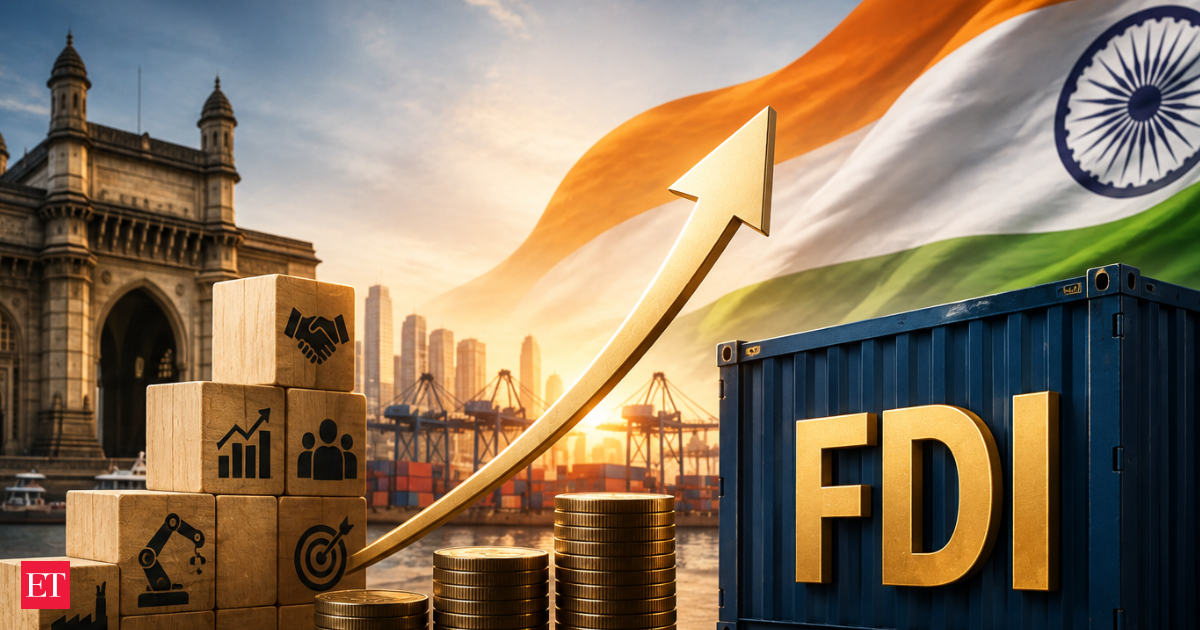
If the government goes ahead with this reported proposal, it would be an ease-of-doing-business measure which will be part of wider effort to attract more foreign capital at a time when policymakers have become increasingly focused on India’s external accounts.
ALSO READ| Govt considering raising CCEA approval threshold for FDI proposals to Rs 15,000 crore: Sources
Over the past few months, the Centre and the Reserve Bank of India (RBI) have launched an unusual mix of initiatives aimed at bringing in dollars. The first phase relied heavily on short-term capital mobilisation through special deposit schemes and overseas borrowing incentives. More recently, the focus has begun to shift towards attracting long-term foreign investment through manufacturing incentives, investment-rule simplification and a review of the legal architecture governing foreign investors.
The emerging strategy reflects a recognition that not all dollars are equal. Policymakers may need quick inflows to ease pressure on the rupee and the balance of payments. But they also need capital that stays for years, builds factories, creates exports and generates future foreign-exchange earnings.

ALSO READ | Govt taps inputs from public sector banks to lure foreign capital
From rupee pressure to a broader external-account concernThe immediate trigger for the recent policy push to attract dollars was a deterioration in India’s external environment. Higher oil prices due to Iran war increased the country’s import bill and at the same time foreign investors became less supportive than they had been in previous years. The rupee came under pressure and the RBI was forced to intervene repeatedly in the foreign-exchange market.
Officially, many of the measures were presented as efforts to attract overseas capital and strengthen external-sector resilience. Yet much of the debate has centred on whether the real concern is the exchange rate or the balance of payments. A weak currency can be managed for some time through intervention. A persistent gap between dollar inflows and outflows is harder to address. Several analysts argue that policymakers are less worried about the rupee itself and more concerned about ensuring that India has sufficient foreign capital to finance imports, investment and growth without eroding reserves.
This is also why comparisons with the 2013 currency turmoil, when forex reserves were much lower and current account deficit was much higher, only go so far. India today has far larger foreign-exchange reserves, a strong services surplus and robust remittance inflows. Few analysts see a crisis. What they see instead is a government trying to get ahead of a potential problem before it becomes more difficult to manage.
Chasing hot dollars
The first response was designed to bring in money quickly. The RBI unveiled a package centred on foreign-currency deposits from non-resident Indians. Banks were encouraged to mobilise dollar deposits through FCNR(B) schemes, supported by a special swap facility from the central bank. The objective was to increase foreign-currency inflows without raising domestic interest rates.
The RBI also introduced incentives aimed at external commercial borrowings. By lowering hedging costs through concessional swap arrangements, it made it more attractive for Indian companies and public-sector entities to raise money overseas.
These measures were never intended to transform India’s investment landscape. Their purpose was to improve liquidity and buy time. That is why many describe them as “hot money” measures. FCNR deposits eventually mature. External borrowings have to be repaid. They provide immediate dollars but do not necessarily create lasting productive assets within the economy.
Supporters of the approach argue that there is nothing wrong with buying time when external conditions are unfavourable. Critics counter that today’s inflows can become tomorrow’s outflows if deeper issues remain unaddressed.
Why policymakers did not choose the conventional route
One notable aspect of the recent response is what policymakers chose not to do. Countries facing currency pressure often rely on higher interest rates to attract foreign capital and defend the exchange rate. India instead opted to mobilise dollars directly.
This reflects the trade-off confronting policymakers. Aggressive monetary tightening can support the currency but may also slow growth, weaken investment and increase borrowing costs.
The government and the RBI appear to have concluded that attracting capital through targeted measures was preferable to imposing a broader economic cost through significantly higher rates. The result has been a strategy focused on increasing dollar supply rather than suppressing domestic demand.
The shift towards sticky money
Over time, however, the discussion within government appears to have moved beyond short-term liquidity. Recent policy signals increasingly point towards what investors often call “sticky money”, long-term foreign capital that is less likely to leave at the first sign of market turbulence unlike FIIs.
The latest proposal to raise the threshold for CCEA approval of FDI projects fits into this category. The current Rs 5,000 crore limit has been in place since 2015. Raising it to Rs 15,000 crore would reduce the number of large projects requiring Cabinet-level scrutiny and could shorten approval timelines. The government is also considering changes to downstream investment rules. One proposal under discussion would exempt certain indirect foreign investments from obtaining fresh approvals if the upstream domestic entity has already secured government clearance. These may appear to be technical reforms but they can go a long way to reduce friction for large investors.
The same logic underlies the ongoing review of India’s bilateral investment treaty framework. Foreign investors have long argued that India’s dispute-resolution architecture is less attractive than that of competing destinations. The government is now examining changes that could make the investment regime more investor-friendly.
Manufacturing-focused incentives form another part of this shift. Recent policy changes aimed at electronics manufacturing and supply-chain investment are intended not merely to bring in capital but to anchor global production networks within India. The objective is to create export capacity and future foreign-exchange earnings rather than simply attract financial flows.
Temporary pressure or structural challenge?
Beneath the policy measures lies a larger argument about the state of the Indian economy. One school of thought sees the recent push as a response to temporary factors. Oil prices rose as clobal uncertainty increased just as capital inflows became more volatile. Under this view, the current package is largely cyclical and may not be needed once external conditions improve.
Another school sees a deeper issue. India’s growth ambitions require vast amounts of investment capital. Competition for global manufacturing investment has intensified. Countries such as Vietnam, Indonesia and Mexico are actively courting multinational companies. From this perspective, the challenge is not simply attracting more dollars this year. It is ensuring that India remains one of the most attractive destinations for foreign capital over the next decade.
That is why discussions around investment treaties, approval mechanisms and regulatory predictability have gained prominence. These are not emergency measures but structural reforms.
Govt wants both hot dollars and sticky capital
The coexistence of short-term and long-term measures is not contradictory. The government needs immediate inflows because external pressures are real. Oil imports still weigh on the economy and currency volatility has to be managed. The balance of payments too has to be financed. At the same time, policymakers recognise that sustainable external strength comes from a different source. Factories, supply chains, export-oriented investment and long-duration foreign capital generate recurring foreign-exchange earnings. They reduce dependence on temporary inflows and strengthen the economy’s ability to withstand future shocks.
In that sense, the recent policy push can be seen as a two-stage strategy. The first stage was about securing dollars quickly. The second is about ensuring those dollars keep coming long after special deposit schemes and borrowing incentives have run their course. The proposal to ease approval requirements for large FDI projects is best understood in that context. It is another sign that after spending months chasing fast money, the government is increasingly focused on attracting money that stays.