

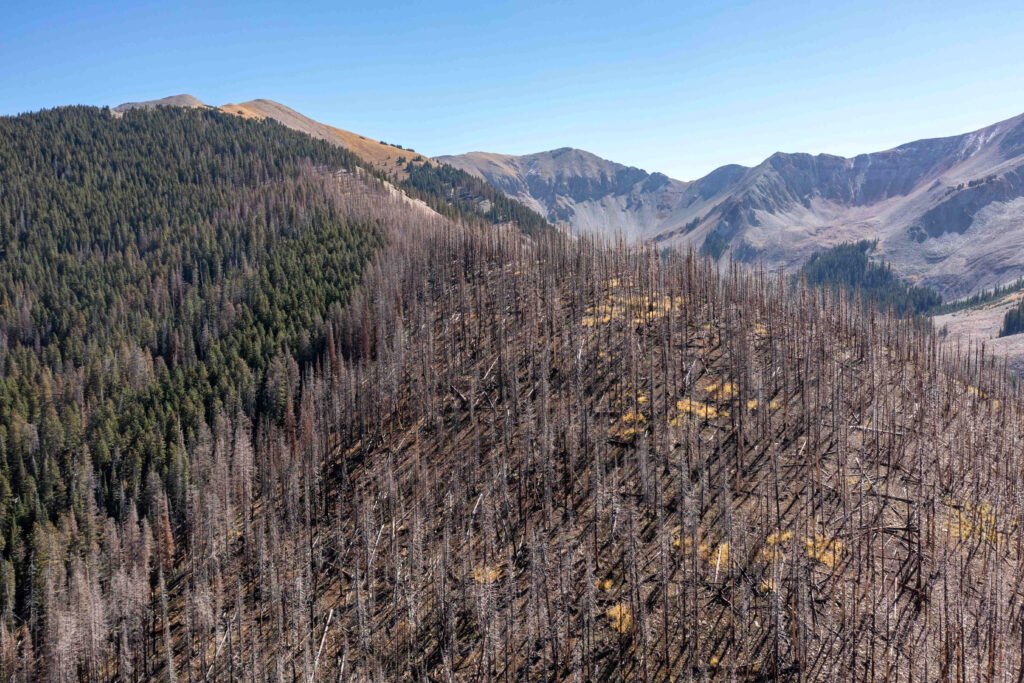
Death casts a shadow over life, not only for people but also other animals, plants and entire ecosystems.
In some ways, the phenomenon is well known. A fallen tree sprouts a plethora of mushrooms while also hosting ants, beetles and the creatures that feast on them.
But a new paper argues that these forces play important yet poorly understood roles in nearly all ecosystems, with the remnants of certain species exerting significant influence long after they die.
The study, published Wednesday in Science Advances, claims to be “the first continental-scale assessment of how live foundation species are influenced by their dead counterparts.”
These “foundation species” generally provide the physical architecture of an ecosystem and tend to be its most abundant organisms—trees, grasses, corals, oysters. The study examined data from 10 ecosystems, ranging from the tropics to subpolar, from montane to marine.
In all but one of those ecosystems, the paper found, the dead remains significantly altered the growth, survival or makeup of living organisms of the same or similar species. In some cases, dead material gave an assist, while in others it posed restraints. Either way, the impacts are far more widespread than previously understood, the authors argue.
“It’s this surprisingly common thread,” said Kai Kopecky, the lead author and a postdoctoral research fellow at the University of Colorado Boulder’s Environmental Data Science Innovation and Impact Lab.
Climate change and human development are driving increased disturbance across the globe, from more frequent and severe heat waves and wildfires to stronger storms. These disturbances are leading to more death, so a deeper understanding of the relationships between the dead and the living could help scientists and others better protect and restore ecosystems as they come under increased pressure, Kopecky said.
“Manipulating the dead remains of foundation species might be this very nature-based way of intervening,” Kopecky said.
Some of the dynamics included in the study are well understood and have already been incorporated into ecosystem management. After dredging, for example, scientists and others will add oyster shells to a damaged reef to promote new growth. Prescribed burns have long been used in tallgrass prairies to burn away dead grass, which inhibits new shoots.
But the authors found similar dynamics at play nearly everywhere they looked. Eastern hemlocks, when left standing after death, help new hemlock seedlings thrive by moderating the microclimates around them. After wildfires in boreal forests, allowing skeletal trees to remain standing translates into higher seed density in the surrounding soil.
Some deaths have the opposite effect. The remnants of branching corals, killed by marine heat waves, accelerated the decline of their remaining relatives. Their skeletal structures, it turned out, host macroalgae that compete with the coral. In salt marshes, dead vegetation damages live grass.
Andrew Dobson, a professor of ecology at Princeton University who was not involved in the study, said that while it is obvious, on one level, that trees and other species alter their environments even in death, he was surprised to learn how long-lasting and pervasive those effects were. He also stressed that the study shows the importance and utility of research now under threat as the Trump administration slashes funding for science.
This story is funded by readers like you.
Our nonprofit newsroom provides award-winning climate coverage free of charge and advertising. We rely on donations from readers like you to keep going. Please donate now to support our work.
The study drew on data collected as part of the National Science Foundation’s Long Term Ecological Research Network, which includes multi-decadal datasets on ecosystems across the United States. The network was in the crosshairs of the Trump administration’s budget-cutting plans last year, The Seattle Times reported, while the administration’s budget request this spring calls for a nearly 60 percent cut to the National Science Foundation’s total research and related activities.
“Understanding how the natural world works is essential to our survival,” Dobson said, adding that the new study’s use of these tools underscores the point.
In some cases, the researchers drew on observational data collected at these sites. In others, the data came from earlier experiments that explored similar questions on the impacts of dead material.
The only ecosystem where the scientists did not find a strong relationship between the dead and the living was a giant kelp forest. Kopecky said one of the main drivers of mortality there are waves, which tend to wash away the remains, leaving little behind to alter new growth.
For Kopecky, the study is part of a broader passion for exploring what he thinks is the sometimes overlooked role of death in ecological systems. This study raised more questions than answers, he said. The remains of species could play different roles over time, for example. While detritus from hurricanes initially inhibits new growth in the tropical forest they studied, it is possible that it eventually helps fertilize new seedlings as it decomposes, serving the opposite effect.
Some of the datasets the researchers drew on spanned decades, while others included just a few years of information. Another uncertainty is whether the dynamics they identified are universal across a given type of ecosystem or vary from place to place.
Ultimately, Kopecky said he’d like to be able to develop a sort of template that scientists could apply broadly, so they might be able to predict the dynamics of any foundation species based on the characteristics of a given ecosystem.
He’s currently seeking funding to expand on the work. “This is probably going to be a more important thing that we should be paying attention to,” Kopecky said, “especially in light of climate change.”
About This Story
Perhaps you noticed: This story, like all the news we publish, is free to read. That’s because Inside Climate News is a 501c3 nonprofit organization. We do not charge a subscription fee, lock our news behind a paywall, or clutter our website with ads. We make our news on climate and the environment freely available to you and anyone who wants it.
That’s not all. We also share our news for free with scores of other media organizations around the country. Many of them can’t afford to do environmental journalism of their own. We’ve built bureaus from coast to coast to report local stories, collaborate with local newsrooms and co-publish articles so that this vital work is shared as widely as possible.
Two of us launched ICN in 2007. Six years later we earned a Pulitzer Prize for National Reporting, and now we run the oldest and largest dedicated climate newsroom in the nation. We tell the story in all its complexity. We hold polluters accountable. We expose environmental injustice. We debunk misinformation. We scrutinize solutions and inspire action.
Donations from readers like you fund every aspect of what we do. If you don’t already, will you support our ongoing work, our reporting on the biggest crisis facing our planet, and help us reach even more readers in more places?
Please take a moment to make a tax-deductible donation. Every one of them makes a difference.
Thank you,

Reporter, New York