

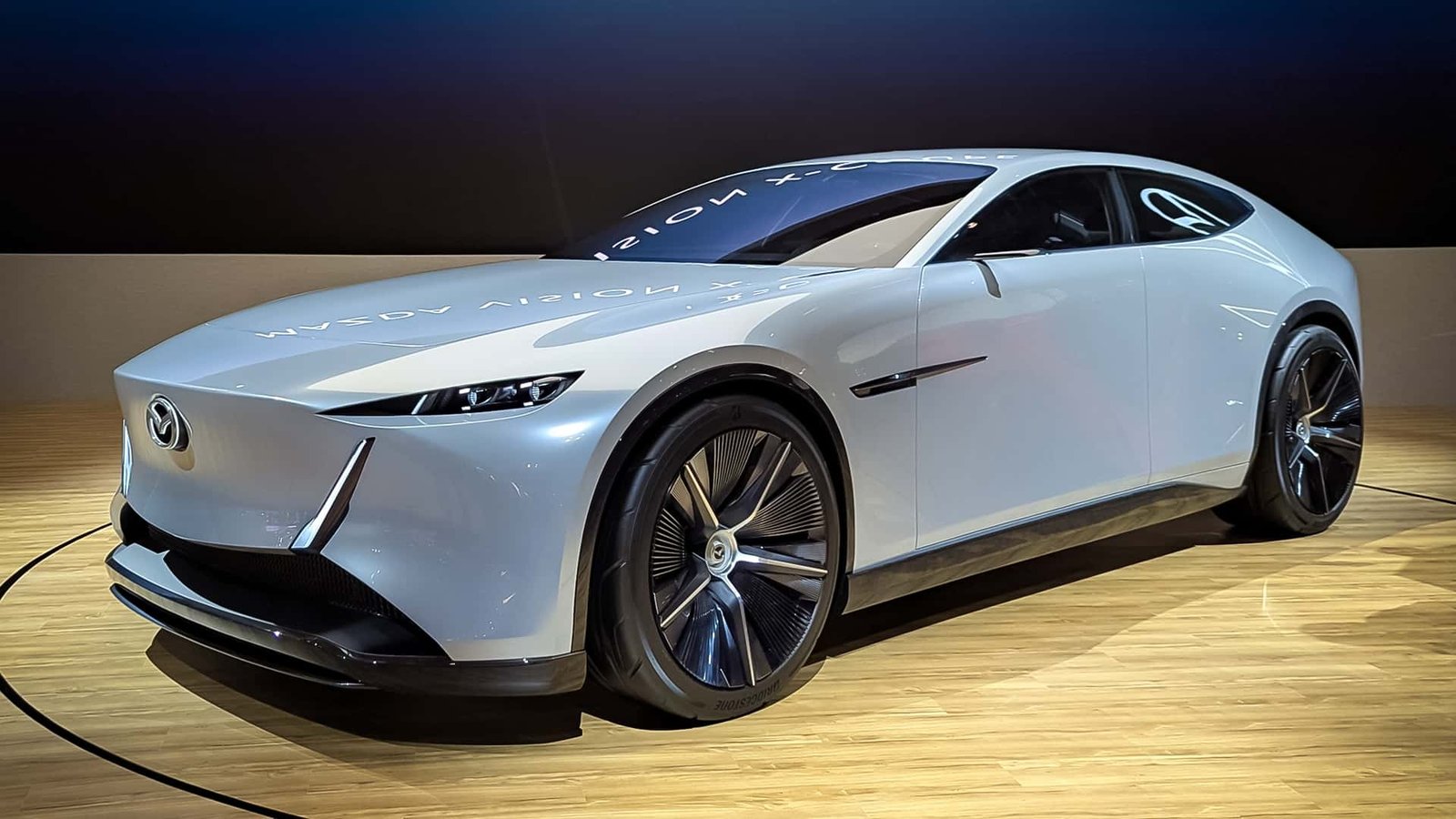
- Mazda was supposed to launch its first long-range EV next year, but it just kicked the can down the road, with the EV now planned for 2029 or later.
- Not only is it delaying the project, but its CEO also admitted that the company had not taken any major steps toward production of the EV before the change of plans.
- Mazda has to balance its need to develop next-gen EVs with a slower-than-expected transition in the U.S. and a much smaller cash pile than its competitors.
In the race to build compelling, affordable, long-range EVs, it would be charitable to describe Mazda as “behind.” It’s more accurate to say the company isn’t really competing. It has launched just one EV in America, the MX-30, which launched in 2021 with specs you’d have expected to see in 2011: 100 miles of EPA range for $35,000. Unsurprisingly, it died in our market within two years.
The company therefore needs a real, long-range EV on a bespoke platform. It was supposed to deliver one in 2027. But, as Automotive News reported first, the company has delayed it another two years, say it will arrive in 2029 at the earliest. Worse still, its CEO admitted that the company wasn’t even close to the start of production when it kicked the can down the road.
“Did we have to impair or write off any facilities? We have not,” Moro said May 12 during an earnings call, per Automotive News. “We made the decision before we started. For battery EVs we were always careful.”

The Mazda MX-30 was a short-lived EV with only 100 miles of EPA range. It’s still the best Mazda has offered in our market.
I’m going to emphasize that: “We made the decision before we started.”
Years after killing its first EV, with the future of the industry at stake, Mazda is so uncommitted to electrification that it had not made a single move that could not be undone for free. Reading between the lines, that likely means there had been no retooling at any factory, no firm supplier contracts, nada. To call it a retreat would be unfair to other automakers reworking their EV investments; they’re retreating, Mazda never advanced.
The company will instead allocate more of its resources toward internal-combustion and hybrid development, with plans to launch a hybrid version of its CX-5 compact crossover. Unlike the CX-50 Hybrid, which uses Toyota technology and a Toyota engine, the CX-5 Hybrid will be an in-house design, which is at least an improvement. More hybrids are planned to follow before the end of this decade.
Mazda will launch a hybrid version of the CX-5 next year. Unlike the CX-50 Hybrid (pictured), which uses Toyota motor and hybrid tech, it’ll use Mazda’s own system.
Photo by: Kevin Williams/InsideEVs
The company now expects to invest just $7.52 billion into electrification by 2030. That’s a fraction of what companies like Ford, General Motors, and even Toyota have invested in EVs. By the same year, Hyundai expects to spend $26 billion on its EV supply chain in the United States alone.
To be sure, Mazda does not have the resources of these companies. It is a much smaller player in the global auto market, with a much smaller war chest. That presents its own challenges. While Ford or Toyota can afford to misallocate some money and catch up later, Mazda has less room for error.
Caution, therefore, makes sense. The company needs to make sure it isn’t wasting money. Yet if your goal is to own the future, being risk-averse and slow is rarely a winning strategy. Surveys repeatedly show that EV customers are satisfied and extremely loyal. And advantages also compound. The more compelling EVs you develop, the more scale you have, and the more experience your team gets with EV design, manufacturing, and support. If a company waits until 2029 or 2030 to learn these hard lessons, they may find that consumers have run out of patience.
The Mazda CX-6e is a great-looking electric crossover. But it’s just a reskinned version of a car developed by a Chinese automaker. A true Mazda-developed EV like this remains a ways off.
Photo by: Mazda
The good news is that Mazda’s EV development lives on in China. The company has already launched some compelling looking EVs in China, with excellent designs and technology developed with the help of local partners. The company’s focus on lightweight design and driving enthusiasm would be a great addition to our EV market, too. To get there, though, the company has to learn how to survive and innovate with a fraction of the capital that its competitors are throwing at the problem.
That isn’t easy work. But as any college freshman could tell you, procrastinating a tough project doesn’t make it any easier. At some point, you have to get started.
Contact the author: Mack.Hogan@insideevs.com