

4 min readNew DelhiUpdated: Aug 21, 2026 11:04 AM IST
The Union Public Service Commission (UPSC) has commenced the Civil Services (Main) Examination 2026, today, on August 21; and is scheduled to be conducted till August 30. In its notice issued during the admit card release, the UPSC has instructed CSE Mains 2026 candidates to carry two recent passport-sized photographs for each session, which may be required along with an undertaking if face authentication fails or there is any discrepancy with the original identity-proof.
Apart from the UPSC admit card, the aspirant is also required also carry black ball-point pens, preferably more than one, for writing the examination.

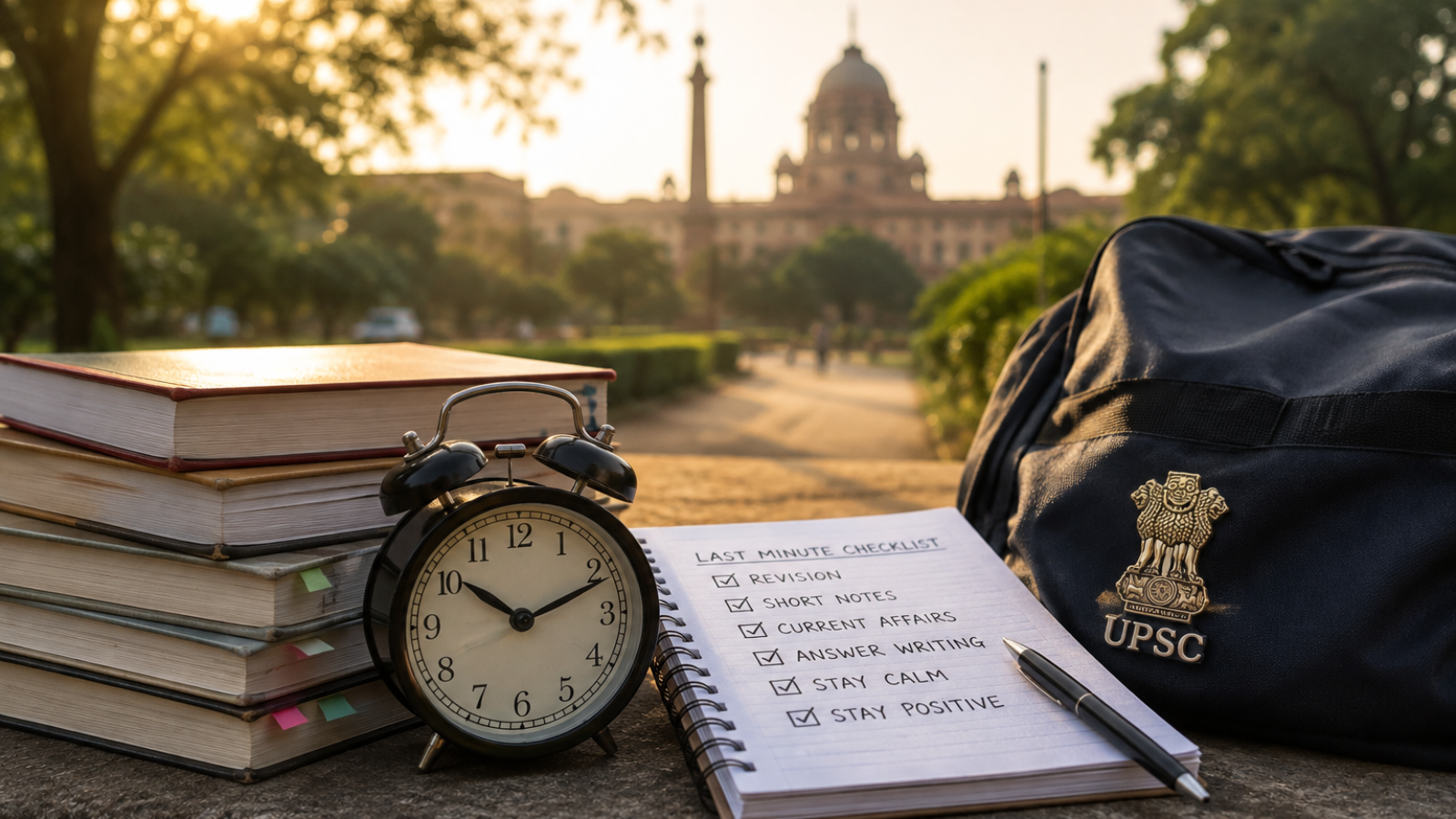
UPSC CSE Mains 2026: What to do on the last day
1. Do not start new topics
The final day is not the time to pick up a new book, source or topic. Candidates should revise material they have already studied, particularly short notes if they have prepared them, important examples, data, constitutional articles, Supreme Court judgments, government schemes and current-affairs linkages.
Also Read | Steps to download UPSC CSE 2026 Main examination admit card
A last-minute revision strategy should focus on making existing knowledge readily accessible rather than trying to expand the syllabus.
2. Revise answer structures, not hundreds of answers
Candidates should quickly revisit the basic structure of an answer — a brief introduction, a logically organised body and a concise conclusion. For questions requiring multiple dimensions, aspirants can use subheadings, bullet points, examples, diagrams and flowcharts where appropriate.
Story continues below this ad
The objective should be clarity and completeness rather than writing elaborate answers.
3. Time management
Candidates should avoid spending excessive time on a single difficult question. A commonly suggested approach by experts is to keep 10-mark answers to around seven minutes and 15-mark answers to around 10-11 minutes.
The priority should be to maintain momentum and ensure that the paper is completed.
4. Revise your strongest examples and data
Rather than memorising new facts or reading new chapters, candidates should revise a small collection of reliable examples that can be used across answers. These could include recent government initiatives, committee recommendations, case studies, constitutional provisions, Supreme Court judgments, international examples and relevant statistics.
Story continues below this ad
These examples can help make otherwise generic answers more specific.
5. Don’t compromise on sleep
A late-night attempt to cover several additional chapters can leave candidates mentally exhausted on the morning of the examination. The last day should include adequate rest, meals and hydration so that concentration is not affected during the paper.
6. Check the admit card and examination-day requirements
Candidates should check their e-Admit Card, examination centre, reporting requirements and other instructions issued by UPSC before leaving for the centre. The Commission’s official CSE 2026 page lists the examination timetable and e-Admit Card.
7. Keep the morning routine simple
Candidates should avoid discussing predicted questions, cut-offs, or the preparation of other aspirants immediately before entering the examination hall. Last-minute comparisons can increase anxiety without improving preparation.
UPSC CSE Mains 2026: Things not allowed in exam hall
— Mobile phones, even if switched off
— Bluetooth devices, earphones, headphones or other communication devices
— Smart watches and other electronic watches/devices
— Calculators, unless specifically permitted for a particular paper
— Electronic gadgets or communication devices of any kind
— Books, notes, study material, loose papers or written material
Story continues below this ad
— Bags and valuables — candidates should avoid bringing unnecessary belongings as examination centres may not have secure storage facilities
— Cameras and other recording devices
Further, candidates should also check for any items prohibited under the instructions printed on the UPSC Mains admit card.