

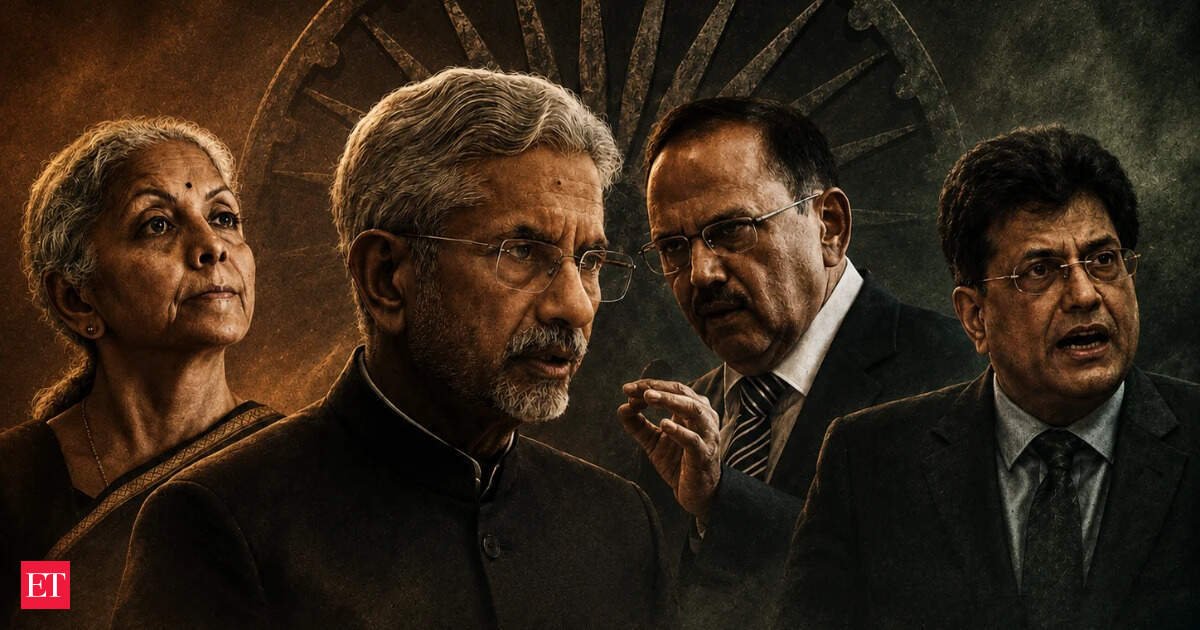
Taken together, the priorities span border management, energy security, investment, technology and manufacturing. Their timing is notable. India will host the BRICS summit in New Delhi on September 12-13, where Russian President Vladimir Putin is confirmed to attend, while Chinese President Xi Jinping is expected to attend.
With China, boundary talks now sit alongside discussions on investment. With Russia, the focus includes energy, fertilisers and a growing trade imbalance. In Japan, Goyal sought investment and manufacturing partnerships, while Sitharaman is meeting investors and financial companies in Canada.
 ET Online
The timing also brings together two tracks that have often been treated separately — India’s security relationships and its economic interests.
China: Border talks now overlap with investment discussions
Doval’s August 24-25 Beijing visit focused on the India-China boundary dispute. At the 25th round of Special Representatives talks, the two sides agreed to continue work on boundary delimitation and management and to use diplomatic and military channels to address situations along the border. India and China also agreed to add meeting points and military hotlines in the eastern and middle sectors.

India also conveyed to China the importance of maintaining peace and tranquillity along the border. The two sides agreed to continue efforts towards a political settlement of the boundary question.
The security discussions are now taking place alongside talks on business and investment.More than $500 million in Chinese-linked investment has already entered India under revised rules, as per an ET report.
Also Read: Before Xi Jinping’s likely India visit, Chinese money is pouring in
India and China are exploring a new framework for business-to-business exchanges and investments, according to an ET report published Thursday. The discussions include ways to accelerate Chinese investment flows and ease approvals for investments in non-strategic sectors.
Beijing could also announce an investment package during Xi’s expected BRICS visit, ET reported. The proposals under discussion include investment in a special economic zone and an export processing zone, but no commitments have been confirmed.
There are also limits to the investment proposals under discussion. Sensitive areas, including projects along the Line of Actual Control and defence, remain outside the scope of such investments, according to people cited by ET Bureau. India is also seeking greater access to Chinese technology and critical raw materials and wants more Chinese imports from India to help address the trade deficit.
Russia: Energy supplies and a widening trade gap
Jaishankar’s August 23-24 Moscow visit has highlighted both energy security and trade.
India-Russia goods trade has risen fourfold in five years, from about $13 billion in 2021-22 to nearly $60 billion in 2025-26, Jaishankar said at the 27th India-Russia Inter-Governmental Commission meeting. But India’s trade deficit with Russia has also widened from $6.6 billion to more than $50 billion.
“Addressing this imbalance is today one of our foremost priorities,” Jaishankar had said.
Also Read: India reaches out to Russia with Modi’s letter to Putin
India and Russia have set a target of taking bilateral trade to $100 billion by 2030. Jaishankar has outlined measures including improving market access and addressing trade barriers as the two sides work towards that target.
New Delhi is now seeking greater access to the Russian market for Indian goods as the two sides work towards the $100 billion target.
Energy and fertilisers remain another part of the relationship. During his meeting with Jaishankar, Putin assured India of uninterrupted supplies of energy and fertilisers amid disruptions caused by the West Asia crisis.
“We are doing everything we can to fully meet the needs of Indian farmers and the agricultural sector, increasing these supplies and standing ready to continue doing so,” Putin was quoted as saying by Russia’s state-run TASS news agency.
Japan: Investment, technology and manufacturing
Goyal’s August 24-27 visit to Japan centred on trade, investment and manufacturing. He led a 200-member business delegation, India’s largest-ever business delegation to Japan, with discussions covering semiconductors, components and manufacturing– elements critical to India’s 2047 mission.
Goyal said India is seeking joint ventures with Japanese companies in pharmaceuticals and shipbuilding. His discussions also covered semiconductors, components, aluminium, paints and coatings, and investment opportunities in sportswear and footwear.
Discussions on semiconductors and components come as India seeks to make it easier for high-technology manufacturers to operate in the country. Goyal has said the government will amend rules to simplify approvals for semiconductor and auto-component manufacturing.
Canada: Wooing investors
Sitharaman’s Canada visit has focused on investment and financial-sector cooperation.
The Finance Minister is on a visit to Canada and the US from August 25 to September 2, where she is meeting global investors and corporate executives and participating in the G20 Finance Ministers and Central Bank Governors meeting.
In Canada, Sitharaman has invited investors to participate in India’s growth story, highlighting the country’s scale, consumption, digital infrastructure and capital markets. She has also pointed to opportunities in fintech, payments and financial services.
On Wednesday, Sitharaman said there were opportunities for collaboration between Indian and Canadian banks, fintech companies and regulators, including in payments and digital financial infrastructure. She also highlighted India’s digital ecosystem and the opening of the insurance sector to 100% foreign direct investment.
Meanwhile, India and Canada are negotiating a Comprehensive Economic Partnership Agreement, with both sides targeting a deal by the end of 2026.
The Canada engagement adds another investment channel to India’s current outreach, with the focus on financial institutions, investors’ capital and economic cooperation rather than the manufacturing-specific agenda seen in Japan.
Ahead of the BRICS summit
The four engagements are different in substance but converge around a common objective. India is seeking investments from different sources, looking to expand manufacturing and exports, and trying to secure access to energy, technology and critical inputs. The nature of each relationship determines what is being discussed and how quickly those discussions can move.
Also Read: Xi Jinping’s Delhi visit could be the big brick in the BRICS summit
The timing of the outreach is significant because India is preparing to host the BRICS summit in New Delhi on September 12-13. Putin will attend, while Xi is expected to visit India for the summit.
Prime Minister Narendra Modi, Putin and Xi held an informal Russia-India-China (RIC) meeting in Tianjin on September 1, 2025, ahead of the Shanghai Cooperation Organisation summit.
The upcoming BRICS Summit will once again bring India’s relationships with China and Russia into the same diplomatic frame, even as New Delhi deepens its engagement with other BRICS members.