

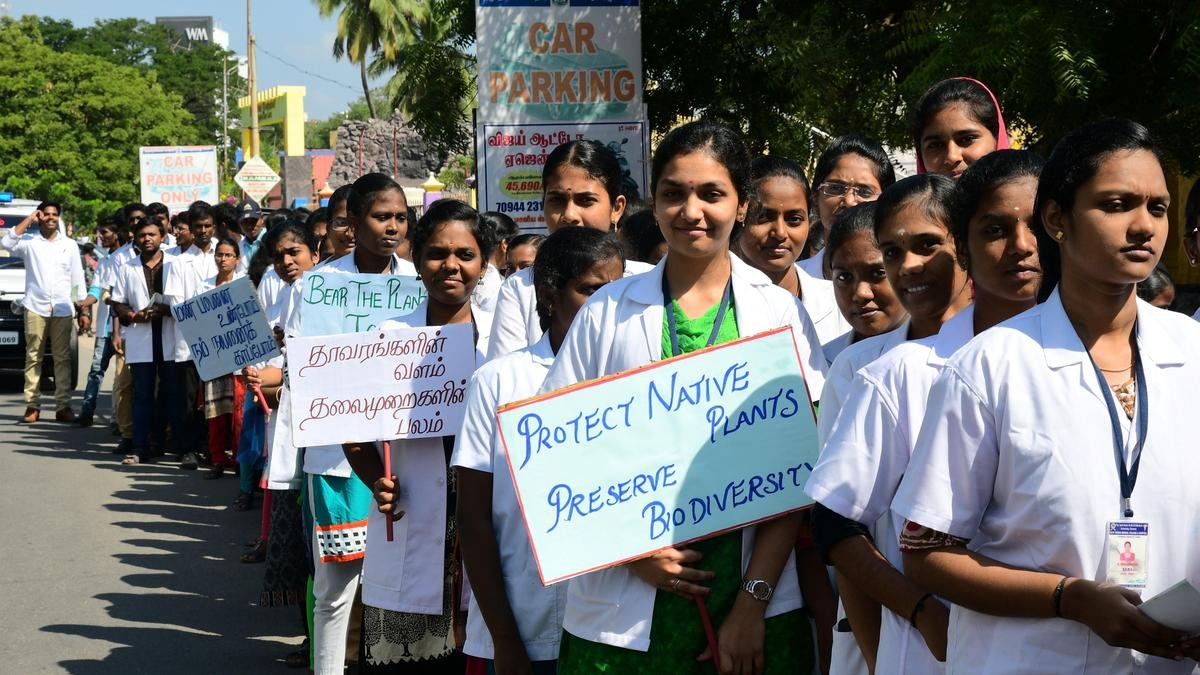

Students of Government Siddha Medical College, Palayamkottai taking out a herbal awareness rally in Tirunelveli district, Tamil Nadu.
| Photo Credit: FILE PHOTO
As the Centre pushes to widen the role of AYUSH in India’s healthcare system — including through greater coverage, rural outreach and integration with mainstream health services — the country’s AYUSH medical education infrastructure has expanded rapidly.
But the expansion appears to have been driven largely by non-government institutions, according to government data.
India must use the AYUSH opportunity
The number of Ayurveda, Yoga and Naturopathy, Unani, Siddha and Homoeopathy (AYUSH) colleges rose from 789 in 2021 to 971 in 2024, an increase of about 23%. Over the same period, total admission capacity grew from 63,477 to 79,593, or nearly 25%, while permitted seats grew from 50,711 to 72,490 — an increase of about 43%.
The 2021 figures cover Ayurveda, Unani, Siddha, Yoga and Naturopathy, Homoeopathy and Sowa-Rigpa. By April 2024, the Ministry registered 541 Ayurveda, 58 Unani, 17 Siddha, 71 Yoga and Naturopathy, 277 Homoeopathy and seven Sowa-Rigpa colleges.
Of the 541 Ayurveda colleges in April 2024, 467 were non-government — nearly 86% of the total. In Homoeopathy, 236 of 277 colleges, or about 85%, were non-government.
The pattern was similar in other systems. Of the 58 Unani colleges, only 16 were government-run; just three of 17 Siddha colleges and 15 of 71 Yoga and Naturopathy colleges were government institutions. Data clearly indicates that non-government institutions have become an important source of undergraduate medical education in AYUSH.
Additionally, the Ministry’s annual report for 2024-25 shows that 60,890 students were admitted against 63,073 permitted undergraduate seats in Ayurveda, Siddha, Unani, and Homoeopathy (ASU&H).
Ayurveda had almost full utilisation, with 39,952 of 40,136 permitted seats filled, Homoeopathy accounted for 1,887 vacancies — more than 86% of the total. The Ministry has also begun collecting admission data from State and Union Territory counselling authorities, improving the availability of national-level vacancy data.
Spending rises from a low base
Central spending under AYURGYAN, the Centre’s scheme supporting AYUSH education, capacity building, continuing medical education, research and innovation, has also increased.
The allocation rose from ₹8.42 crore in 2021-22 to ₹10.5 crore in 2022-23, ₹14.66 crore in 2023-24 and ₹48.5 crore in 2024-25, according to Ministry data placed before Parliament.
This, however, is not an education-only budget as AYURGYAN also supports capacity building and continuing medical education, research, and innovation; from 2023-24, it includes Ayurveda Biology Integrated Health Research.
Published – August 27, 2026 05:56 pm IST