


4 min readNew DelhiUpdated: Aug 23, 2026 10:10 AM IST
An estimated 8.7 crore Indians aged 15 to 29 were not studying, working or undergoing training in 2021, according to NITI Aayog’s report ‘Reimagining Skilling for Viksit Bharat@2047’. The figure points to a large section of young people who are not making a direct transition from education to employment or skill development.
The report, based on data from the 78th round of the National Sample Survey, identifies this group as NEET youth — those not in education, employment or training, including unemployed people. NITI Aayog said this group, along with women, needs affordable or subsidised training and financial support, while skilling programmes should be linked to local demand, self-employment opportunities and emerging sectors.

READ | Don’t replace NTA: Ex-UGC head suggests 3 key changes to improve exam security
One of the concerns highlighted by the report is the weak link between formal education and employment. Only 8.25 per cent of graduates are employed in roles aligned with their qualifications, it said. Limited practical exposure and industry-aligned training continue to affect employability even among formally educated young people.
The report said students from low-income households often cannot afford additional paid skilling alongside college expenses and private tuition. After graduation, some take up whatever work provides a stable income, even when it is low-paying, while others struggle to enter the workforce and become NEET.
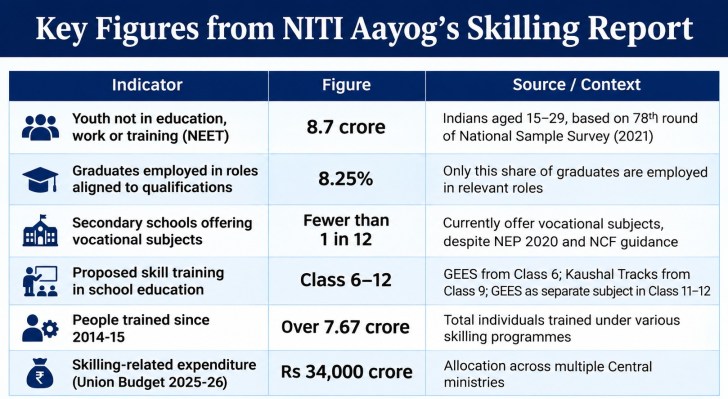
NITI Aayog has therefore proposed moving skilling further into the school system rather than treating it as an option after formal education. It suggested universal General Employability and Entrepreneurship Skills from Class 6 to Class 12, along with structured vocational pathways, or Kaushal Tracks, from Class 9. The tracks would provide deeper vocational specialisation based on local and national demand.
The report noted that fewer than one in 12 secondary schools currently offer vocational subjects, despite the National Education Policy 2020 and National Curriculum Framework providing for greater integration of vocational education and employability skills from Class 6.
Story continues below this ad
For Classes 10 and 12, NITI Aayog has suggested including vocational subjects in the board subject scheme with equal weightage and allowing state boards to accept the revised scheme for certification. It has also proposed continuing General Employability and Entrepreneurship Skills as a separate subject for students in Classes 11 and 12.
The recommendations extend beyond schools. For higher education, the report called for a shift from generic degrees towards applied, industry-aligned specialisations, along with greater use of apprenticeships and work-integrated degree and diploma programmes. It also proposed flexible, modular and earn-while-you-learn options.
Apprenticeships have been identified as another missing link between education and employment. While schemes such as the National Apprenticeship Promotion Scheme and National Apprenticeship Training Scheme have expanded access, NITI Aayog said participation remains uneven and opportunities are fragmented. It suggested expanding apprenticeship opportunities through incentives for MSMEs and creating a unified platform to make credible opportunities easier to find.
The report also called for greater focus on sectors expected to generate demand, including green industries and electric vehicles, while providing reskilling for workers in declining occupations. It said training should increasingly be linked to measurable employment outcomes rather than participation alone.
Story continues below this ad
NITI Aayog said more than 7.67 crore people have been trained since 2014-15. The Union Budget for 2025-26 allocated Rs 34,000 crore towards skilling-related expenditure across multiple Central ministries. However, the report said outcomes remain uneven, suggesting that increasing spending and training numbers alone may not be enough without stronger links between education, skills and actual employment.