

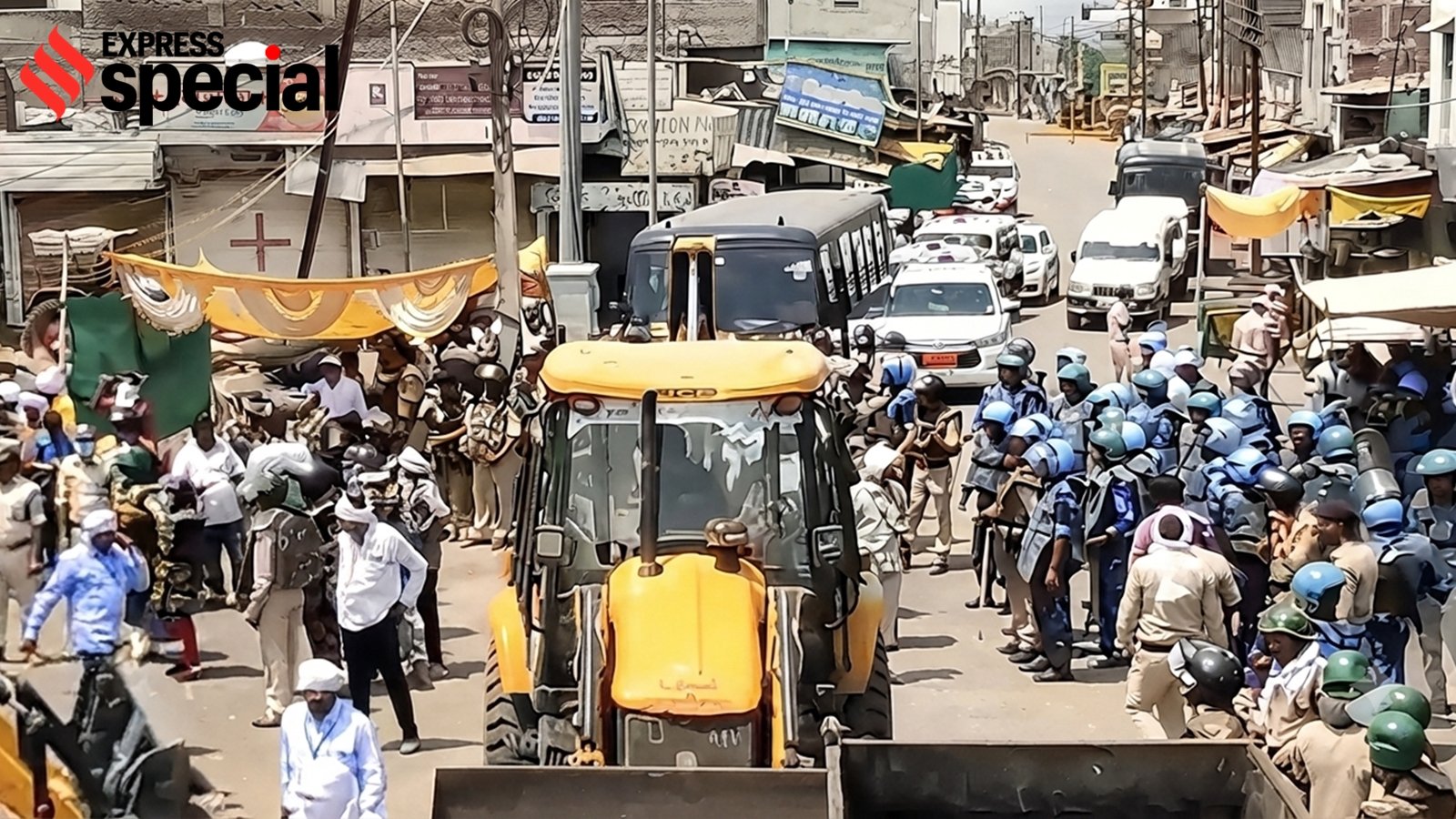
In the wake of the clashes, the administration razed 16 houses in the affected localities, linking these to irregularities, and 65 cases were registered. Then Chief Minister Shivraj Chouhan vowed, “There is no place for rioters on the soil of Madhya Pradesh… They will not be released. Strictest action will be taken against them.”
Four years later, the cases are collapsing one by one, or are stuck without headway, an investigation into court records by The Indian Express reveals.
The only three riot cases to complete trial have all ended in acquittal, including the one in which the order came on July 27. As per the Khargone police, four cases have been closed for want of evidence after police failed to trace the accused, while 38 FIRs remain under investigation, with police yet to find roughly 85 accused in them.
Twenty cases are at the stage of submission of evidence by the prosecution, with witnesses being examined.
In the cases leading to acquittal in Sessions Courts, three different judges pointed to the prosecution’s failure to prove who committed the crimes, questioned how the accused came to be implicated, and noted that the forensic evidence itself contradicted claims of the use of petrol bombs.
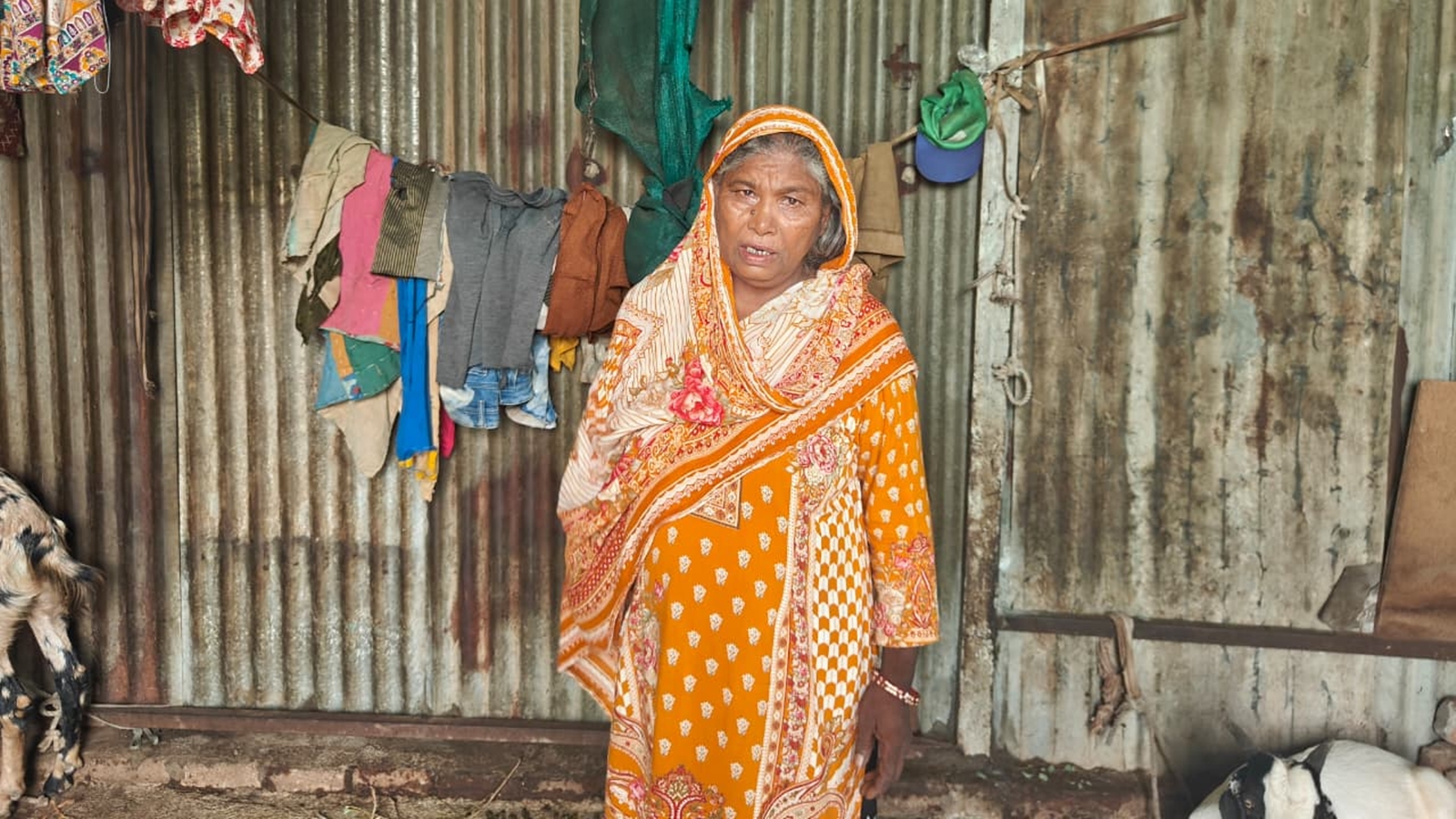 Hasina Fakhroo’s house built under PMAY (Urban) was demolished. (Express photo by Anand Mohan J)
Asked whether the government will appeal against the acquittals or not, the prosecution department said they will first review the judgment.
Hostile witnesses, probe gaps
1. June 13, 2025
Story continues below this ad
The first case to see acquittals, on June 13, 2025, dealt with the burning down of an ancestral house belonging to Mahesh and Vijayalakshmi Mahajan in Khargone’s Bhatwadi Mohalla. The prosecution’s case was that Soaib, Wasim, Salim Khan (now deceased), and a juvenile had conspired and set alight the house using a petrol bomb, with the family putting its losses at Rs 90,000.
Fourteen witnesses were examined. None admitted to seeing the accused start the fire. Mahesh Mahajan described learning of the blaze second-hand; Vijayalakshmi said she had been at her parents’ home in Manawar at the time; other witnesses said they had learned of the fire only after being told riots had broken out.
The court of Sixth Additional Sessions Judge Kailash Prasad Marekam noted that “none of these witnesses made any statement before the court that the accused had participated in the riots or committed the incident”.
The judgment’s sharpest findings concerned the investigation itself. The investigating officer, Sub-Inspector Shankutala Dudwe, told the court the accused had been arrested on the “basis of the available evidence”. The judge asked what that evidence was, given that the FIR itself recorded the accused as unknown persons at the time it was lodged.
Story continues below this ad
The judgment added that the investigating officer “has nowhere disclosed in her examination-in-chief how the number of accused increased from one unknown accused”, and that “there is no evidence on record as to when, where, or how a criminal conspiracy was formed”.
The electronic evidence fared no better. A pen drive said to contain footage of the arson was seized but never played before the court. The judge held that the prosecution could “derive no benefit from the pen drive”, and added that even if it had been played, it would “not have advanced the prosecution’s case”, since Mahesh, who had produced the pen drive, made no statement about it in his testimony and – after being declared hostile – denied identifying any accused from the footage.
No certificate under Section 65B of the Indian Evidence Act, which deals with the admissibility of electronic records as evidence, was produced to authenticate the recording, and the prosecution offered no evidence that the pen drive had ever been played on a police computer or that anyone had identified the accused in it.
A set of photographs fared similarly. While a Section 65B certificate was submitted by a woman named Vaishnavi for the photographs, the prosecution didn’t call her as a witness. The judge also noted that crucial details about the device used to take the photographs, such as a mobile phone number, were missing.
Story continues below this ad
The forensic findings undercut the arson theory directly. Investigators sent three exhibits to the Sagar laboratory – a glass bottle, burnt wooden remnants from the house and a burnt iron gas stove. The FSL report, quoted in the judgment, found that “no residues of inflammable petroleum hydrocarbons (petrol/diesel/kerosene oil) were detected in any of the articles”.
2. October 14, 2025
The second acquittal came in the attack on the family of Mehroon B in Khargone’s Anand Nagar locality. The prosecution’s case was that at around 11 pm on April 10, 2022, Mehroon and her family were asleep when stones were thrown at their house. Mehroon said she saw 10-11 attackers. One of the intruders, identified during the investigation as Kapil alias Golu Verma, allegedly lunged at her with a sword, leaving her with cuts. Her daughter Zubaida was allegedly struck by a stone.
Police treated the case as an attempt to murder, recovered two stones and a sword measuring roughly 2 ft 10 inches, and charged three men – Kapil Verma, Sonu Verma and Sachin Verma. The Arms Act was added later due to the sword.
Ten prosecution witnesses were examined during the trial before Third Additional Sessions Judge Rajkumar Yadav. All of them, including Mehroon, said they could not identify the accused.
Story continues below this ad
A panch witness, Mehraj, who had signed the seizure and damage memos, also turned hostile, telling the court he had no knowledge of the incident and did not know what he had signed.
Judge Yadav’s order, on October 14, 2025, rested on settled principles of criminal evidence, particularly the “fundamental” one “that the prosecution must prove the offence against the accused beyond reasonable doubt”, and that conviction “cannot be recorded on the basis of suspicious evidence or merely because of the gravity of the offence”.
The Sessions Court invoked the gap between “may be true” and “must be true”, and found that the prosecution had failed to prove the trespass, attempted murder, assault on Zubaida or the property damage.
3. July 27, 2026
This third case was the largest of the three, acquitting 11 men – Ibadat, Sadiq, Abdullah, Saheb alias Shahib, Sheryar, Faizal, Azam, Shabbir, Imran, Mustaq and Rajik – of rioting, arson, house trespass and Explosive Substances Act charges.
Story continues below this ad
The prosecution’s case was that between 6 pm and 9 pm on April 10, 2022, mobs armed with stones, swords and petrol bombs attacked houses in Bhatwadi, setting homes and motorcycles alight.
Eleven eyewitnesses were examined during the trial. Eight of them, including complainants and injured victims, did not support the prosecution’s account. The judgment by Fourth Additional Sessions Judge Mukesh Nath, on July 27, 2026, recorded that “none of these eight witnesses identified any of the accused…; no substantive evidence emerged in their testimonies against any accused”. After they were declared hostile, “the prosecution derived no benefit”, the court said, concluding that “the involvement of the accused persons in the offence is neither disclosed nor proved in any manner”.
Vaishnavi Jain was the only witness who claimed to identify all the 11 accused. But her testimony did not survive scrutiny as her own father, Dinesh Jain, and her brother, Akash Jain, told the court that the rioters had “their faces covered with cloth”.
While Akash said he saw four-five people but could not identify them because of their faces being covered, Dinesh said he watched the mob from 500 to 600 metres away, had no prior acquaintance with them, and so could not be sure who the accused were.
Story continues below this ad
The judge called it “not natural, satisfactory, or reliable” that a witness could identify individuals from behind at that distance, particularly once he had accepted the rioters’ faces were covered.
There were also unexplained gaps in the investigation. Vaishnavi’s name did not appear as an eyewitness in either the written complaint or the FIR, both of which were lodged two days after the riots – a delay the court said had “no explanation”. Her statement was recorded 51 days after the incident. The FIR itself named only six of the 11 accused eventually put on trial; the other five were added later, with the judgment finding no explanation on record for how or why.
The Sagar laboratory’s report did not help the police case either, after it found “no residues of inflammable petroleum hydrocarbons (petrol/diesel/kerosene)” in the seized bottle fragments and burnt material.
The prosecution’s task
Inspector B L Mandloi of the Khargone Kotwali Police Station has been supervising the riot cases, with a team of 10 officers, taking over from an SIT that was disbanded after the initial investigation.
Story continues below this ad
On why around 85 accused still remain “absconding”, Mandloi says: “We are facing difficulty as the accused names are generic, without any father’s name or address. Incidents happened at 13 spots and we can’t blindly implicate people. We have to match faces with the CCTV footage and CDR (Call Detail Record) details.”
On the slow pace of the trials, Mandloi says: “In at least 23 cases, reports are still awaited from the State Forensic Science Laboratory in Sagar. We are trying to expedite that.”
Khargone Superintendent of Police Ravindra Verma says they are trying their best to speed up trials. “I am taking stock and trying to track down the accused in all the cases.”
In the Khargone District Court, where the cases are being heard, two special public prosecutors have been handling the complaints.
One of the two, refusing to be named, says: “The witnesses turned hostile since they all live in the same locality and now want to move on with their lives.” Even if they provide protection to some witnesses, it is impossible to do so for “hundreds of people”, he says.
An Assistant District Prosecution Officer (ADPO) associated with the riots cases says he and others are tracking cases in the Chief Judicial Magistrate Court, where the chargesheets are supposed to be filed. “In at least 15 cases I am tracking, the accused are yet to be caught, all the residents have fled. These cases are under threat of having closure reports filed.”
Another ADPO attached with a Sessions Court says: “We don’t even have proper chambers or offices where we can call a witness before the trial and explain their statements to them. They fail to properly depose and make material contradictions. In at least two-three cases that I am tracking, the accused failed to recollect their statements.”
The witnesses can hardly be faulted, the ADPO adds. “We can’t expect them to have no contact with the case for four years and then recollect minute details of violence which took place one night.”
Life halted, lives go on
The case in which 11 men were acquitted on July 27 was one of the first criminal cases lodged in the violence. The 11 spent between 462 and 827 days in jail before securing bail.
Most of them school dropouts, they have returned to similar occupations that they held before their arrest – repairing motorcycles, selling vegetables, driving handcarts or working as daily-wage labourers. What has changed are mounting loans, and growing difficulties to make ends meet.
But it’s festivals which are the hardest, say the families. “Whenever we hear drums, everyone leaves to stay with relatives. Those sounds remind us of the night everything changed,” says a relative of a 27-year-old accused.
The oldest among the accused, now in his seventies, has been mentally distressed since his imprisonment, his family members say. “His bail was rejected three times and he could not believe what was happening to him,” says a relative.
During the time a 42-year-old was in jail, his four children had to drop out of school as the family could not afford the fees. A relative says they also depended on help from neighbours.
The three children of a motorcycle mechanic moved school because they could not afford the expenses at the previous one.
Another accused, then 22, was picked up soon after he had returned from his shift as a municipal sanitation worker. A family member says: “His father was seriously ill. The family exhausted savings of about Rs 50,000. He died before his son returned home.”
One of the accused was 23 when the riots broke out, and his wife gave birth to their son while he was in jail. He is back selling vegetables from a cart to support the family.
Relatives of another accused say he fractured his arm while being taken into custody, and was put in a barrack with around 70 inmates. “He would cry whenever we met him,” a family member says. “There wasn’t enough space to sleep properly.”