

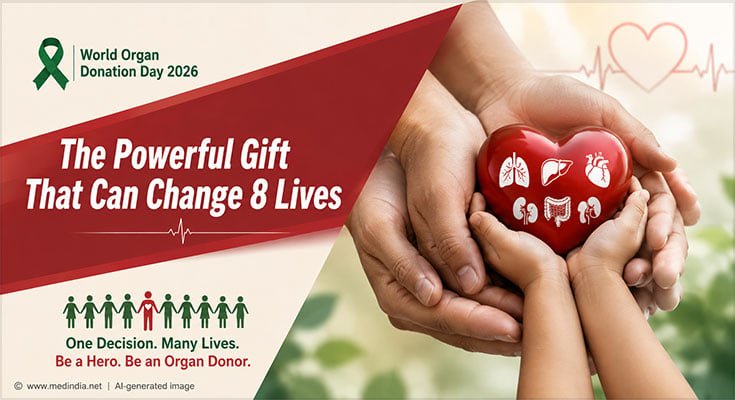
One organ donor can save up to eight lives. World Organ Donation Day 2026 highlights how one decision can give multiple patients a second chance.

- One donor can potentially save up to eight lives through organ donation
- Kidneys account for the largest share of transplants, but patients also need hearts, livers, and other organs
- A donor pledge matters most when family members know about the decision and understand the person’s wishes
Organ donation is one of the simplest ways a single person can change the fate of many families. A healthy organ from one donor can give someone with end-stage
World Organ Donation Day is observed every year on August 13, and it exists to remind everyone, everywhere, of this fact. In India, the same message is carried forward through National Organ Donation Day and year-round pledge drives run by hospitals and health authorities (1✔ ✔Trusted Source
World Organ Donation Day 2026: How Organ Donation Saves Lives
).
Even with rising awareness, the demand for organs is far bigger than the supply almost everywhere in the world.
According to the World Health Organization (WHO),
World Organ Donation Day 2026: How Organ Donation Saves Lives
Go to source)(2✔ ✔Trusted Source
Transplantation
This gap is what pushes patients onto long waiting lists across the globe, and sadly, tens of thousands do not survive the wait every year.
Advertisement
What Is Organ Donation, and Who Can Become a Donor?
Organ donation is the process of taking a healthy organ or tissue from one person and transplanting it into someone whose own organ has failed. It can happen in a few different ways.
- Living donation: A healthy person can donate a kidney or part of the liver, lung, pancreas, or intestine while they are alive.
- Deceased donation: Organs are retrieved after brain death or circulatory death, once the family gives consent or the person had already pledged.
- Tissue donation: Corneas, skin, bone, and heart valves can be donated after death and stored in tissue banks.
- Pediatric donation: Children can be both donors and recipients, matched carefully by age and body size.
Most adults can register as donors regardless of blood type or medical history, and there is no fixed upper age limit. Doctors decide final eligibility only at the time of donation, and having a condition like diabetes or high blood pressure does not automatically rule someone out.
Advertisement
Why Does a Single Organ Donor Matter So Much?
One deceased donor can save up to eight lives by donating the heart, lungs, liver, kidneys, pancreas, and intestines (3✔ ✔Trusted Source
Organ Donation Statistics
).
Tissue donation from that same donor, including corneas, skin, and bone, can go on to improve the lives of more than 75 additional people.
The impact goes beyond any single donor too.
According to the recent report, one recent analysis projected that scaling up kidney transplantation alone could prevent between 290,000 and 1,000,000 deaths linked to chronic kidney disease (4✔ ✔Trusted Source
Organ Donation and Transplantation Worldwide: The Global Observatory on Donation and Transplantation 2024 Report
The World Health Assembly now formally recognizes transplantation as an essential tool for cutting premature deaths from non-communicable diseases, one of the United Nations’ global health targets.
This multiplying effect is exactly why World Organ Donation Day exists. A single pledge does not just help one family. It can ripple outward to dozens of others who are waiting for a second chance, wherever in the world they happen to live.
Advertisement
Which Organs and Tissues Can You Actually Donate?
People are often surprised by how many organs and tissues can be donated, both during life and after death (5✔ ✔Trusted Source
What Can Be Donated
).
| Category | What Can Be Donated |
|---|---|
| While alive | One kidney, one lung, a part of the liver, a part of the pancreas, a part of the intestine |
| After death (organs) | Both kidneys, liver, both lungs, heart, pancreas, intestines, hands and face |
| After death (tissues) | Corneas, skin, heart valves, bone, veins, cartilage, tendons, ligaments |
| Other | Blood stem cells, cord blood, bone marrow, blood, and platelets |
Corneal donation deserves a special mention. Over 85,000 corneal transplants were performed in a single year in the US, and more than 97 percent of them successfully restored the recipient’s vision.
Unlike organs, corneas do not need to be matched to the recipient, so age, eye colour, or eyesight quality do not matter.
How Big Is the Need for Organ Donation Around the World?
Organ donation can give people with organ failure a second chance at life, but the need for donated organs remains much greater than the supply.
Data from the Global Observatory on Donation and Transplantation (GODT) show that kidneys account for the largest share of transplants, while both deceased and living donors remain essential to meeting this need.
The Global Organ Donation Picture
| Key Indicator | What The Numbers Show | Why It Matters |
|---|---|---|
| Organ transplants worldwide | More than 170,000 annually | Thousands of people receive a potentially life-saving transplant each year |
| Kidney transplants | More than 110,000 annually | Kidneys are by far the most commonly transplanted organs |
| Deceased donors | More than 47,000 annually | Deceased donation provides the majority of transplanted organs |
| Living donors | Nearly 30% of transplants | Living donation makes a major contribution, particularly for kidney and liver transplants |
| People waiting for a transplant | More than 668,000 | The number waiting remains far higher than the number of organs available |
| People who die while waiting | More than 31,000 | Some patients never receive an organ in time |
The figures show why every registered donor can matter. A donated organ can help another person survive, recover, and return to everyday life.
For World Organ Donation Day, the message is therefore not only about the number of transplants performed. It is also about the people still waiting and the families whose decision to donate can give someone else another chance at life.
How Did Tamil Nadu Build a Stronger Organ Donation System?
Tamil Nadu shows how better governance, hospital readiness, public trust, and awareness can strengthen organ donation. A recent Kidney International Reports editorial highlights the state as a model for building a sustainable deceased-donation system.
In 2024, Tamil Nadu recorded 268 deceased donors, its highest-ever figure, with 1,500 organs and tissues retrieved and used. This was up from 178 donors and 1,000 organs and tissues in 2023. The state contributed 23.7% of India’s deceased donations that year (6✔ ✔Trusted Source
Building a Sustainable Deceased Donation Ecosystem: The Tamil Nadu Experience
The state’s approach focuses on more than simply encouraging people to donate. Key elements include:
- TRANSTAN: The Transplant Authority of Tamil Nadu coordinates allocation, standardizes processes, and supports hospitals.
- Transparent Allocation: A centralized registry and clearly defined allocation criteria help build public and professional trust.
- Honor Walks: Hospitals publicly recognize deceased donors and their families, reinforcing the dignity of donation.
- State Honors: Government Order 331 introduced official state honors for deceased donors. The article reports 650 such honors so far.
- More Hospitals Involved: Non-Transplant Organ Retrieval Centres (NTORCs) allow hospitals without transplant programmes to participate in organ retrieval. They contributed 43 donations, or 16%, in 2024.
- Training and Coordination: Medical professionals and transplant coordinators receive structured training in donor care, family communication, legal requirements, and retrieval logistics.
What Are the Biggest Challenges Facing Organ Donation Worldwide?
Despite record numbers, the report points out that more than half of all transplants worldwide still happen in just two regions, the Americas and Europe, while regions such as Africa and the Eastern Mediterranean account for only a small fraction of global activity. This shows how uneven access to transplantation remains globally.
According to the WHO, several factors continue to hold back progress in many countries.
- Lack of national strategies and clear legislation for donation and transplantation.
- Insufficient donation, processing, and transplantation infrastructure.
- Gaps in universal health coverage that leave transplantation out of reach for many patients.
- Low awareness and engagement among both the public and healthcare professionals.
- Ethical concerns, including the risk of organ trafficking where legitimate organ supply falls short.
The WHO also notes that research into alternatives such as xenotransplantation, the use of animal organs, and bioengineered materials is progressing, though these are not yet a full replacement for human donation and are likely to remain costly for some time.
What Are the Biggest Myths About Organ Donation
Misinformation is one of the main reasons people hesitate to pledge their organs, no matter which country they live in. Some of the most common myths, along with the facts that address them, have been listed below:
| Myth | Fact |
|---|---|
| Only young people can donate organs | There is no fixed age limit. Eligibility depends on the health of the organs, not the donor’s age |
| Major religions forbid organ donation | Most major religions view organ donation as an act of compassion and support it |
| Organ retrieval disfigures the body and stops last rites | Retrieval is done with dignity and does not interfere with customary funeral practices |
| Doctors will not try as hard to save a registered donor | Medical teams focus entirely on saving the patient’s life. Donation is only considered after death has been legally certified |
Awareness alone is not always enough. Many people register as donors but never tell their families, which creates confusion at the critical moment when consent is needed. Discussing the decision openly with family is just as important as registering the pledge itself.
The message from World Organ Donation Day is simple.
A single pledge can transform, and even save, several lives. Wherever you are, you can register through your country’s official donor registry, such as NOTTO in India or your national transplant authority elsewhere, and talk to your family about your decision so they can honor it when it matters most.
Every donor has the potential to change someone’s story from loss to survival, and this World Organ Donation Day, that choice is entirely yours to make.
Frequently Asked Questions
Q: How Many Lives Can One Organ Donor Save?
A: One deceased organ donor can potentially save up to eight lives through organ donation. Tissue donation can help many additional people. NOTTO uses the same “up to 8 lives” message in its official awareness materials.
Q: Who Can Become An Organ Donor?
A: For deceased donation, people of any age can potentially become donors. Medical teams determine whether organs and tissues are suitable for donation at the time of death.
Q: Can People Donate Organs While They Are Alive?
A: Yes. Living donation can involve a kidney or part of the liver, among other medically defined possibilities. Living donors must meet medical and legal requirements.
Q: What Organs Can Be Donated After Death?
A: Depending on medical suitability, organs may include the heart, lungs, liver, kidneys, pancreas and intestines. Tissues such as corneas, skin, bone and heart valves can also be donated.
Q: Does Age Automatically Prevent Organ Donation?
A: No. NOTTO states that deceased donors can be of any age, with medical suitability assessed at the time of death.
Q: Does a Donor Pledge Guarantee Organ Donation After Death?
A: No. A pledge records a person’s intention. NOTTO advises people to discuss their wishes with their family because consent requirements still apply after death.
Q: Can Someone With a Medical Condition Become a Donor?
A: Having a medical condition does not automatically rule someone out. Doctors determine whether particular organs or tissues are suitable for donation at the time of death.
References:
- World Organ Donation Day 2026: How Organ Donation Saves Lives – (https://www.yashodahospital.org/blog/world-organ-donation-day-2026-how-organ-donation-saves-lives)
- Transplantation – (https://www.who.int/health-topics/transplantation#tab=tab_1)
- Organ Donation Statistics – (https://www.organdonor.gov/learn/organ-donation-statistics)
- Organ Donation and Transplantation Worldwide: The Global Observatory on Donation and Transplantation 2024 Report – (https://journals.lww.com/transplantjournal/fulltext/10.1097/tp.0000000000005657~organ-donation-and-transplantation-worldwide-the-global)
- What Can Be Donated – (https://www.organdonor.gov/learn/what-can-be-donated)
- Building a Sustainable Deceased Donation Ecosystem: The Tamil Nadu Experience – (https://www.kireports.org/article/S2468-0249(26)02809-3/fulltext)
Source-Medindia