

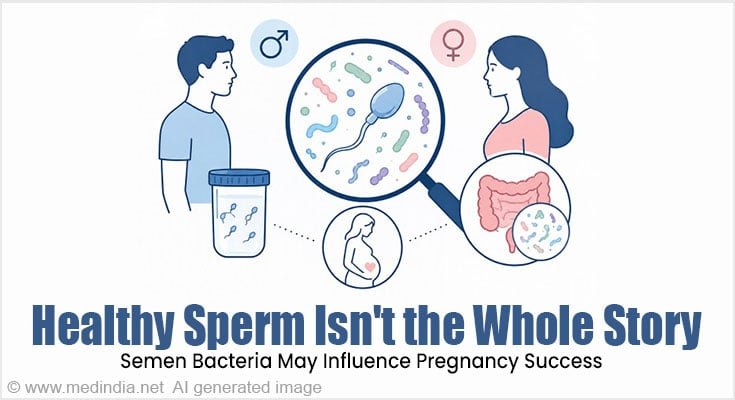
An unhealthy balance of bacteria in semen and a woman’s gut was linked to lower pregnancy and live birth rates among couples undergoing fertility treatment.

- Men with seminal dysbiosis had lower live birth rates after IVF/ICSI (57% vs 85%)
- Female gut dysbiosis was linked to reduced chances of conception and longer time to pregnancy
- Researchers say microbiome testing could become a future tool in fertility care, but more studies are needed
A healthy pregnancy may depend on more than sperm count or egg quality. A large prospective study published in The Lancet Obstetrics, Gynaecology & Women’s Health reported that an unhealthy balance of bacteria in a man’s semen and a woman’s gut is associated with lower live birth rates, reduced chances of conception, and a higher risk of pregnancy loss (1✔ ✔Trusted Source
Gut, vaginal, and seminal microbiomes in couples with infertility or recurrent pregnancy loss: a two-cohort prospective study of reproductive outcomes
).
Among couples undergoing IVF or ICSI, only 57% of those in which the male partner had seminal dysbiosis achieved a live birth compared with 85% of couples without the bacterial imbalance.
The findings suggest that the microbiome of both partners may represent a previously overlooked factor affecting fertility.
Advertisement
Can an Imbalance in Semen Bacteria Reduce the Chances of Having a Baby?
Researchers followed 353 women and 191 male partners between April 2018 and September 2023. The participants either had a history of recurrent pregnancy loss or were undergoing assisted reproductive treatment, including in vitro fertilization (IVF) and intracytoplasmic sperm injection (ICSI).
Before treatment, scientists analyzed the bacterial communities in the men’s semen and the women’s gut and vaginal microbiomes, then tracked pregnancy and birth outcomes. Approximately one in four men were found to have seminal dysbiosis, an imbalance in the normal bacterial community present in semen.
The difference in pregnancy outcomes was striking.
Among couples undergoing IVF or ICSI:
- 57% of couples in which the male partner had seminal dysbiosis achieved a live birth.
- 85% of couples without seminal dysbiosis successfully had a baby.
- Pregnancy loss was also considerably more common among couples in which the male partner had seminal dysbiosis, affecting roughly one in five more couples than those without the imbalance.
The researchers also found that women with gut dysbiosis were less likely to become pregnant through fertility treatment and generally took longer to conceive.
However, unlike seminal dysbiosis, female gut dysbiosis was not associated with miscarriage, and the study found no clear association between vaginal microbiome imbalance and infertility or pregnancy loss.
According to the researchers, these findings identify seminal dysbiosis and female gut dysbiosis as previously overlooked and potentially treatable risk factors that could influence reproductive success.
Advertisement
Why Are Researchers Looking Beyond Routine Fertility Tests?
Current infertility tests mainly assess the sperm itself, its count, movement, shape, and genetic health. According to the Male Infertility Guideline, a routine male fertility evaluation includes (2✔ ✔Trusted Source
Updates to Male Infertility: AUA/ASRM Guideline (2024)
):
| Routine Male Fertility Evaluation | Purpose |
|---|---|
| Medical and reproductive history | Identifies infertility risk factors and previous reproductive problems. |
| Physical examination | Checks for conditions affecting fertility, such as varicocele or structural abnormalities. |
| Semen analysis | Measures sperm count, movement (motility), and shape (morphology). |
| Hormone tests | Evaluates hormone levels when sperm production problems are suspected. |
| Genetic tests (selected men) | Identifies inherited genetic causes of infertility. |
However, microbiome testing is not currently included because there is not yet enough evidence to support its routine use.
The new Lancet study highlights an important limitation of current testing. A man may have a normal sperm count, motility, and morphology, yet still have seminal dysbiosis—an unhealthy bacterial imbalance that routine semen analysis cannot detect.
The researchers suggest that assessing the microbiome of both partners could help uncover hidden causes of infertility and recurrent pregnancy loss.
However, microbiome testing remains investigational, and larger clinical trials are needed before it becomes part of standard fertility care.
Advertisement
How Can Healthy and Harmful Bacteria Influence Fertility?
The seminal microbiome plays an important role in male reproductive health.
A systematic review and meta-analysis published in Andrology evaluated 55 observational studies involving 51,299 men and found that semen contains a rich and diverse bacterial community in both fertile and infertile men (3✔ ✔Trusted Source
The semen microbiome and its impact on sperm function and male fertility: A systematic review and meta-analysis
However, the composition of this microbial community differed, with several bacterial groups showing consistent associations with sperm health.
The review reported that:
- Lactobacillus was generally associated with healthier semen quality and better sperm parameters.
- Prevotella appeared to have a negative effect on sperm quality.
- Ureaplasma urealyticum was significantly more common in infertile men and was associated with poorer sperm concentration and morphology.
- Enterococcus faecalis and Mycoplasma hominis were linked with reduced sperm motility and concentration in several studies.
- Men with bacteriospermia also showed significantly higher sperm DNA fragmentation, a marker associated with poorer reproductive outcomes.
According to the Journal of Personalized Medicine review, these bacteria may influence fertility by increasing oxidative stress, triggering chronic inflammation, damaging sperm cell membranes, disrupting normal sperm movement, and increasing DNA damage (4✔ ✔Trusted Source
Probiotics as Microbiome Modulators in Male Infertility: Rethinking Dysbiosis Across the Gut-Testis Axis
).
Researchers also describe a gut-testis axis, suggesting that gut microorganisms can influence male reproductive function through immune regulation, hormonal signaling, and metabolic pathways.
Can Male Reproductive Health Influence Miscarriage Risk?
Pregnancy loss has traditionally been linked to maternal factors such as hormone problems, uterine abnormalities, and egg quality. However, growing evidence shows that male reproductive health also plays an important role.
The new study found that couples in which the male partner had seminal dysbiosis experienced more pregnancy losses than couples without the bacterial imbalance.
Although the study does not prove that bacteria directly cause miscarriage, it suggests that an unhealthy seminal microbiome may affect embryo development after fertilization.
Supporting studies also identify sperm DNA fragmentation (damage to sperm DNA) as an important paternal risk factor for recurrent pregnancy loss.
Damaged sperm DNA can interfere with normal embryo development, increasing the risk of implantation failure or miscarriage.
Factors that may increase sperm DNA damage include:
- Advanced paternal age
- Smoking and excessive alcohol use
- Obesity and uncontrolled diabetes
- Chronic oxidative stress
- Environmental toxins and chemical exposure
- Untreated genital tract infections
Researchers also report that chromosomal abnormalities in sperm can produce embryos with abnormal chromosome numbers, making pregnancy loss more likely.
These findings highlight that a healthy pregnancy depends on the reproductive health of both partners, not just the mother.
Could the Semen Microbiome Change the Future of Fertility Care?
The Lancet study is important not simply because it identified another infertility risk factor, but because it introduces an entirely new way of thinking about fertility assessment.
Traditionally, clinicians evaluate sperm count, movement, shape, hormones, and genetics. Microbiome analysis, however, examines the biological environment surrounding sperm, which may influence fertilization, embryo implantation, and early pregnancy.
Researchers believe this approach could eventually help fertility specialists:
- Identify couples whose infertility remains unexplained despite normal investigations.
- Better predict IVF and ICSI success.
- Personalize fertility treatment based on the microbiome of both partners.
- Identify patients who may benefit from future microbiome-targeted therapies.
However, the researchers emphasize that these possibilities remain future applications rather than current clinical practice.
What Do These Findings Mean for Couples Planning a Pregnancy?
The growing body of evidence does not mean that every fertility problem is caused by bacteria or that microbiome testing should replace conventional investigations.
Instead, researchers believe these findings reinforce the importance of evaluating both partners throughout infertility assessment.
Current evidence supports maintaining good reproductive health by:
- Following a healthy, balanced diet rich in fibre.
- Maintaining a healthy body weight.
- Exercising regularly.
- Avoiding smoking, excessive alcohol, and recreational drugs.
- Managing chronic conditions such as diabetes.
- Seeking medical care for reproductive tract infections.
- Consulting a fertility specialist if pregnancy does not occur after one year of regular unprotected intercourse, or after six months when the female partner is older than 35 years.
Experts also advise against self-prescribing probiotics or antibiotics specifically to improve fertility because there is currently insufficient clinical evidence that these treatments improve pregnancy outcomes.
Frequently Asked Questions
Q: What is Seminal Dysbiosis?
A: Seminal dysbiosis is an unhealthy imbalance of bacteria naturally present in semen.
Q: How did Seminal Dysbiosis affect IVF outcomes?
A: In the study, couples in which the male partner had seminal dysbiosis had a 57% live birth rate after IVF/ICSI, compared with 85% among couples without the imbalance.
Q: Does routine Semen analysis Detect Bacterial Imbalance?
A: No. Standard semen tests evaluate sperm count, movement, and shape but do not assess the semen microbiome.
Q: Did the study show that Bacteria cause Miscarriage?
A: No. The study found an association between seminal dysbiosis and a higher risk of pregnancy loss but did not prove that bacteria directly caused miscarriage.
Q: Should couples get Microbiome testing before IVF?
A: Not yet. Researchers consider microbiome testing investigational, and larger clinical studies are needed before it becomes part of routine fertility care.
Q: Can Probiotics Improve Fertility?
A: Current evidence is insufficient to recommend probiotics or antibiotics specifically to improve fertility or pregnancy outcomes.
References:
- Gut, vaginal, and seminal microbiomes in couples with infertility or recurrent pregnancy loss: a two-cohort prospective study of reproductive outcomes – (https://www.thelancet.com/journals/lanogw/article/PIIS3050-5038(26)00213-X/fulltext)
- Updates to Male Infertility: AUA/ASRM Guideline (2024) – (https://www.auajournals.org/doi/10.1097/JU.0000000000004180)
- The semen microbiome and its impact on sperm function and male fertility: A systematic review and meta-analysis – (https://onlinelibrary.wiley.com/doi/full/10.1111/andr.12886)
- Probiotics as Microbiome Modulators in Male Infertility: Rethinking Dysbiosis Across the Gut-Testis Axis – (https://www.mdpi.com/2075-4426/16/2/99)
Source-Medindia