

Close Menu

    Subscribe to Updates

    Get the latest news information from worldwide businesses.

    What's Hot

    For 15,000 years, humans and dogs have been changing each other

    August 10, 2026

    Gum Disease Could Be a Warning Sign of Diabetes Risk

    August 10, 2026

    Mark Zuckerberg doesn’t understand how to live

    August 10, 2026
    Facebook Instagram YouTube LinkedIn X (Twitter)
    Trending
    • For 15,000 years, humans and dogs have been changing each other
    • Gum Disease Could Be a Warning Sign of Diabetes Risk
    • Mark Zuckerberg doesn’t understand how to live
    • Google co-founder Sergey Brin has now spent $100 million to fight the billionaire tax
    • Rs 20,000 crore credit guarantee plan misses the mark
    • Turkey's parliament passes limited amnesty law for Kurdish PKK militants
    • Europe battles the flames: Wildfire contained near Athens and evacuations in Spain
    • DOGE said it saved $1.7 billion by terminating a military health IT contract. GAO found the contract was never terminated.
    Newspublicly
    • About Us
    • Advertise & Partner with us
    • Pitch Your Story
    • Contact Us
    Facebook Instagram LinkedIn X (Twitter)
    Subscribe
    • Home
    • World News
      • Asia
      • India
      • USA
      • UK & Europe
      • Middle East
    • Economy & Business
      • Global Economy
      • Corporate & Industry
      • Finance & Markets
      • Policy & Trade
    • Technology
      • Gadgets & Devices
      • Software & Apps
      • AI & Machine Learning
      • Robotics & Automation
    • Health & Medicine
      • Fitness & Nutrition
      • Research & Innovation
      • Disease & Treatment
      • Doctors, Clinics & Patient Care
    • Travel & Tourism
    • Automobile
      • Electric & Hybrid Vehicles
      • Auto Industry Insights
    • Sports
    • More
      • Education
      • Real Estate
      • Environment & Climate
      • Space & Astronomy
      • War & Conflicts
    Newspublicly
    Home»Health & Medicine»Research & Innovation»The sun will vanish over Europe in a rare total solar eclipse: Watch live
    Research & Innovation

    The sun will vanish over Europe in a rare total solar eclipse: Watch live

    AdminBy AdminAugust 10, 2026No Comments4 Mins Read0 Views
    Share
    Facebook Twitter LinkedIn Copy Link WhatsApp


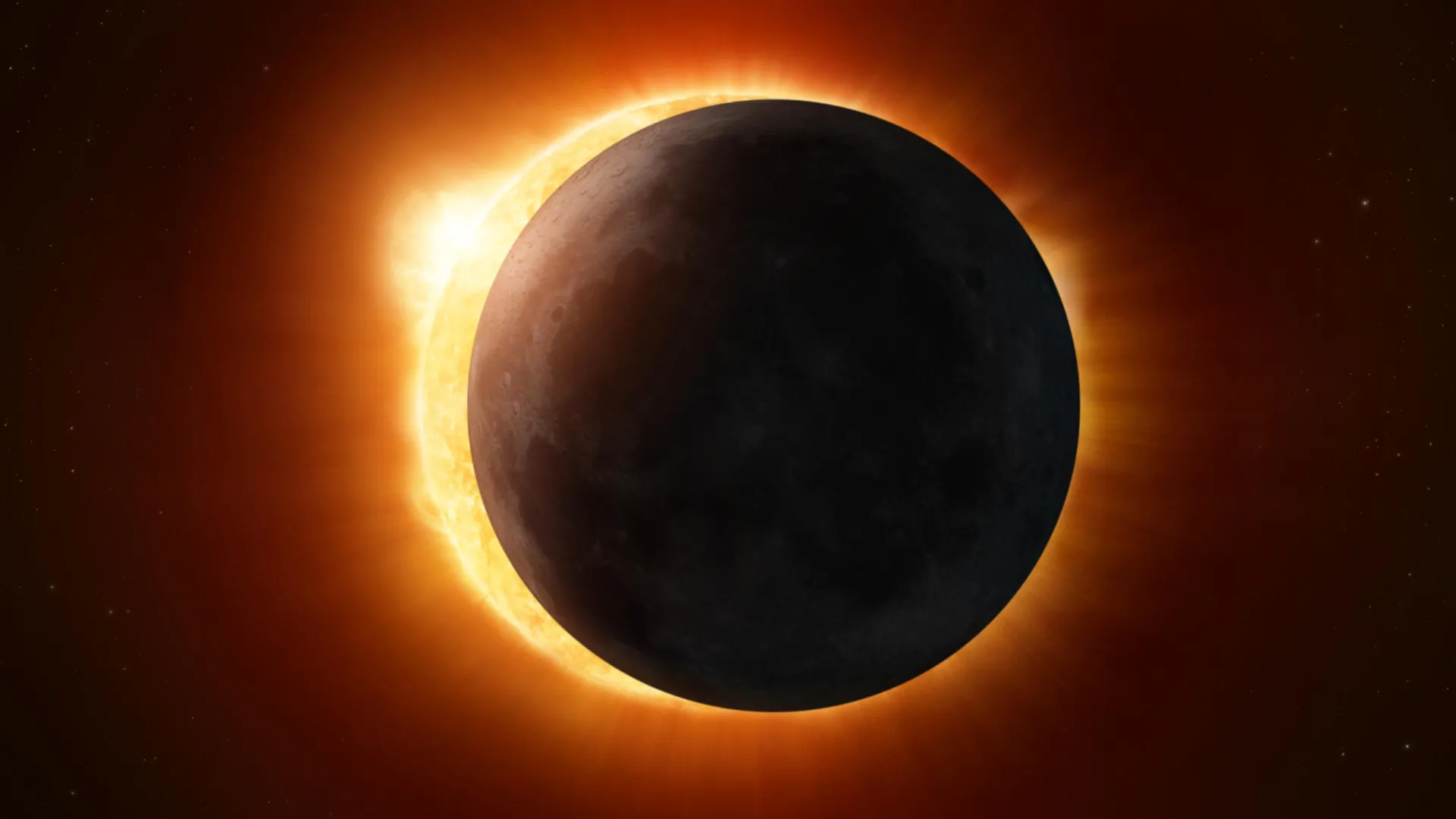
    A total solar eclipse is set to cross Europe, and people around the world will be able to watch the event live. The European Space Agency (ESA) will begin its broadcast at 1:30 p.m. EDT (19:30 CEST) on August 12, giving viewers a chance to experience the eclipse from home..

    Quick links

    What Happens During a Total Solar Eclipse

    A solar eclipse happens when the Moon moves directly between Earth and the Sun, covering the Sun and casting a narrow region of Earth into darkness.

    When the Sun’s brilliant surface is hidden, its faint and wispy atmosphere becomes visible. Stars and planets can emerge in the darkened sky, temperatures can fall, and winds may strengthen. Birds and insects may even begin behaving as though night has arrived.

    On August 12, 2026, a solar eclipse will be visible across a large part of Europe. The narrow path of totality, where the Moon completely covers the Sun, will pass across Greenland, Iceland, a small part of northeastern Portugal, and then Spain.

    Elsewhere in Europe, observers will experience a partial solar eclipse. In these locations, the Moon will appear to take a ‘bite’ out of the Sun, causing daylight to dim slightly.

    ESA Will Broadcast the Eclipse Live From Spain

    ESA will mark the event with a live broadcast from the Observatorio Astrofísico de Javalambre in Teruel (Spain). Spain is expected to provide excellent conditions for viewing as the eclipse moves across the country from west to east.

    Viewers can tune in through ESA Web TV or ESA’s YouTube channel beginning at 1:30 p.m. EDT (19:30 CEST) on August 12.

    Award-winning space scientist and science communicator Dame Dr Maggie Aderin will host the broadcast. Guests will include ESA’s Director of Science Professor Carole Mundell, ESA scientists Andy To, Miho Janvier and Martin Hewitson, and observatory director Javier Cenarro.

    Live interviews, explanations and striking imagery will explore several aspects of eclipse science. Topics will include the Sun and its corona, the famous eclipse that helped transform our understanding of gravity, and ESA’s work to create artificial solar eclipses in space.

    81 Seconds of Total Darkness

    The main event will occur at 2:31 p.m. EDT (11:31 a.m. PDT) when Javalambre experiences 1 minute and 21 seconds of totality. During that brief period, the Moon will completely cover the Sun and send the observatory into darkness.

    Coverage will include telescope views and drone footage of the eclipse, along with Maggie and Carole’s reactions as they witness the event.

    The broadcast will be presented in English and is expected to finish at about 2:45 p.m. EDT (11:45 a.m. PDT).

    Why Javalambre Is an Ideal Eclipse Viewing Site

    The Observatorio Astrofísico de Javalambre is a world-class astronomical facility positioned directly within the path of totality. Its two main professional telescopes carry out wide-sky astronomical surveys that help scientists investigate galaxies, dark energy, and the large-scale structure of the cosmos.

    The observatory is also well suited for eclipse viewing. Cloud cover is uncommon, light pollution is low, and the site has an especially clear view toward the western horizon. That will be important because the Sun will be moving toward sunset as the Moon passes in front of it.

    Several additional small telescopes will be brought to the observatory specifically for the eclipse. Their live feeds will provide continuous close-up views as the Moon gradually moves across the Sun, showing the different stages of the event.

    During the broadcast, Javier Cenarro, Director of the observatory, will discuss Javalambre and explain its significance for a future ESA space science mission.

    Multiple Live Feeds Will Track the Eclipse

    ESA will not rely only on observations from Javalambre. Two additional live feeds will come from other locations inside the path of totality, improving the chances that the broadcast will capture clear, high-quality views of the eclipse.

    One feed will come from ESA’s public event in León. Another will originate in Frómista (Palencia), where collaborator Alejandro Sánchez de Miguel will conduct eclipse observations. He is affiliated with the Institute of Astrophysics of Andalusia, the Complutense University of Madrid, and the Stars4All Foundation.


    Source link

    Author

    • Admin

      NewsPublicly.com is News & Articles Platform that creating SEO-focused articles on travel, lifestyle, and digital trends.

    Admin
    • Website

    NewsPublicly.com is News & Articles Platform that creating SEO-focused articles on travel, lifestyle, and digital trends.

    Related Posts

    For 15,000 years, humans and dogs have been changing each other

    August 10, 2026

    Voyager 2 was running out of power. NASA just bought it more time

    August 10, 2026

    Potatoes may have given Indigenous Andeans a digestive superpower

    August 10, 2026
    Leave A Reply Cancel Reply

    Demo
    Top Posts

    The Blue Moon rises on May 30— Where and when to see the second full moon of the month

    May 30, 202640 Views

    New SOCOM rifle allows barrel swapping and cartridge changes

    June 1, 202633 Views

    “Inside Gemini Robotics 1.5: How Robots Learn to Reason & Act

    November 22, 202527 Views

    525 pounds of cocaine seized after Nebraska K9 alerts troopers on I-80

    May 28, 202624 Views
    Don't Miss

    For 15,000 years, humans and dogs have been changing each other

    August 10, 20266 Mins Read0 Views

    Dogs are often called ‘man’s best friend’, and their long history with people gives that…

    Gum Disease Could Be a Warning Sign of Diabetes Risk

    August 10, 2026

    Mark Zuckerberg doesn’t understand how to live

    August 10, 2026

    Google co-founder Sergey Brin has now spent $100 million to fight the billionaire tax

    August 10, 2026
    Stay In Touch
    • Facebook
    • Twitter
    • Instagram
    • YouTube
    • LinkedIn
    • WhatsApp

    Subscribe to Updates

    Get the latest creative news from SmartMag about art & design.

    Demo
    NEWSPUBLICLY
    Facebook X (Twitter) Instagram LinkedIn

    Home

    • About Us
    • Leadership
    • Advertise & Partner With Us
    • Pitch Your Story
    • Media Kit & Pricing
    • Career
    • FAQs

    Guidelines

    • Editorial & Submission
    • Partnership
    • Advertising & Sponsor
    • Intellectual Property Policy
    • Community & Comment
    • Security & Data Protection
    • Send Your Opinion

    Quick Links

    • Cookie Policy
    • Payment & Billing Terms
    • Refund & Cancellation
    • Copyright Policy
    • Complaint & Support
    • Sitemap
    • Contact Us

    Subscribe Us

    Get the latest news and updates!

    Copyright © 2026 Newspublicly (DIGITALIX COMMUNICATION). All Rights Reserved.
    • Privacy Policy
    • Terms of Use
    • Disclaimer