

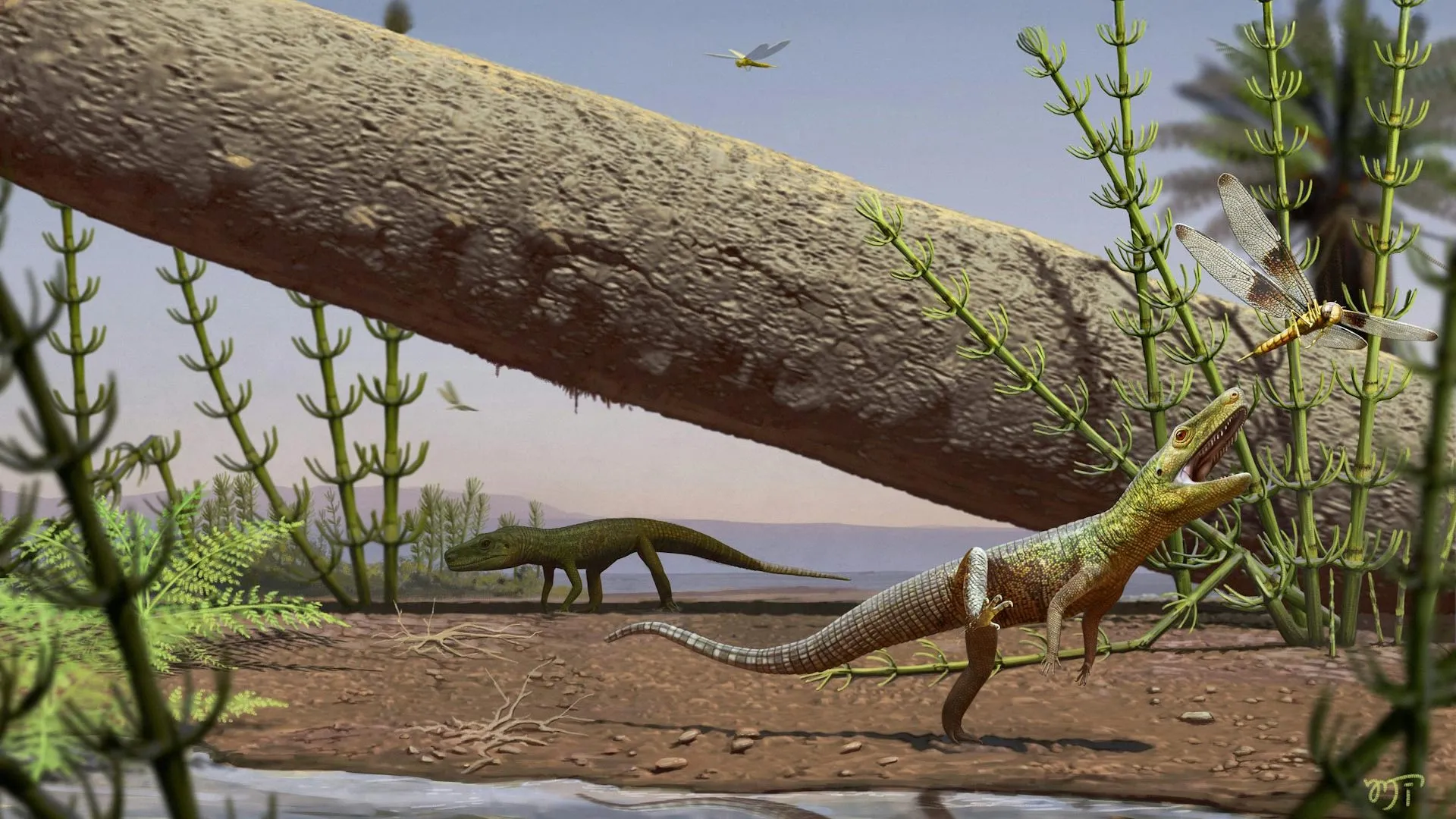
Named Silescelida acristata, the species lived about 240 million years ago, during the Middle Triassic Period. The fossil was found in Dona Francisca, in central Rio Grande do Sul, in rocks that are part of the UNESCO Quarta Colônia Geopark.
The discovery helps fill an important gap in our understanding of the evolution of archosauriformes, a group of reptiles that gave rise to the archosaurs. Archosaurs, in turn, are the lineage that encompasses two of the best-known groups of terrestrial vertebrates: crocodiles and dinosaurs, including birds.
The study was conducted by researchers from the Quarta Colônia Center for Paleontological Research at the Federal University of Santa Maria, CAPPA/UFSM, in collaboration with researchers from the Federal University of Rio Grande do Sul (UFRGS) and the Pontifical Catholic University of Rio Grande do Sul (PUCRS), and was published in the scientific journal Scientific Reports.
A small animal in a world under reconstruction
When Silescelida acristata lived, terrestrial ecosystems were still recovering from the Permian–Triassic extinction event, which occurred about 252 million years ago. This event wiped out much of the life on the planet and paved the way for the diversification of new groups of animals.
It was against this backdrop of ecological recovery that different lineages of reptiles began to take on new roles in terrestrial environments. Among them were the archosauriforms, which underwent extensive diversification during the Triassic. Silescelida acristata was a relatively small, slender animal that moved on all four limbs. Its size can be compared to that of a small alligator.
Although it was neither a dinosaur nor a crocodile, it belonged to a lineage closely related to the forms that preceded the origin of these groups. Its diet likely included smaller animals, suggesting that it played the role of a small predator in the Triassic ecosystems of southern Brazil.
Why is this fossil important?
The fossil primarily preserves parts of the limbs, and at first glance, this type of material may seem limited, but it carries important information about the animal’s locomotion and evolutionary relationships.
One of the most significant characteristics of Silescelida acristata lies in its femur, the thigh bone. Like some of its close relatives, it had legs in a more semi-erect position, lower on the body than to the side.
This change allowed for more efficient locomotion, reducing drag as the body moved across the ground. In evolutionary terms, this type of transformation is related to the set of anatomical changes that would later prove fundamental to the success of archosaurs.
In other words, the new fossil helps us understand a phase preceding the rise of dinosaurs and crocodiles, when their close relatives were still experimenting with different body shapes, postures, and modes of locomotion.
Rare phylogenetic relationship
Phylogenetic analyses indicate that Silescelida acristata may be related to the Euparkeriidae, a rare group of archosauriforms that is still poorly understood by science.
Until now, fossils associated with this group were known primarily from the continents of Africa, Asia and Europe. The presence of a form related to the Euparkeriidae in South America significantly expands the known geographic distribution of these animals.
This suggests that these reptiles were more widely distributed across the world during the Triassic than the fossil record indicated. It also reinforces the importance of South America for the study of the origin and diversification of major groups of terrestrial vertebrates.
The ‘rediscovery’ of a forgotten fossil
The discovery of Silescelida acristata also has an unusual history. Part of the fossil – precisely the portion that preserved essential information about its provenance – was accidentally lost for more than two decades.
It was not until 2022, during a technical visit to the scientific collection at the Pontifical Catholic University of Rio Grande do Sul (PUCRS), that researchers located the missing fragment. This rediscovery made it possible to confirm the specimen’s origin and formally describe it as a new species.
The animal’s very name refers to this story. Silescelida combines words associated with “silence” and “leg.” “Silence” refers to the long period during which part of the fossil lay forgotten, while “leg” refers to the type of preserved material, consisting mainly of limb bones.
The name acristata, meanwhile, means “without a crest.” It was chosen because this animal’s femur lacks a crest or raised bony protrusion – known as a trochanter – where part of the tail musculature would attach. This absence distinguishes Silescelida acristata from nearly all of its close relatives.
What does the discovery change?
The presence of Silescelida acristata in the Middle Triassic of Brazil shows that the evolutionary history of archosauriforms was broader and more complex than previously thought. The fossil indicates that lineages closely related to the Euparkeriidae were also present in South America, highlighting the continent’s role in the early diversification of the relatives of dinosaurs and crocodiles.
Furthermore, the discovery reinforces Rio Grande do Sul’s status as one of the world’s most important regions for the study of Triassic fauna. The region’s rocks preserve fossils from different stages in the evolution of terrestrial vertebrates, including some of the oldest known dinosaurs and large predators that lived before the Age of Dinosaurs.
Every new fossil found in this context helps reconstruct how terrestrial ecosystems reorganized after the Permian–Triassic extinction and how the groups that would later dominate the continents emerged.
Small bones, big stories
Incomplete fossils are often viewed as less informative than nearly complete skeletons. However, it is important to remember that the vast majority of fossils found during excavations are fragmentary. Discoveries such as Silescelida acristata show that even isolated parts of the skeleton can reveal fundamental information about evolution.
In this case, limb bones made it possible to identify a new species, infer aspects of its locomotion, investigate its phylogenetic relationships, and expand the known distribution of a rare group of Triassic reptiles.
More than just describing a new animal, the study shows how Brazilian paleontology continues to contribute to our understanding of central chapters in the history of life on Earth. In rocks from the interior of Rio Grande do Sul, 240-million-year-old fossils still hold clues about the origin of the animal groups that would transform terrestrial ecosystems forever.