

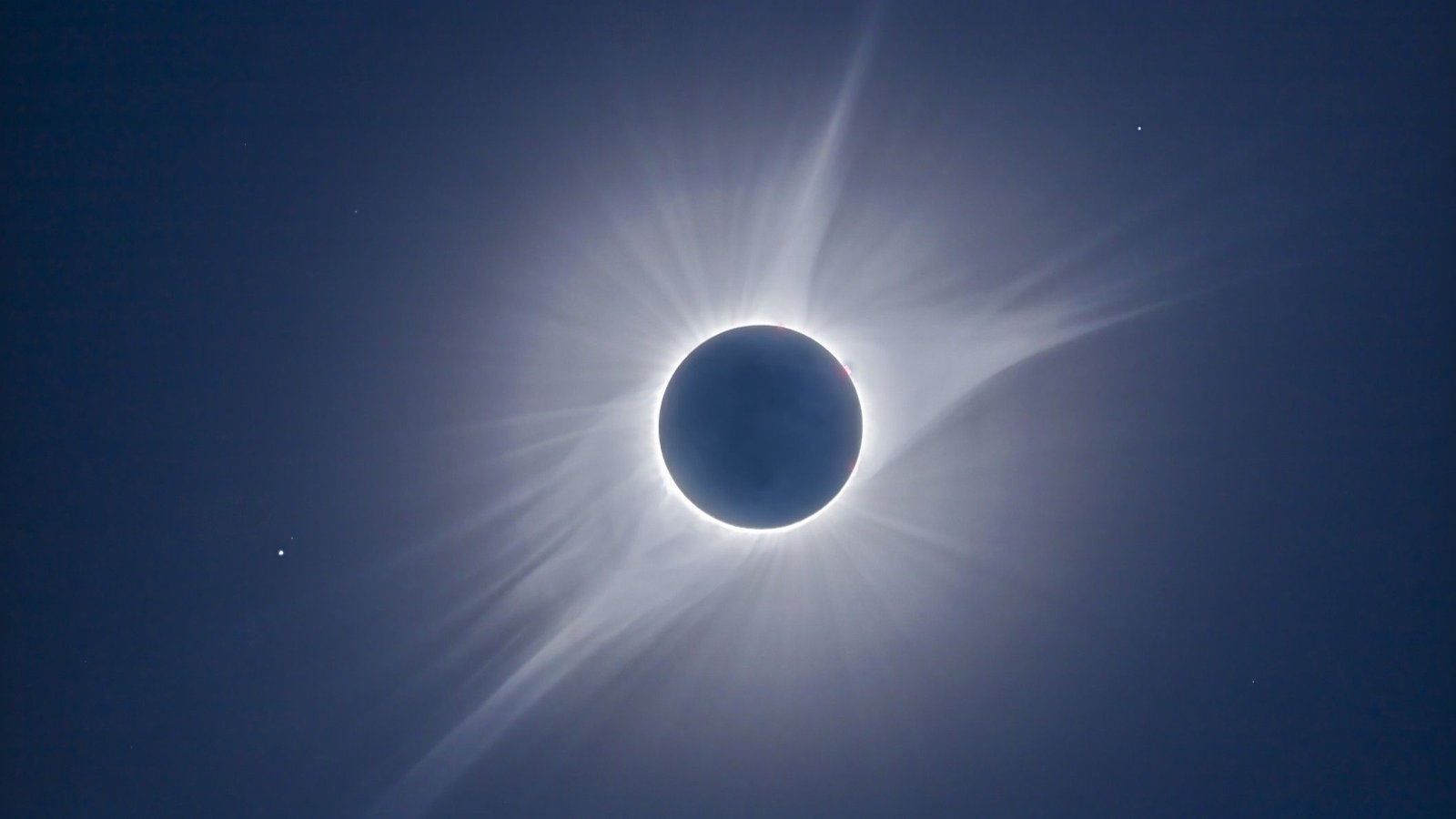
Every total solar eclipse is different. While the silhouette of the moon passing across the sun barely changes, the moment our natural satellite covers the entire solar disk, something spectacular happens — the emergence of the corona. The Latin word for “crown”, the solar corona is one of the wonders of nature. To gaze upon its delicate, spiky white tendrils during brief moments of totality is to glimpse the infinite, but it’s only a glimpse because the corona is always changing. Shaped by the sun’s constantly changing magnetic field, the corona evolves from year to year, month to month and even day to day. No two total eclipses ever reveal exactly the same structure.
It’s one reason why eclipse chasers keep traveling. The corona visible during the total solar eclipse of Aug. 12, 2026 — if skies are clear — will be a unique snapshot of the sun at a specific moment in Solar Cycle 25. It will reflect years of changing magnetic activity, thousands of sunspots and countless eruptions of solar material.
Once totality ends, that exact configuration of the corona will never be seen again. Can we know in advance what it might look like?
The sun’s hidden atmosphere
Under normal circumstances, the sun’s corona — our star’s outer atmosphere — is invisible. It extends millions of miles into the solar system, but it’s overwhelmed by the brilliant light of the sun’s photosphere, its visible surface. Totality changes that. When the moon completely covers the photosphere, the corona suddenly emerges. White streamers extend away from the black silhouette of the moon. Pink loops and prominences can appear around the edge of the moon.
For many first-time observers, the greatest surprise during totality is not only the detail but the scale. The corona often appears much larger than expected, extending several solar diameters away from the eclipsed sun. Photographs can capture some of that complexity, but they rarely reproduce the impression of depth and structure visible to the human eye, whose dynamic range is vastly superior to any camera.

Why every corona looks different
The corona is not a fixed object. It is created by extremely hot plasma — highly energized, ionized gas — that’s trapped and sculpted by the sun’s magnetic field. Since the sun’s magnetic field is constantly changing, the corona changes with it.
“The sun follows a natural 11-year cycle of increasing and decreasing activity,” Ryan French, solar physicist, author and science communicator at the Laboratory for Atmospheric and Space Physics (LASP) in Boulder, Colorado, and author of Little Book of Eclipses: An Essential Companion to Solar and Lunar Events told Space.com in an email. “At the peak of this cycle, called solar maximum, there are loads of sunspots on the sun, which are giant magnets nestled in the base of the sun’s atmosphere. These sunspots produce a lot of solar flares and coronal mass ejections, which are kind of bursts and eruptions of energy from the sun’s atmosphere, and at solar minimum, the sun has none of these things.”
That magnetic activity determines the overall shape of the corona. During solar minimum, when the sun has few or no sunspots, the corona tends to look more uniform and more symmetrical. Long streamers often stretch from either side of the sun, giving the corona a wing-like appearance. During solar maximum, it can look much more complex. Sunspot regions act like magnetic anchors, creating structures that can appear as spikes or streamers extending in different directions.
“If you were to see a total eclipse during solar maximum, the solar corona looks almost like a five-pointed cartoon star,” said French. “That’s because every one of these sunspot regions creates a spire or spike that you can see with the eye.”
Not solar maximum — but not quiet
The 2026 eclipse will not occur at solar maximum. Solar Cycle 25 peaked in October 2024, according to NASA and NOAA, with the Aug. 12, 2026 eclipse occurring almost two years later, during the cycle’s declining phase. However, solar activity does not collapse immediately after solar maximum. It declines gradually, and the sun is expected to remain more active than it was in the lead-up to solar maximum.
“We’re no longer in solar maximum — we’re a third of the way past the peak in terms of amplitude and years passed,” said French. “The corona will still be far more active than during the 2017, 2019 and 2020 total solar eclipses, but much less so than 2024’s.”
That makes the 2026 eclipse especially interesting. It likely won’t show the full, highly structured corona seen close to the peak of activity in 2024, when the April 8 total solar eclipse occurred with a monthly sunspot number of about 144. Current predictions for August 2026 are closer to 102; far fewer, but still considered active by recent-cycle standards.
That means eclipse-watchers should expect something between extremes: not the clean, flattened corona of solar minimum, but not quite the wildest solar-maximum display either.

A comparison with past eclipses
A useful comparison may be the total solar eclipses near the previous solar maximum. Solar Cycle 24, which peaked in April 2014, was relatively weak. The closest total solar eclipses to that peak were the rare hybrid eclipse of Nov. 3, 2013, when the monthly sunspot number was around 113. By contrast, Solar Cycle 23, which had a double peak — in March 2000 and November 2001 — was relatively strong. The closest total solar eclipse occurred on June 21, 2001, with a monthly sunspot number of around 203. Its corona was likely more complex than expected in 2026.
The 2026 eclipse therefore sits in a middle category. It’s not a repeat of 2024, but it’s not a quiet-sun eclipse either. An active declining-phase corona, it will likely feature strong streamers extending far into space, but with greater asymmetry, with one side of the corona more active. “It’s sunspots specifically near the edge of the sun that dictate what the corona will look like,” said French. The sun rotates every 27 days, so any large active region of sunspots rotating onto the sun’s edge shortly before Aug. 12 could alter the corona’s appearance dramatically. It’s why any forecasts of what the corona looks like — which often come from Predictive Science a week before the eclipse — are generally refined on the day of the eclipse.
Red prominences may steal the show
One of the most memorable sights during totality is the appearance of vivid pink or crimson features around the moon’s edge. These are usually prominences — immense structures of hydrogen plasma suspended above the sun’s surface by magnetic fields. They’re often mistaken for solar flares by beginners, such as after the 2024 total solar eclipse.
“Prominences are large magnetic structures that suspend plasma in the atmosphere of the sun, and they glow very bright in a very specific wavelength of light called hydrogen alpha,” said French. Prominences are more likely when the sun is active, and because they can last for days or weeks, they are easier to anticipate than a flare. In hydrogen-alpha images taken before eclipse day, observers may be able to see which prominences are present around the solar edge.
The 2026 eclipse may have favorable geometry for sighting prominences. Because the moon will appear only slightly larger than the sun — which contributed to the relatively short duration of totality, at a maximum of just 2 minutes 18 seconds — smaller prominences on different sides of the sun could be visible at the same time. That is different from longer eclipses, where the larger apparent moon can cover prominences on one side before revealing others on the opposite side.
Could a CME be visible?
A coronal mass ejection (CME) is an eruption of plasma and magnetic field from the sun’s atmosphere. Seeing one during totality is possible — it happened during the total solar eclipse on Dec. 14, 2020 — but requires luck. “CMEs travel very slowly, so they take several hours to traverse and escape from the sun’s atmosphere, so you wouldn’t see any motion during an eclipse,” said French. “But what you could see, if you’re lucky, is a snapshot of an eruption — though maybe a long exposure camera will be more likely to see this than your eye would.” Such a view would be rare, but the chances are higher in an active solar environment than near solar minimum.

Predicting the corona yourself
There will be a forecast from Predictive Science, which can be so accurate that some eclipse chasers avoid it, so as not to ruin the surprise of totality. One way to get a general idea is to look at real-time images from telescopes that use coronagraphs to block the sun, such as the COSMO K-Coronagraph, NASA SOHO’s LASCO C3 and the GOES CCOR-1. For sunspots, check the latest H-Alpha image from the Global Oscillation Network Group (GONG).
No scientist can say exactly what the corona will look like on Aug. 12, 2026. That will depend on the sun’s magnetic activity in the days immediately before totality, the location of sunspot groups, the presence of prominences and the possibility of eruptions. “What exactly we see during the August eclipse will depend on what the activity is that week,” said French. “And even if you saw an eclipse a month before or a month after, it could be very different.” For a few fleeting minutes over Greenland, Iceland, Spain and the Balearic Islands, the sun’s hidden atmosphere will become momentarily visible before vanishing back into the glare, never being seen again in quite the same way.