

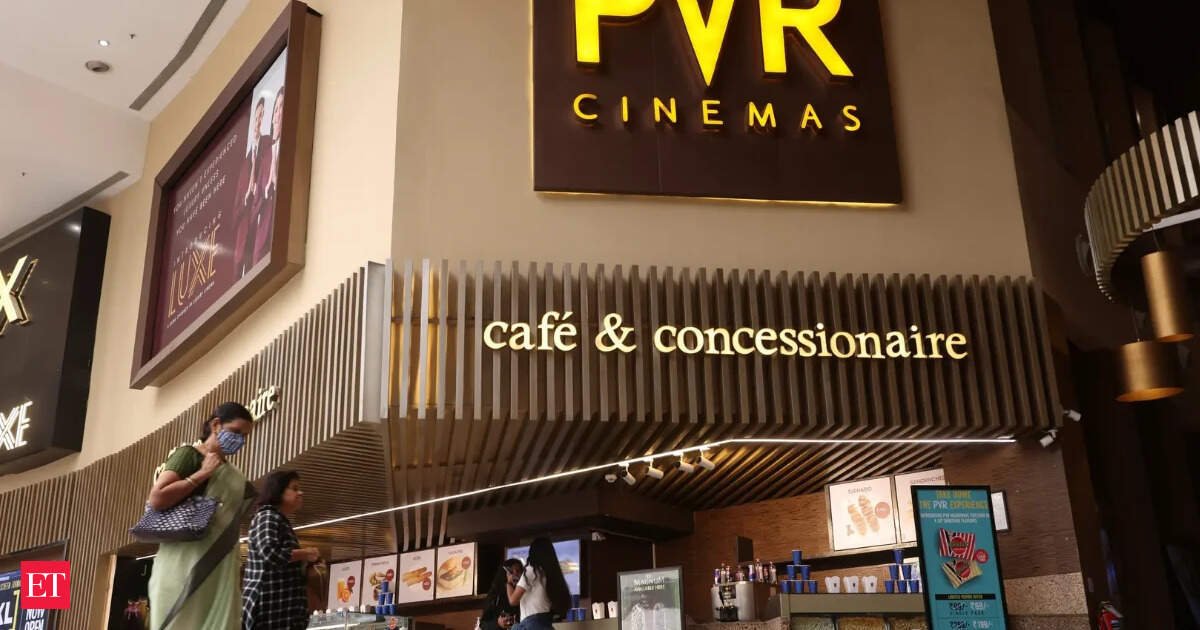
The country’s largest multiplex operator plans to add at least 1,000 screens over the next five years, focusing on franchise-owned, company-operated (FOCO) and other asset-light models, with developers funding a significant share of project costs.
The opportunity is significant. About 16,350 of India’s 19,000 pin codes still have no cinema screens, leaving vast parts of the country underserved despite rising consumption, according to EY’s The Story of Film Exhibition in India.
Also Read: PVR Inox bets on ₹175 tickets to win small-town India
India had 10,033 cinema screens at the end of 2025, only marginally more than six years earlier. Meanwhile, screen density declined from 7.6 screens per million people in 2018 to 6.8 in 2024, while nearly 1,000 single-screen theatres shut during the period, underscoring the structural challenges facing the traditional exhibition model.

“I started with a single screen myself, and the reason I moved into multiplexes was because it became very difficult to fill a 1,093-seat cinema throughout the year. I used to struggle to achieve optimum occupancy across all 52 weeks because you don’t get 52 films that can fill the cinema to the threshold where you make money,” Bijli told ET.
Unlike a traditional single-screen theatre that depends on a single film to drive admissions, a three- or four-screen multiplex can programme multiple films simultaneously, improving utilisation while giving audiences greater choice, he said.The economics are increasingly prompting single-screen owners to convert their properties into multiplexes. PVR INOX is itself converting Mymoon, a prominent single-screen cinema in Kochi, into a five-screen multiplex in partnership with Lulu Group.
Also Read: PVR INOX bets on tier-III India with launch of SMART Cinemas
“One compelling reason many single-screen theatres are converting into multiplexes is that the business becomes much more viable with four or five screens. Instead of showing just one film, we can screen five, six, seven or even 10 movies a day. Consumers benefit because they get a wider choice under one roof, while producers benefit as more films can be showcased simultaneously,” he said.
The company has identified around 300 smaller cities, including Jabalpur, Muzaffarpur, Barrackpore and Rampur, for its affordable multiplex format. Ticket prices will be comparable to, or only marginally higher than, balcony tickets at single-screen theatres.
“Ticket pricing will be designed keeping in mind the paying capacity of the local catchment. For comparable formats and locations, ticket prices will generally be 30-35% lower than similar PVR INOX cinemas operating today,” Bijli said. PVR INOX’s average ticket price stood at Rs 273 in the June quarter.
The expansion marks the next phase of PVR INOX’s growth strategy as it looks beyond major urban markets.
Under the franchise-owned, company-operated (FOCO) model, partners invest in developing the cinema while PVR INOX manages operations. In its asset-light model, developers or landlords contribute between 30% and 80% of project costs, allowing the company to accelerate expansion while conserving capital.
PVR INOX currently operates 1,779 screens and expects to spend Rs 300-350 crore this financial year on around 100 new screens, as well as renovating and premiumising its existing circuit. Around 60-70% of the new additions will come under the asset-light model. As the share of such projects rises, the company expects the same level of capital expenditure to support a larger number of screen additions.
Bijli believes India has the potential to support around 25,000 cinema screens over time but said achieving that would require greater policy support, including rationalising GST on cinema tickets, lowering local entertainment levies where applicable, and reducing electricity and property taxes.
Alongside expanding its footprint, PVR INOX will continue investing in premium formats such as IMAX, PXL, 4DX, ICE, ScreenX, Director’s Cut, INSIGNIA and LUXE, while expanding alternative content, including live sports screenings and concerts.