

Close Menu

    Subscribe to Updates

    Get the latest news information from worldwide businesses.

    What's Hot

    Jharkhand protest, Day 14: Government holds talks with students, seeks time to examine demands | India News

    August 7, 2026

    Pennsylvania candidate Chris Rabb says he wants to abolish ICE, end deportations

    August 7, 2026

    NASA figured out how to keep its 48-year-old Voyager 2 probe running for yet another year

    August 7, 2026
    Facebook Instagram YouTube LinkedIn X (Twitter)
    Trending
    • Jharkhand protest, Day 14: Government holds talks with students, seeks time to examine demands | India News
    • Pennsylvania candidate Chris Rabb says he wants to abolish ICE, end deportations
    • NASA figured out how to keep its 48-year-old Voyager 2 probe running for yet another year
    • Disturbing video shows Stephanie Vaquer hounded by WWE fans
    • Navee UT5 Ultra X superscooter $1,955 low, EGO Nexus power station bundle $799 low, Aventon $1,299 flash sale e-bike lows, more
    • The NYC Pizza Places, Bodegas, and Nightclubs of ‘One Night Only’
    • Scientists rediscover lost Megalodon fossils—and reveal a 79-foot giant
    • Understanding Ovulatory Disorders With FIGO’s New HyPO-P Classification
    Newspublicly
    • About Us
    • Advertise & Partner with us
    • Pitch Your Story
    • Contact Us
    Facebook Instagram LinkedIn X (Twitter)
    Subscribe
    • Home
    • World News
      • Asia
      • India
      • USA
      • UK & Europe
      • Middle East
    • Economy & Business
      • Global Economy
      • Corporate & Industry
      • Finance & Markets
      • Policy & Trade
    • Technology
      • Gadgets & Devices
      • Software & Apps
      • AI & Machine Learning
      • Robotics & Automation
    • Health & Medicine
      • Fitness & Nutrition
      • Research & Innovation
      • Disease & Treatment
      • Doctors, Clinics & Patient Care
    • Travel & Tourism
    • Automobile
      • Electric & Hybrid Vehicles
      • Auto Industry Insights
    • Sports
    • More
      • Education
      • Real Estate
      • Environment & Climate
      • Space & Astronomy
      • War & Conflicts
    Newspublicly
    Home»More»Space & Astronomy»Inside the mystery of the James Webb Space Telescope’s little red dots — and how they might be evolving
    Space & Astronomy

    Inside the mystery of the James Webb Space Telescope’s little red dots — and how they might be evolving

    AdminBy AdminAugust 7, 2026No Comments5 Mins Read0 Views
    Share
    Facebook Twitter LinkedIn Copy Link WhatsApp


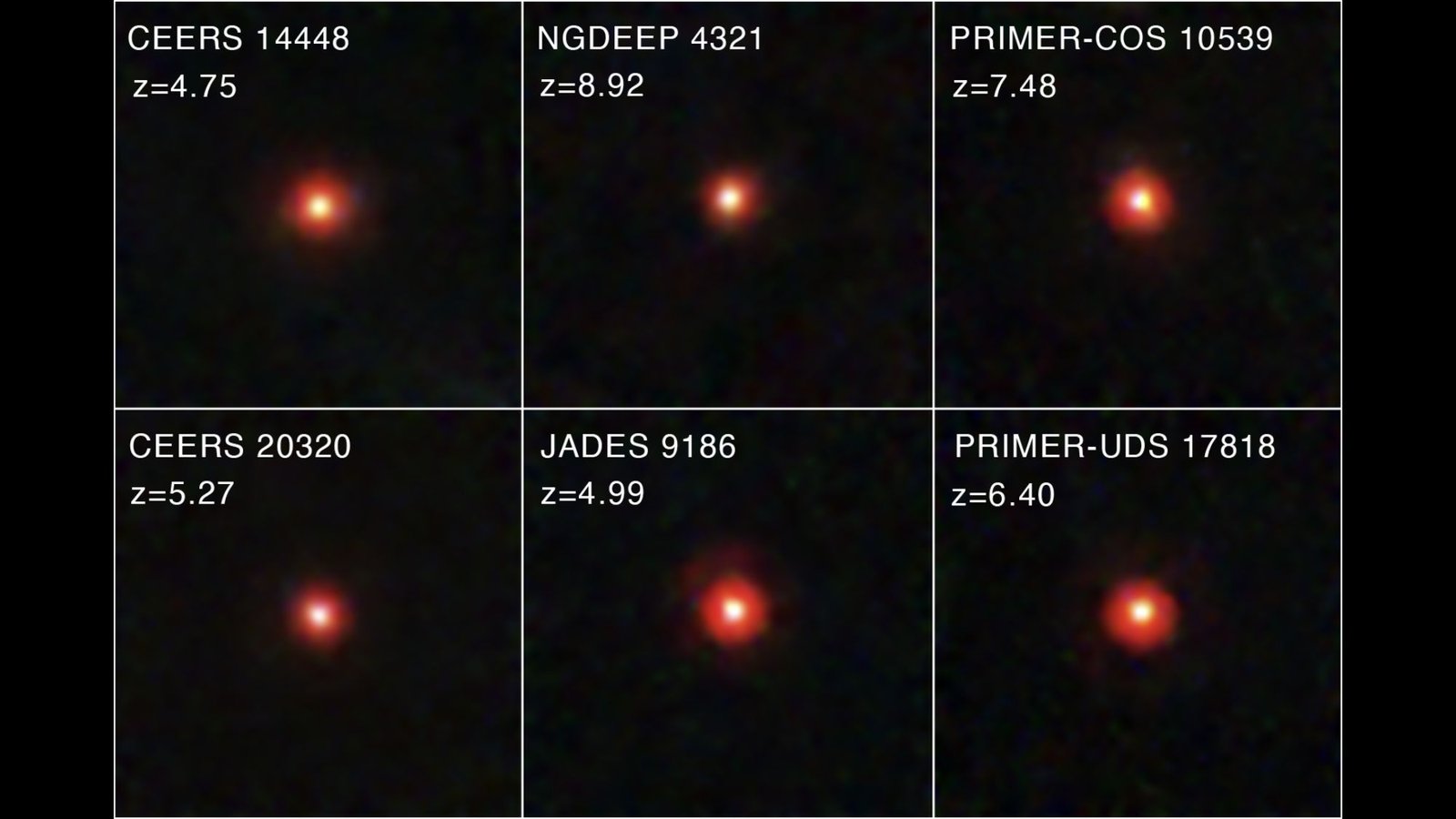
    New evidence has come to light showing that the mysterious ‘little red dots’ discovered in the early universe by the James Webb Space Telescope could evolve into the active centers of fully formed galaxies.

    “Everything created in the early universe must evolve into something around us,” said George Rieke of the University of Arizona in a statement. “We have had little idea of what little red dots become, but these results finally show us how to find their progeny.”

    Discovered by the James Webb Space Telescope (JWST) almost as soon as it became operational in 2022, little red dots have been a perplexing cosmological mystery. As their name suggests, they appear small, red and surprisingly bright. They are mostly found at redshift values suggesting they existed between 13.2 and 12.2 billion years ago. To shine so brightly at such great distances would usually imply these objects are quasars — which are luminous nuclei of galaxies powered by active supermassive black holes — but the light coming from little red dots is more like that of bloated stars. It looks to be mostly in infrared with some ultraviolet, and none of the X-rays that one would expect from an active black hole chomping down on material.

    As such, researchers have come up with the hypothesis that little red dots are “black hole stars,” or vast clouds of gas heated from within by a concealed but growing supermassive black hole.

    However, the population of little red dots drops off a cliff at redshifts equating to less than 12 billion years ago. Where did they all go? There are two options. Either they all died off, or they developed into objects more familiar to us.


    You may like

    One recent hypothesis is that little red dots turned into large globular clusters. And now, an alternative possibility has come along.

    A team led by Pierluigi Rinaldi, who was at the University of Arizona’s Steward Observatory when conducting this research but is now at the Space Telescope Science Institute (STScI) in Baltimore, think it has identified a descendent of a little red dot. It appears to be in the form of a distant galaxy, catalogued as WISEA J123635.56+621424.2, which is found at a redshift of 2, meaning that we see it as it was 10.5 billion years ago.

    Space

    The galaxy displays neat spiral arms around a red core. Rinaldi’s team have nicknamed it the Saguaro, after a species of cactus native to the Sonoran desert in the United States’ south-west, thanks to the galaxy’s arms and how its core resembles the red fruit produced by the cactus.

    A large field of glowing dots against a dark background. One of the dots is enlarged in a boxout.

    A field of galaxies in Ursa Major, with the Saguaro galaxy inset. (Image credit: NASA/ESA/CSA/STScI/Pierluigi Rinaldi (Steward Observatory); Image Processing: Alyssa Pagan (STScI))

    Saguaro’s core has all the hallmarks of a little red dot. It shines bright in infrared as seen by JWST, and also emits in ultraviolet as detected by the Hubble Space Telescope. Yet, NASA’s Chandra X-ray Observatory has also detected faint X-rays originating from Saguaro.

    “What the X-ray observations show is that this galaxy has an active galactic nucleus, and a very obscured one at that,” Carys Gilbert of the University of Cape Town in South Africa, who participated in the study alongside Rinaldi, said in the statement. “It’s not only obscured but also X-ray weak. That kind of combination could explain the lack of X-ray emission that we see from all other little red dots. It fits the puzzle of little red dots nicely.”


    What to read next

    This is not the first time X-rays have been seen coming from a little red dot. Earlier this year it was reported that scattered X-rays were seen breaking through from a little red dot called 3DHST-AEGIS-12014, given credence to the hypothesis that little red dots are black hole stars, where the black hole gradually consumes the “star” from the inside out, eventually carving holes through which X-rays can escape. We see 3DHST-AEGIS-12014 as it was 11.8 billion years ago, meaning that Saguaro, which existed 1.3 billion years later, is a little bit further on in its development.

    Three boxes with blurred dots within. Two in the far ground show a simulated red dot and a real red dot from 13 billion years ago. In the foreground is Saguaro, which is more orange in color, at 10.4 billion years ago.

    A comparison to how the Saguaro galaxy appears to us now, and how it would appear as a little red dot if it existed at a higher redshift. (Image credit: Alyssa Pagan (STScI); Illustration: Leah Hustak (STScI))

    “Because the Saguaro is at lower redshift, we can see the very beautiful and bright host galaxy in high resolution and detail with Webb and Hubble,” said Harvard’s Zihao Wu, who was also part of Rinaldi’s team.

    Intrigued, Rinaldi’s team simulated how Saguaro would appear to us if it existed a billion years after the big bang. Much of its galactic structure would either be less developed or simply just too faint to be seen at such distance. All that would be visible would be the nucleus, looking very much like all the other little red dots.

    This implies that little red dots are not a unique population of their own, but are simply a phase in the development of galaxies with supermassive black holes. Our own Milky Way could have been a little red dot once upon a time.

    Saguaro is a crucial link in the story of little red dots and how they connect with modern galaxies. While there is still much to learn, such as the beginning of their story and how they form, the middle and end of their story is now beginning to take shape.

    The findings were reported on 29 July in The Astrophysical Journal.


    Source link

    Author

    • Admin

      NewsPublicly.com is News & Articles Platform that creating SEO-focused articles on travel, lifestyle, and digital trends.

    Admin
    • Website

    NewsPublicly.com is News & Articles Platform that creating SEO-focused articles on travel, lifestyle, and digital trends.

    Related Posts

    NASA figured out how to keep its 48-year-old Voyager 2 probe running for yet another year

    August 7, 2026

    How to use a smart telescope to watch the eclipse and solar surface

    August 7, 2026

    Engineers race to save stricken LINK rescue spacecraft before it’s too late

    August 7, 2026
    Leave A Reply Cancel Reply

    Demo
    Top Posts

    The Blue Moon rises on May 30— Where and when to see the second full moon of the month

    May 30, 202640 Views

    New SOCOM rifle allows barrel swapping and cartridge changes

    June 1, 202633 Views

    “Inside Gemini Robotics 1.5: How Robots Learn to Reason & Act

    November 22, 202527 Views

    525 pounds of cocaine seized after Nebraska K9 alerts troopers on I-80

    May 28, 202624 Views
    Don't Miss

    Jharkhand protest, Day 14: Government holds talks with students, seeks time to examine demands | India News

    August 7, 20263 Mins Read0 Views

    3 min readRanchiAug 7, 2026 11:50 PM IST Two weeks after students’ protest kicked off…

    Pennsylvania candidate Chris Rabb says he wants to abolish ICE, end deportations

    August 7, 2026

    NASA figured out how to keep its 48-year-old Voyager 2 probe running for yet another year

    August 7, 2026

    Disturbing video shows Stephanie Vaquer hounded by WWE fans

    August 7, 2026
    Stay In Touch
    • Facebook
    • Twitter
    • Instagram
    • YouTube
    • LinkedIn
    • WhatsApp

    Subscribe to Updates

    Get the latest creative news from SmartMag about art & design.

    Demo
    NEWSPUBLICLY
    Facebook X (Twitter) Instagram LinkedIn

    Home

    • About Us
    • Leadership
    • Advertise & Partner With Us
    • Pitch Your Story
    • Media Kit & Pricing
    • Career
    • FAQs

    Guidelines

    • Editorial & Submission
    • Partnership
    • Advertising & Sponsor
    • Intellectual Property Policy
    • Community & Comment
    • Security & Data Protection
    • Send Your Opinion

    Quick Links

    • Cookie Policy
    • Payment & Billing Terms
    • Refund & Cancellation
    • Copyright Policy
    • Complaint & Support
    • Sitemap
    • Contact Us

    Subscribe Us

    Get the latest news and updates!

    Copyright © 2026 Newspublicly (DIGITALIX COMMUNICATION). All Rights Reserved.
    • Privacy Policy
    • Terms of Use
    • Disclaimer