

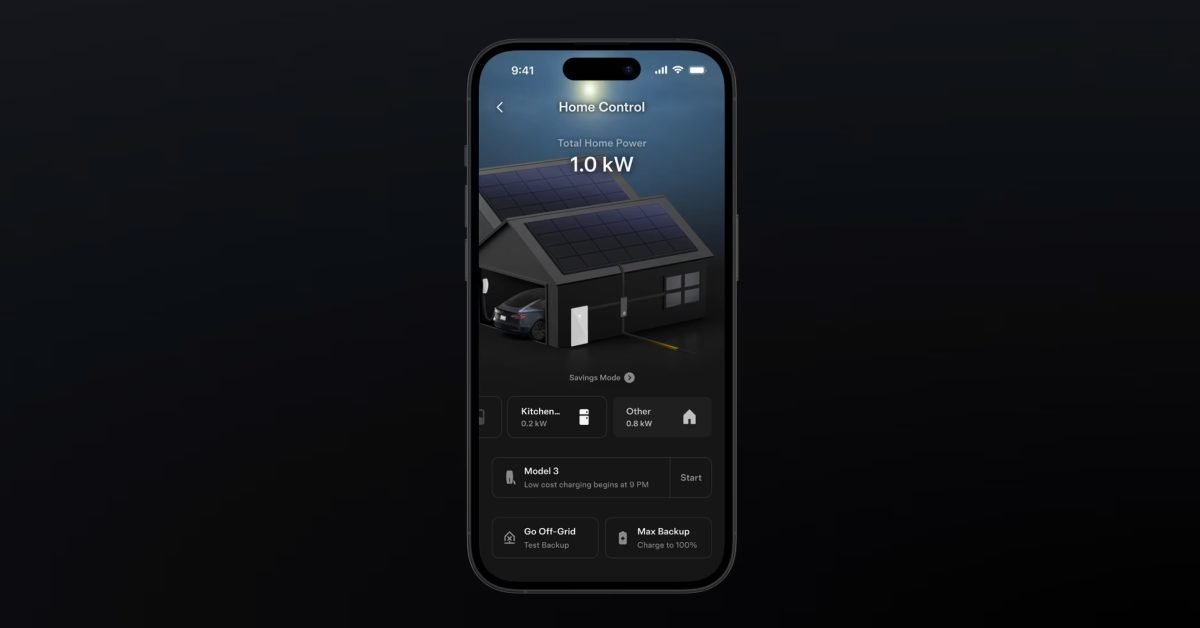
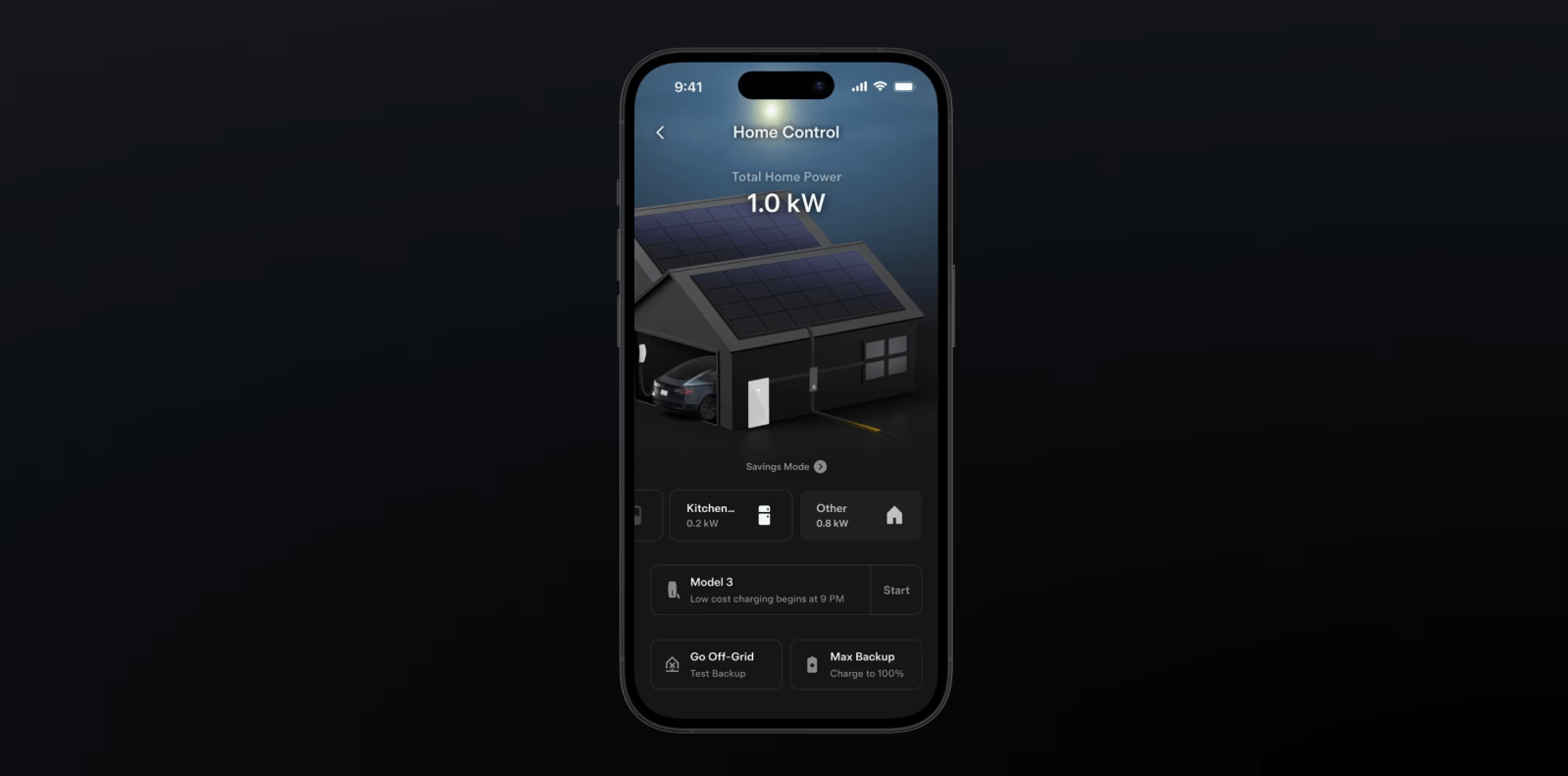
Tesla has launched Tesla Home, a home energy management platform powered by an AI engine called Opticaster that it says makes “hundreds of decisions” a day about when to store and use electricity to lower your bill.
However, it’s not an entirely new product as Electrek has been reporting on Tesla’s Opticaster for 5 years.
What Tesla Home actually is
According to Tesla’s own support page, Tesla Home “controls your home battery, solar, Wall Connector and smart breakers to optimize electricity consumption in your home and increase your energy savings.” It comes standard on every Powerwall, with no additional hardware required for existing owners.
The pitch is a single interface that ties together the products Tesla already sells — Powerwall, solar panels, Solar Roof, the Wall Connector, and now Eaton’s AbleEdge smart breakers — and lets homeowners pick a goal. Choose “Savings” and the system minimizes your bill against utility rates; choose “Self-Powered” and it prioritizes running the house on stored solar after dark.
Tesla describes four functions on the page: goal setting, optimization, control, and visibility. Through the Tesla app, owners can see each decision the system makes and “why it made that choice.”
The engine is Opticaster — and it’s been running for years
The AI doing the work is Opticaster, which Tesla calls “the artificial intelligence (AI) engine for smart energy management that runs on every Powerwall.” It forecasts solar production and home loads, then builds a personalized dispatch strategy to hit whatever goal the owner sets.
Here’s where the “launch” framing gets thin. Opticaster is not a new product. On its dedicated Opticaster page, Tesla describes it as “the fundamental machine learning and optimization engine for Tesla energy software” and part of Autonomous Control, the same suite that powers Tesla’s Autobidder trading software.
Tesla says Opticaster “has accumulated over a hundred million hours of operational experience, delivering tens of millions of dollars in value from opex savings and grid service revenue to thousands of Tesla customers globally.” It’s the software behind Tesla’s utility-scale deployments and its virtual power plants, which paid Powerwall owners nearly $10 million in 2024. Every Tesla site — Powerwall, Powerpack, and Megapack — already ships “Opticaster-enabled.”
In other words, Tesla Home is largely a consumer-facing name and interface wrapped around software that has been optimizing batteries in the field for years.
What’s genuinely new
The real change landed in the Tesla app, version 4.58.6, which began rolling out this week. It consolidates previously scattered energy toggles — backup reserve, off-grid modes, operational modes — into a single “Home Controls” menu and reorganizes settings into Home Settings, Your Products, and Site Configuration.
The update also brings smart breaker integration to the app, letting owners control individual circuits and decide which loads stay live during an outage, plus a “Home Status” feature that uses AI to summarize what the system is doing and why. Rate Plan Charging, which times EV charging to the cheapest hours, works when a Powerwall is paired with a Gen 3 or Universal Wall Connector.
None of this requires new hardware for existing customers. It’s a branding and app-experience consolidation layered on top of features Tesla has shipped piecemeal — including through partnerships like the Tesla-SPAN home energy bundle — and the newer three-phase Powerwall 3P.
Electrek’s Take
Tesla Home is a smart move. It consolidates several products with a rebrand and a UI cleanup. It’s not really a new product.
That’s not a criticism of the underlying technology. Opticaster is genuinely good software, and Tesla’s decision to give residential owners a single, goal-based dashboard on top of it is exactly the kind of thing the home energy space has needed.
Now the question is if Opticaster can deliver the same benefits for residential owners as it does for Tesla’s commercial fleet of stationary energy storage.
If you’re a Powerwall or Tesla owner, pairing your home with solar is the surest way to get the most out of a system like Tesla Home and lock in low energy costs. With electricity rates climbing nearly 10% last year, home solar protects you against future rate increases. And with lease and PPA options, you can go solar with zero upfront cost and start saving immediately. If you want to find the best deal, check out EnergySage. It’s a free service with hundreds of pre-vetted installers competing for your business, so you save 20 to 30% compared to going it alone. No sales calls until you pick an installer. Get your free quotes here.


FTC: We use income earning auto affiliate links. More.