

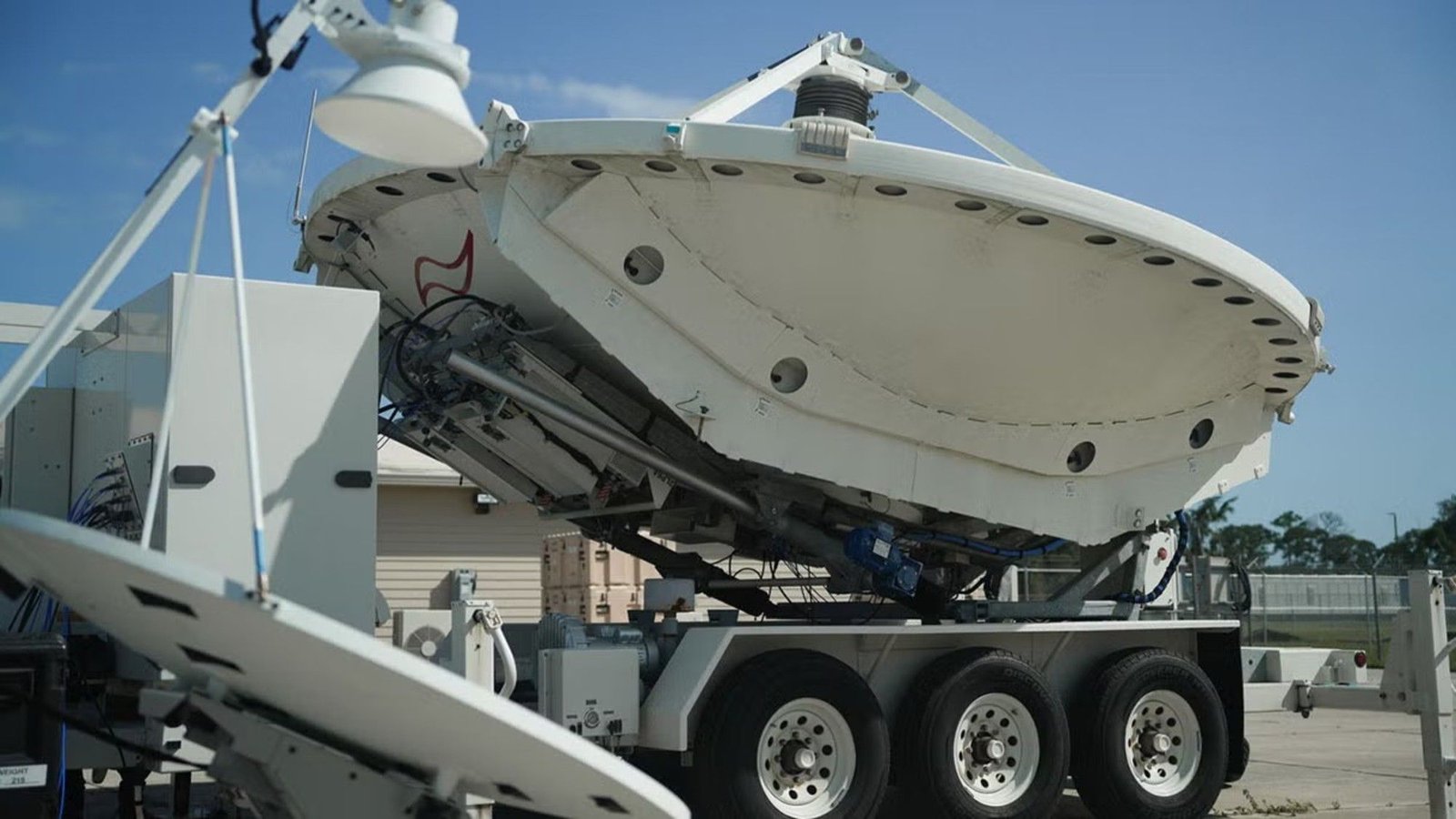
The U.S. Space Force has acquired one of its first publicly acknowledged offensive weapons, one that can blast adversary satellites with beams of electromagnetic radiation to disrupt their signals without physically damaging them.
The system, known as Meadowlands, was developed by L3 Harris. It is an electromagnetic warfare system, meaning it is designed to disrupt, deny or degrade an adversary’s use of the electromagnetic spectrum — such as radio waves, for example — rendering their satellites effectively silent, unable to communicate or share data with forces on the ground. These are “reversible effects,” meaning they don’t permanently destroy satellites but instead jam or interfere with signals being transmitted to or from them.
Or, as the Space Force puts it, Meadowlands provides the U.S. military with a “robust toolkit for spectrum dominance,” according to a statement. Based on the few publicly available photos shared by the U.S. Space Force, Meadowlands appears to consist of an antenna dish mounted to a wheeled trailer, which presumably could allow it to be transported either by ground or a large cargo aircraft. This would allow it to be deployed in areas where adversary satellites might be stationed overhead.
According to available budget documentation, Space Force requested nearly $460 million in Fiscal Year 2027 to develop Meadowlands and the support and training needed to field it.
Space Force leadership has repeatedly stated that these types of systems are key to the U.S. military’s current emphasis on space-based warfare. “Continued U.S. Space Force investment in electromagnetic warfare systems, software, and advanced training is essential to modern warfare,” said U.S. Space Force Col. Angelo Fernandez, commander of Mission Delta 3 – Space Electromagnetic Warfare, a unit tasked specifically with operating systems such as Meadowlands.
In the same statement, the Space Force said that these types of capabilities were central to the success of Operation Midnight Hammer, a June 2025 offensive in which the U.S. military attacked nuclear sites in Iran.
During that conflict, “electromagnetic warfare professionals successfully created a silence zone to ensure secure bomber ingress and egress, effectively halting adversary communications to provide vital indications and warnings,” Space Force said in the statement.
Gen. Chance Saltzman, the service’s current Chief of Space Operations, cited how Space Force personnel employed the same types of capabilities during the ongoing conflict with Iran in a keynote speech at the Space Foundation’s annual Space Symposium in April 2026.
“On day one of Operation Epic Fury, one of these specialists led the planning and execution of high-tempo space electronic warfare fires for U.S. Central Command,” Saltzman said. “That’s what it means to be a Guardian in today’s Space Force.”
The service has been procuring these types of systems and training its personnel in what it calls orbital warfare since the Space Force was created back in 2019. Because satellite surveillance and communication systems are so vital to the battlefields of today, the ability to disrupt an adversary’s use of space is a highly sought-after one by militaries worldwide.