

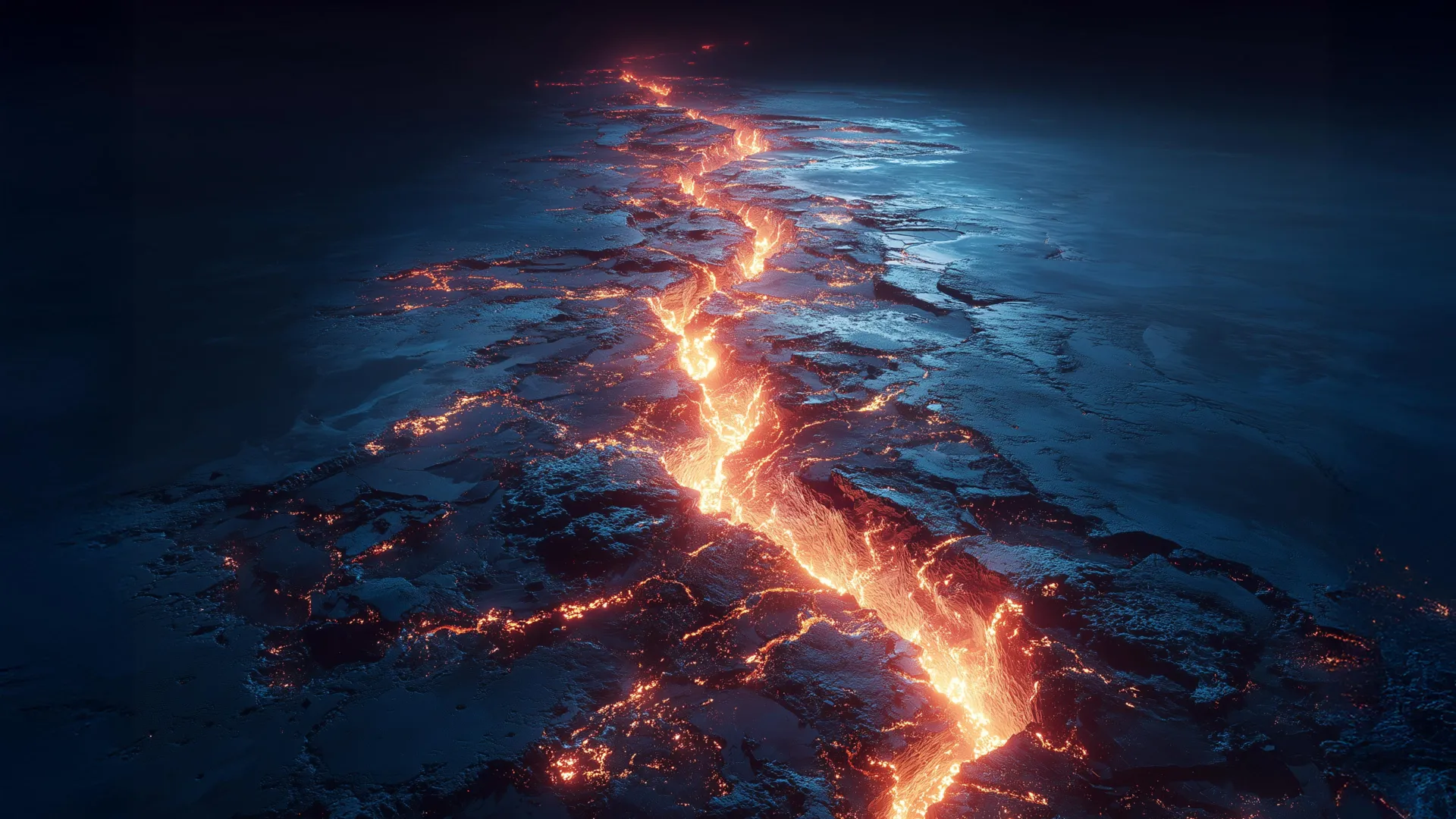
Scientists have discovered that one of the most extreme volcanic events in Earth’s history did more than build a massive underwater plateau. It also altered the structure and chemistry of the oceanic plate beneath it.
A research team led by Lecturer Azusa Shito of Okayama University of Science, working with Associate Professor Akira Ishikawa of the Institute of Science Tokyo and Professor Masako Yoshikawa of Hiroshima University, used seismic waves to investigate the deep structure beneath the Ontong Java Plateau. Their results suggest that enormous volumes of magma pushed through the existing plate, creating networks of vertical intrusions and chemically transforming the surrounding rock.
The findings were published in Geophysical Research Letters.
A Hidden Structure Beneath the Ontong Java Plateau
The oceanic plate beneath the Ontong Java Plateau (OJP) does not appear to have the relatively simple structure expected of a typical oceanic plate. Instead, the researchers found evidence of a composite interior made up of horizontal layers crossed by swarms of vertical magma pathways.
These vertical features are known as dikes. Dikes form when molten rock forces its way through cracks and then cools inside them. Large groups of these intrusions, called dike swarms, can preserve a record of intense volcanic activity long after the magma has solidified.
The team also detected unusually low seismic wave speeds within the plate. This suggests that magma rising from deep inside Earth did not simply pass through the plate. It likely changed the plate’s chemical composition as well.
The Largest Oceanic Plateau on Earth
The Ontong Java Plateau (OJP) lies beneath the western Pacific Ocean and is the world’s largest oceanic plateau. Oceanic plateaus are enormous elevated regions of seafloor formed by the eruption of vast quantities of lava.
The OJP formed approximately 110-120 million years ago during a period of extraordinary submarine volcanism. This event is considered the largest volcanic outpouring known in Earth’s history.
Scientists have proposed that the eruption released enough heat, gases, and volcanic material to severely disrupt the global environment. It may also have contributed to mass extinctions by changing ocean chemistry, climate, and the amount of oxygen available in seawater.
Recent research indicates that the volcanic event may have been driven by a thermochemical plume rising from deep within the mantle. A mantle plume is a column of unusually hot material moving upward through Earth’s interior. A thermochemical plume also differs chemically from the mantle around it and may carry material recycled from ancient oceanic crust.
Although such plumes can produce enormous amounts of magma, scientists have not fully understood how that magma affects an oceanic plate that already exists above it.
Seismic Waves Reveal the Plate’s Interior
To examine the plate beneath the OJP, the researchers studied high frequency seismic signals called Po and So waves. The waves were recorded by ocean bottom seismometers positioned around the plateau and by instruments installed on nearby oceanic islands.
Po and So waves travel through oceanic plates rather than moving only through the surrounding mantle. Because their speed and strength depend on the rocks they pass through, they can reveal hidden layers, fractures, and other structures deep below the seafloor.
Under typical conditions, Po and So waves form when P and S waves scatter repeatedly through layered structures inside an oceanic plate. This repeated scattering allows the signals to travel for several thousand kilometers.
The waves recorded near the OJP behaved in an unusual way. Po waves moved through the region efficiently, while So waves weakened dramatically.
This difference provided an important clue that the plate beneath the plateau has a more complicated internal structure than most oceanic plates.
Ancient Magma Channels Cross the Plate
The scientists used seismic waveform modeling to determine what type of structure could produce the observed wave patterns.
Their results indicate that the plate contains layered structures (horizontal lamination) intersected by dike swarms (vertical intrusion). The horizontal layering allows some seismic waves to travel long distances, while the vertical intrusions appear to disrupt and weaken others.
The discovery provides evidence that magma once rose through the existing oceanic plate along many separate pathways. Together, these pathways formed a broad underground network beneath the growing plateau.
Magma May Have Changed the Plate’s Chemistry
The team found another major difference between the OJP and ordinary oceanic plates. Both Po and So waves traveled significantly more slowly beneath the plateau.
Seismic waves tend to slow down when they pass through rocks that are hotter, less rigid, fractured, or chemically different from typical mantle material. The researchers concluded that structure alone could not fully explain the unusually low speeds.
They propose that magma from a thermal-chemical plume rose through the plate, created the dike swarms, and then reacted with the surrounding mantle rock. This process caused chemical modification (i.e. refertilization) of the plate.
Refertilization occurs when magma restores chemical components to mantle rock that previously lost them during partial melting. The mantle is largely made of a rock called peridotite. When part of that rock melts, some elements are removed with the molten material. Later magma can return those components, changing the rock’s mineral content and physical properties.
Giant Eruptions Can Transform Oceanic Plates
The results suggest that massive volcanic events can do much more than cover the seafloor with thick layers of lava. Magma rising from deep within Earth can fracture an oceanic plate, form extensive dike networks, and alter the chemistry of the plate itself.
This model of physicochemical modification could improve scientists’ understanding of how oceanic plates develop and how large volcanic provinces reshape Earth’s interior.
The study was published in Geophysical Research Letters.
Key Findings
- The oceanic plate beneath the Ontong Java Plateau (OJP) has a complex structure made up of horizontal layers crossed by dike swarms.
- Unusually slow seismic waves suggest that magma from a thermochemical plume chemically altered the plate.
- The findings show that large scale volcanic activity can significantly change both the physical structure and chemical composition of an oceanic plate.
Notes
Thermochemical plume:
A mantle plume ascending from deep within the mantle whose constituent material differs chemically from the surrounding mantle and may include components derived from ancient oceanic crust.
Refertilization:
Peridotite in the mantle becomes depleted in melt components when melt generated by partial melting is extracted. The process by which melt components are reintroduced into such depleted peridotite is referred to as refertilization.