

Close Menu

    Subscribe to Updates

    Get the latest news information from worldwide businesses.

    What's Hot

    Hyundai cuts IONIQ 5 N EV prices by $6,300

    July 15, 2026

    Want to Work from Abroad? The Top 10 Digital Nomad Visas for 2026

    July 15, 2026

    ‘I thought it was cellulite’: Debinna Bonnerjee reveals lipedema

    July 15, 2026
    Facebook Instagram YouTube LinkedIn X (Twitter)
    Trending
    • Hyundai cuts IONIQ 5 N EV prices by $6,300
    • Want to Work from Abroad? The Top 10 Digital Nomad Visas for 2026
    • ‘I thought it was cellulite’: Debinna Bonnerjee reveals lipedema
    • Are humans really the ultimate super-predator?
    • Amended RPwD Act to include persons internally injured by acid ingestion, Centre tells Supreme Court
    • NSAID Use Associated With Reduced Periodontal Bone Loss in Postmenopausal Women, suggests study
    • The rise in cyclosporiasis cases goes beyond Taco Bell
    • Microsoft patches bug in video game Age of Empires II
    Newspublicly
    • About Us
    • Advertise & Partner with us
    • Pitch Your Story
    • Contact Us
    Facebook Instagram LinkedIn X (Twitter)
    Subscribe
    • Home
    • World News
      • Asia
      • India
      • USA
      • UK & Europe
      • Middle East
    • Economy & Business
      • Global Economy
      • Corporate & Industry
      • Finance & Markets
      • Policy & Trade
    • Technology
      • Gadgets & Devices
      • Software & Apps
      • AI & Machine Learning
      • Robotics & Automation
    • Health & Medicine
      • Fitness & Nutrition
      • Research & Innovation
      • Disease & Treatment
      • Doctors, Clinics & Patient Care
    • Travel & Tourism
    • Automobile
      • Electric & Hybrid Vehicles
      • Auto Industry Insights
    • Sports
    • More
      • Education
      • Real Estate
      • Environment & Climate
      • Space & Astronomy
      • War & Conflicts
    Newspublicly
    Home»Health & Medicine»Research & Innovation»NASA captured the Black Sea turning brilliant turquoise from space
    Research & Innovation

    NASA captured the Black Sea turning brilliant turquoise from space

    AdminBy AdminJuly 15, 2026No Comments3 Mins Read0 Views
    Share
    Facebook Twitter LinkedIn Copy Link WhatsApp


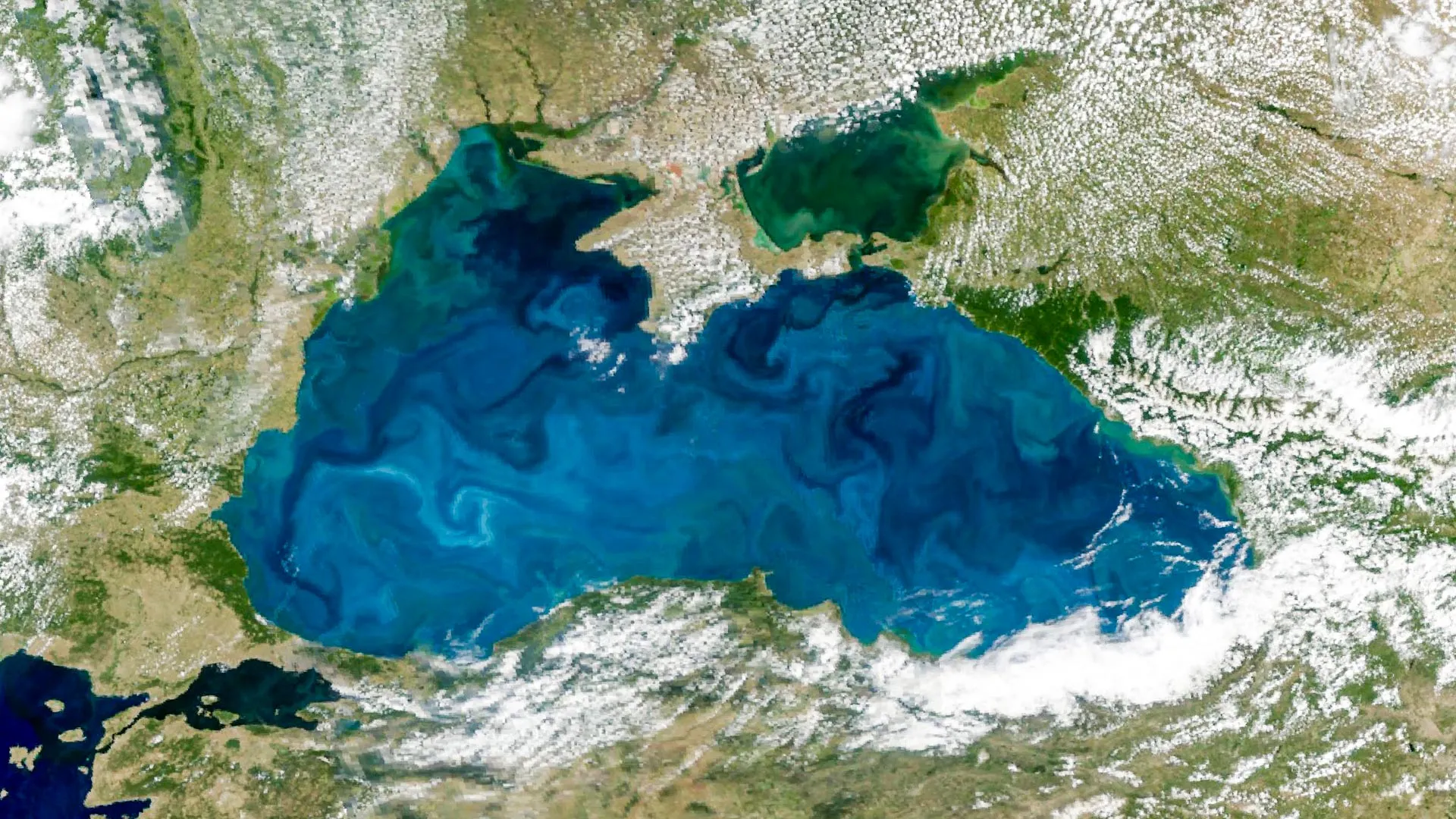
    The Black Sea, which lies between Europe and Asia and connects to the Mediterranean through a series of waterways, is known for its dark waters. But every spring and summer, it undergoes a remarkable transformation, with large areas turning a vivid turquoise. On June 22, 2026, NASA’s PACE (Plankton, Aerosol, Cloud, ocean Ecosystem) satellite captured this colorful seasonal display using its OCI (Ocean Color Instrument).

    Scientists believe the striking turquoise color comes from blooms of coccolithophores, microscopic phytoplankton coated in calcium carbonate plates. When these organisms multiply in enormous numbers during late spring and early summer, their reflective shells scatter sunlight and give the ocean a milky blue appearance that is visible even from space.

    At other times of the year, different microscopic algae called diatoms become more abundant. Unlike coccolithophores, diatoms have silica shells and generally make the Black Sea appear darker instead of brighter.

    Bosphorus Also Glows Turquoise

    The seasonal bloom extended into the Bosphorus, the narrow waterway that runs through Istanbul and links the Black Sea with the Sea of Marmara. On May 27, 2026, about a month before the PACE satellite captured the wider scene, an astronaut aboard the International Space Station photographed the strait as blooming phytoplankton traced swirling currents on both sides of the channel. (Note that north is oriented toward the bottom of the frame.)

    Why These Blooms Matter

    Although individual coccolithophores are far too small to see with the naked eye, their populations can become so dense that entire regions of ocean change color. Because these blooms are easily detected from orbit, satellite observations provide scientists with an important way to monitor marine ecosystems in areas where collecting water samples is difficult.

    These phytoplankton also play an important role in Earth’s carbon cycle. As they grow, they absorb carbon from the atmosphere and surrounding water. After they die, a portion of that carbon sinks to the seafloor, where it can remain stored for long periods, helping transfer carbon from the surface ocean into long term storage.

    NASA Earth Observatory created the satellite image using PACE data from NASA EOSDIS LANCE, GIBS/Worldview, and the NASA Ocean Biology Distributed Active Archive Center OB.DAAC. The astronaut photograph (ISS074-E-619520) was taken on May 27, 2026, by a member of the Expedition 74 crew using a Nikon Z9 camera with a 50 millimeter focal length. The image was cropped, enhanced to improve contrast, and corrected to remove lens artifacts.

    The photograph was provided by the ISS Crew Earth Observations Facility and the Earth Science and Remote Sensing Unit at NASA Johnson Space Center. Through the International Space Station Program and the ISS National Lab, astronauts regularly capture images of Earth that support scientific research and are made freely available to researchers and the public. Additional photographs taken by astronauts and cosmonauts can be viewed through the NASA/JSC Gateway to Astronaut Photography of Earth.


    Source link

    Author

    • Admin

      NewsPublicly.com is News & Articles Platform that creating SEO-focused articles on travel, lifestyle, and digital trends.

    Admin
    • Website

    NewsPublicly.com is News & Articles Platform that creating SEO-focused articles on travel, lifestyle, and digital trends.

    Related Posts

    Are humans really the ultimate super-predator?

    July 15, 2026

    Archaeologists found Homer’s Iliad inside a 1,600-year-old Egyptian mummy

    July 15, 2026

    This pet gecko could help scientists unlock the secrets of cancer

    July 15, 2026
    Leave A Reply Cancel Reply

    Demo
    Top Posts

    The Blue Moon rises on May 30— Where and when to see the second full moon of the month

    May 30, 202640 Views

    New SOCOM rifle allows barrel swapping and cartridge changes

    June 1, 202633 Views

    “Inside Gemini Robotics 1.5: How Robots Learn to Reason & Act

    November 22, 202526 Views

    525 pounds of cocaine seized after Nebraska K9 alerts troopers on I-80

    May 28, 202624 Views
    Don't Miss

    Hyundai cuts IONIQ 5 N EV prices by $6,300

    July 15, 20263 Mins Read0 Views

    Hyundai slashed prices on the all-electric 2026 IONIQ 5 N by $6,300, making it more…

    Want to Work from Abroad? The Top 10 Digital Nomad Visas for 2026

    July 15, 2026

    ‘I thought it was cellulite’: Debinna Bonnerjee reveals lipedema

    July 15, 2026

    Are humans really the ultimate super-predator?

    July 15, 2026
    Stay In Touch
    • Facebook
    • Twitter
    • Instagram
    • YouTube
    • LinkedIn
    • WhatsApp

    Subscribe to Updates

    Get the latest creative news from SmartMag about art & design.

    Demo
    NEWSPUBLICLY
    Facebook X (Twitter) Instagram LinkedIn

    Home

    • About Us
    • Leadership
    • Advertise & Partner With Us
    • Pitch Your Story
    • Media Kit & Pricing
    • Career
    • FAQs

    Guidelines

    • Editorial & Submission
    • Partnership
    • Advertising & Sponsor
    • Intellectual Property Policy
    • Community & Comment
    • Security & Data Protection
    • Send Your Opinion

    Quick Links

    • Cookie Policy
    • Payment & Billing Terms
    • Refund & Cancellation
    • Copyright Policy
    • Complaint & Support
    • Sitemap
    • Contact Us

    Subscribe Us

    Get the latest news and updates!

    Copyright © 2026 Newspublicly (DIGITALIX COMMUNICATION). All Rights Reserved.
    • Privacy Policy
    • Terms of Use
    • Disclaimer