

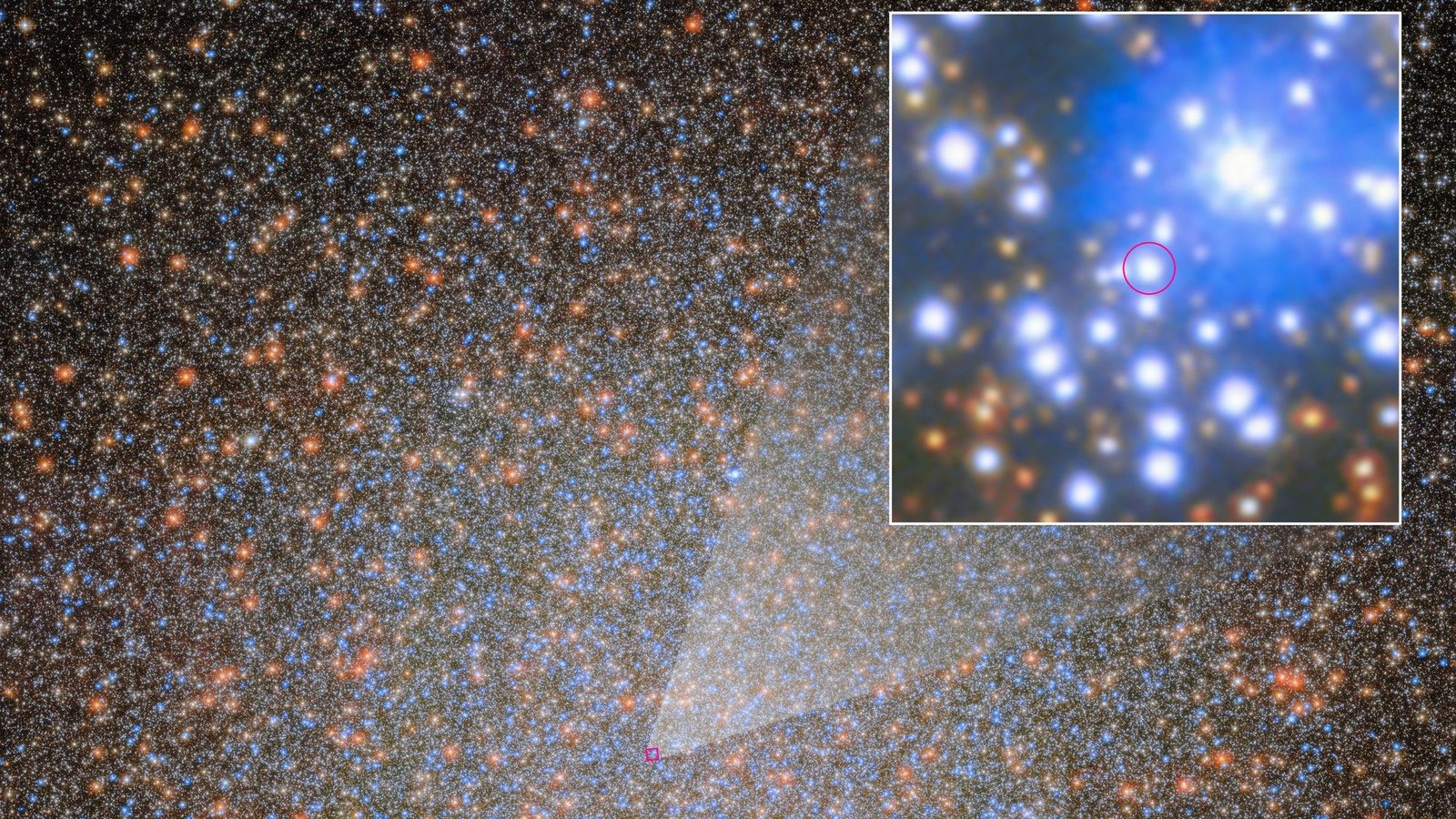
The first of 10,000 missing black holes in the Omega Centauri globular cluster has been found thanks to teamwork by the Hubble and James Webb space telescopes.
The two observatories discovered the black hole after watching a star orbiting around something massive but dark, and which therefore could not be seen. The Hubble data ran from 2003 to 2023, and the James Webb Space Telescope picked up after that to help refine the measurements.
Astronomers used the space telescopes to focus on a particular star in a binary system that appeared to be home to another, dark object called oMEGACat BH-2. Previous studies had suggested that the dark object was a neutron star. However, the new results are conclusive: the object has a mass 4.46 times that of the sun. This is too massive to be a neutron star, so it must therefore be a black hole.
Omega Centauri is the most massive of our Milky Way galaxy‘s globular clusters. It is so massive that astronomers suspect that it is actually the core of a dwarf galaxy that has lost most of its stars to the Milky Way’s gravitational cannibalism, which over the aeons has torn strips from Omega Centauri. Even so, Omega Centauri still contains about 10 million stars, collectively located 18,000 light-years from Earth.
In 2024, astronomers using the Hubble Space Telescope found clinching evidence that an intermediate-mass black hole – one that has a mass about 8,200 times that of our sun – lurks at the center of Omega Centauri, strengthening its claim of being the remnant of a dwarf galaxy, since galaxies harbor black holes at their center but star clusters typically do not.
However, alongside this intermediate-mass black hole should be about 10,000 other stellar-mass black holes born from the supernova explosions of massive stars. Searches have focused on binary systems where a star orbits a compact object, but until now astronomers had drawn a blank.
Now, a team led by Matthew Whitaker of the University of Utah in Salt Lake City have come along to save the day by diligently sifting through 20 years of Hubble observations, plus additional supporting views from the JWST, to uncover a stellar-mass black hole in Omega Centauri for the first time.
Whitaker’s team used a technique called astrometry, which is the measurement of the changing positions of stars as they move through space. Although the black hole itself is dark, it is orbited by a normal star with a mass 78% that of our sun. Thanks to the unprecedented vision of Hubble and the JWST, Whitaker and his colleagues were able to track the motion of this star around the black hole.
It turns out that the star is on a 94-year-long orbit around the black hole, which is the widest separation of a binary composed of a stellar-mass black hole and star ever found. Over that 20-year-period, Hubble saw less than a quarter of the star’s total orbit, but it coincided with the star’s closest approach to the black hole, during which the star moved faster.
Based on this motion, Whitaker’s team were able to measure the strength of the black hole’s gravitational field acting on the star, and from that calculate the mass of the black hole.

“The precision of these measurements is incredible, down to a fraction of a pixel on Hubble and Webb’s detectors,” said Whitaker in a statement. “It would not have been possible to find this black hole without these two space telescopes.”
Given how wide the orbit of the star is around the black hole, the likelihood is that the black hole’s gravity captured the star when it passed close. This is a state of affairs that will not last forever; within another billion years, encounters with other stars in the crowded environs of the cluster will probably pluck the black hole’s companion away.
The mass of oMEGACat BH-2 does seem unusual, however, in the sense that it is lower than expected. The mass of oMEGACat BH-2 exists in a void that has only become apparent during the past eleven years of gravitational wave detections. These gravitational waves are produced by the mergers of stellar-mass black holes, but black holes with masses between 2.5 times the mass of our sun (the theoretical limit for neutron stars) and five solar masses are conspicuous by their absence in the gravitational-wave events. Yet here is oMEGACat BH-2, sitting within that mass gap.
“It’s important to understand black hole populations in globular clusters because there’s uncertainty about their physics and formation,” said Anil Seth of the University of Utah.
“More specifically, understanding the process of forming black holes and then dynamically forming binaries is vital, because it affects our ability to interpret and understand gravitational-wave events. Environments like Omega Centauri are the primary places where we think binaries are merging and creating these waves.”

In particular, the stars of Omega Centauri are more primitive than our sun, chemically speaking, with fewer elements heavier than hydrogen and helium. Which types of massive stars produce black holes when they explode as supernovas is still an area of active research, but oMEGACat BH-2 adds another complication to the mix in that its progenitor star contained few heavy elements.
“We need to figure out how that happens,” said Seth.
So that’s one down, and 9,999 or thereabouts to go. Whitaker’s team continue to use Hubble and JWST data to find more stellar-mass black holes in Omega Centauri, but he also highlights the potential of NASA’s Nancy Grace Roman Space Telescope to find black-hole binary systems in our Milky Way galaxy at least when the telescope launches later this year.
“Roman … will image the crowded galactic bulge, including the galactic center, very regularly with Hubble-like resolution and with a much wider field of view,” said Whitaker. “We’re hoping we’ll be able to find black hole binary systems like this one because of the regular cadence of Roman’s observations.”
The details regarding oMEGACat BH-2 are described in a paper published on July 13 in The Astrophysical Journal Letters.