

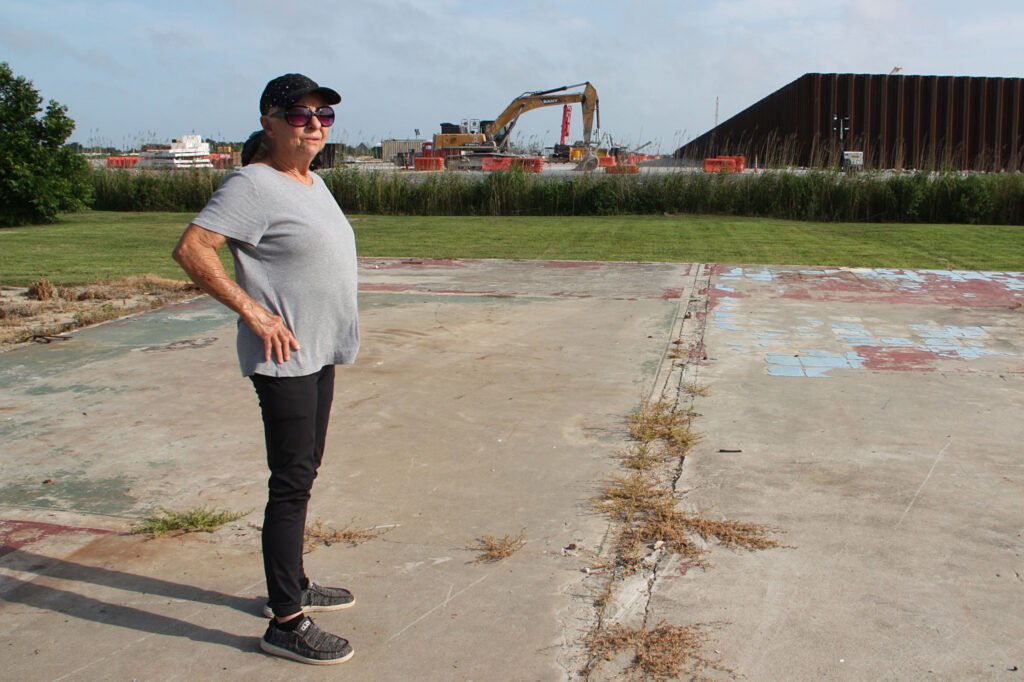
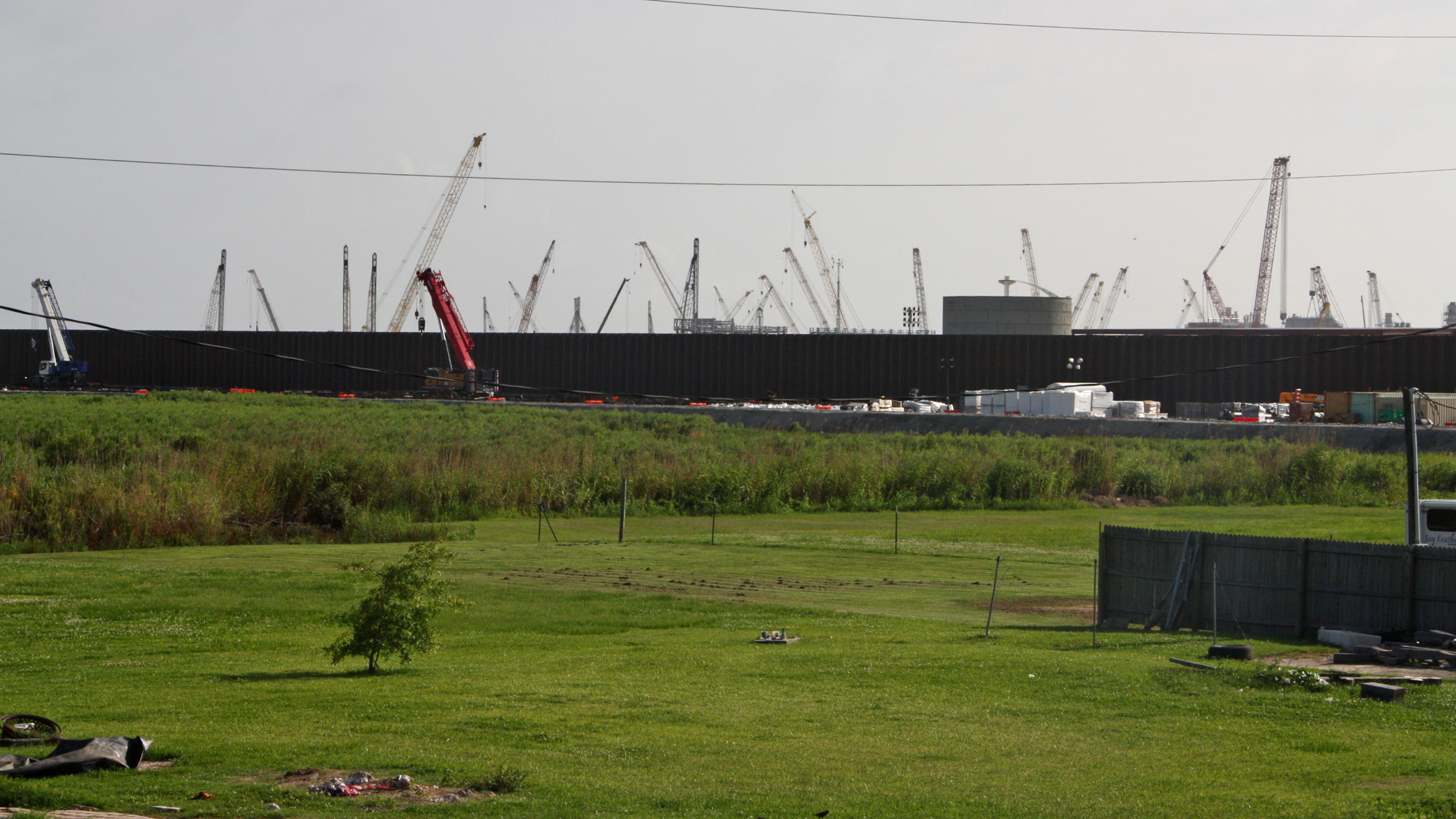
CAMERON, La.—Sherry Peshoff can see the steel wall from her front door. Her home is lifted 12 feet off the ground to protect it from stormwaters that surge in off the Gulf, but it’s not as high as the wall.
Rust red and corrugated, the 31.5-foot-high solid steel fence circumscribes a natural gas export terminal that sprawls across 1,150 acres where grasslands stood just a year ago. The wall is meant to hold back the type of storm surges that pushed through here when Hurricane Rita hit in 2005, followed by Ike in 2008 and Laura and Delta in 2020.
Before the storms, Cameron was home to some 2,000 people. Today, fewer than 200 remain. In their place, a company called Venture Global is building a complex of liquefied natural gas terminals that will be one of the largest in the country. The industrial operations cluster together gas-fired turbines and compressors to super-cool methane gas until it becomes a liquid, which is then pumped into tankers and shipped across the ocean.
Liquefied natural gas, or LNG, is one of the oil and gas industry’s most lucrative wins. Over a decade, the United States went from nothing to become the world’s largest exporter, and output is expected to nearly double between now and 2029. The growth defied the Biden administration’s goal of reining in climate pollution and has been super-charged by the Trump administration’s pro-fossil-fuel agenda.
No LNG exporter is growing faster than Venture Global. Started by a former investment banker and a Washington lawyer, the company was built in the mold of its founders.
“Ultimately our business is that we manufacture and operate machines that produce money,” the company’s chief executive, Michael Sabel, told CNBC on the day he took his company public last year.
Sabel and his co-founder Robert Pender set out to build LNG terminals faster and cheaper than their competitors. They borrowed big, built fast and today they are making money like never before, buoyed by the Trump administration’s permissive oversight and its war in Iran that has sent global natural gas prices surging. “Unstoppable energy” is the company’s new tagline.
Venture Global’s growth has made Sabel and Pender enormously wealthy, with compensation last year of more than $39 million and $12 million respectively, and net worths in the billions—the pair own nearly 80 percent of the company’s stock. Since the United States started bombing Iran, several other company insiders have collectively netted more than $246 million by selling Venture Global stock, the price of which spiked during the war, according to an analysis by the advocacy group Friends of the Earth and confirmed by Inside Climate News.
“It’s hard to think of a company that has more effectively turned international turmoil into money and expansion than Venture Global,” said Lukas Shankar-Ross, deputy director of the climate and energy justice program at Friends of the Earth, who performed the analysis.
Like many success stories, Venture Global’s has come at others’ expense. In its first year of operation, the company’s Calcasieu Pass terminal, or CP1, which looms over what’s left of Cameron, spewed hundreds of thousands of pounds of methane, carbon monoxide, volatile organic compounds and other hazardous pollutants into the air, registering 139 exceedances of its air permits, state regulators say. Some lasted months. Last year, as the company started building CP2 right next door, its dredging operation released mud and silt into waterways, killing or damaging millions of oysters, according to fishermen and a lawsuit filed by an oyster farm.
Venture Global has faced allegations in legal claims from its Big Oil customers for violating contracts, from former employees for blocking stock option purchases and from environmental groups and fishermen for damaging ecosystems, livelihoods and public health.
Scott Eustis, the community science director for Healthy Gulf, a Louisiana environmental group, said the LNG terminals are accelerating the demise of the state’s coastal communities.
“These are the doomsday machines,” Eustis said. CP1 and CP2, along with a third Venture Global terminal in Plaquemines Parish, are now among Louisiana’s largest new sources of climate pollution. Meanwhile, they were built on some of the most climate-vulnerable land in the country, in the path of frequent storms and no more than a few feet above sea level. And like many Cameron residents, Venture Global is at least partly uninsured against hurricanes—for certain storm risks, the company is not covered by a third party, according to its annual securities filing.
“It really just feels like we really are trading our future away just to backfill holes in the parish budget,” Eustis said.
While it might not seem like it, the LNG business as a whole is a precarious bet.
With American gas relatively cheap and plentiful, companies have been rushing to build terminals to sell it overseas. After Iran retaliated against the U.S.-Israeli bombing campaign by hitting LNG terminals in Qatar, which ranks third in output, the case seemed to grow even stronger. Analysts consider proposed terminals that were once on the fence now more likely to advance because of the bombings.
Yet the war also shows signs of accelerating efforts by many countries to wean themselves off imported fossil fuels. Many analysts say the LNG boom will eventually lead to a glut. Depending on when the glut hits, and how big it is, companies like Venture Global—which has accumulated more than $36 billion in debt to build its terminals—could land in trouble.
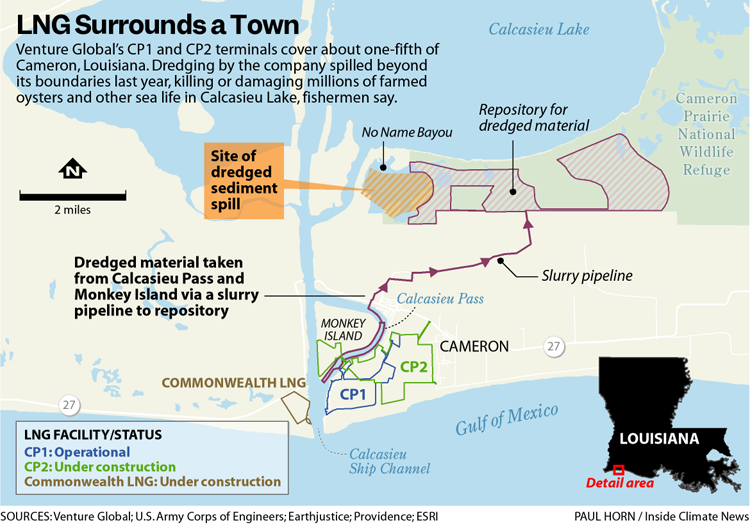
For now, Venture Global is seizing on its wartime windfall to finance rapid expansion. Already, the footprints of the company’s two Cameron projects cover about one-fifth of the entire town. One day it hopes to build a CP3.
Yet little of Venture Global’s good fortune is making its way back to Cameron, some residents say. They had hoped the LNG terminals would bring a second wind. Instead, the industrial activity makes some want to leave.
“I hate this place,” Peshoff said recently, sitting in her living room with CP2 framed out the window. “I never dreamed I would feel this way.”
Peshoff grew up next door, on land adjacent to the site, and raised her family here. But as she gazed out at the terminal, a black sequined cap covering her gray hair, she said the company is making Cameron unlivable, adding, “They think they’re safe with that big wall.”
“Nobody Wants to Buy This”
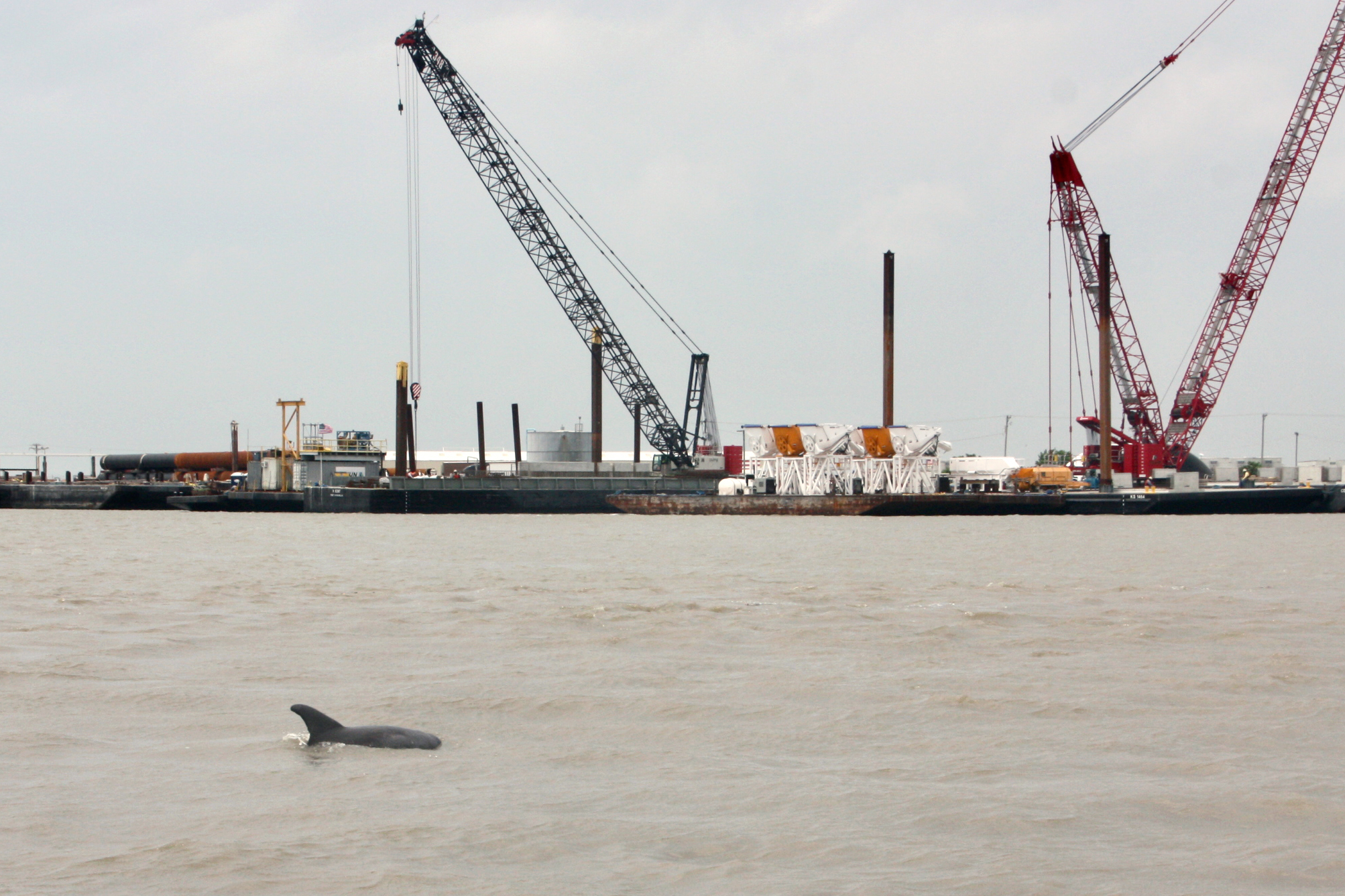
Cameron lies at the end of a long, two-lane highway, past wildlife refuges where alligator roadkill line the shoulder, beyond marsh grasses taller than a truck, out at the end where land gives way to the Gulf of Mexico. The cranes are visible long before town, dozens of them sticking into the sky, building the LNG terminal that now dwarfs anything that was there before.
In addition to Venture Global’s two terminals, another company is building a third directly across the Calcasieu Ship Channel, while two more are either operating or under construction farther up the channel.
Apart from oil and gas, fishing is one of the few local industries. Cameron was one of the most productive seafood ports in the nation until 2014, after a fish oil company closed a local processing plant. Generations have plied the waters of the Gulf and the estuarine Calcasieu Lake for shrimp, crabs, finfish and oysters, paying off mortgages and sending children through college.
It was late July last year when Anthony Theriot, a shrimper and oysterman, first noticed mud in the lake. By the first week of August drone footage had confirmed that mud was spilling from a marsh where a contractor for Venture Global had been pumping the material it was dredging from a nearby channel, home to the docks for CP2.
The mud had leaked into Calcasieu Lake, where Theriot and several others had been farming oysters in floating cages. Photographs show the oysters covered in sludge, even though they sit just beneath the surface. Over the next few weeks, the mud killed or ruined millions of oysters worth millions of dollars, according to the oyster farmers and a lawsuit.
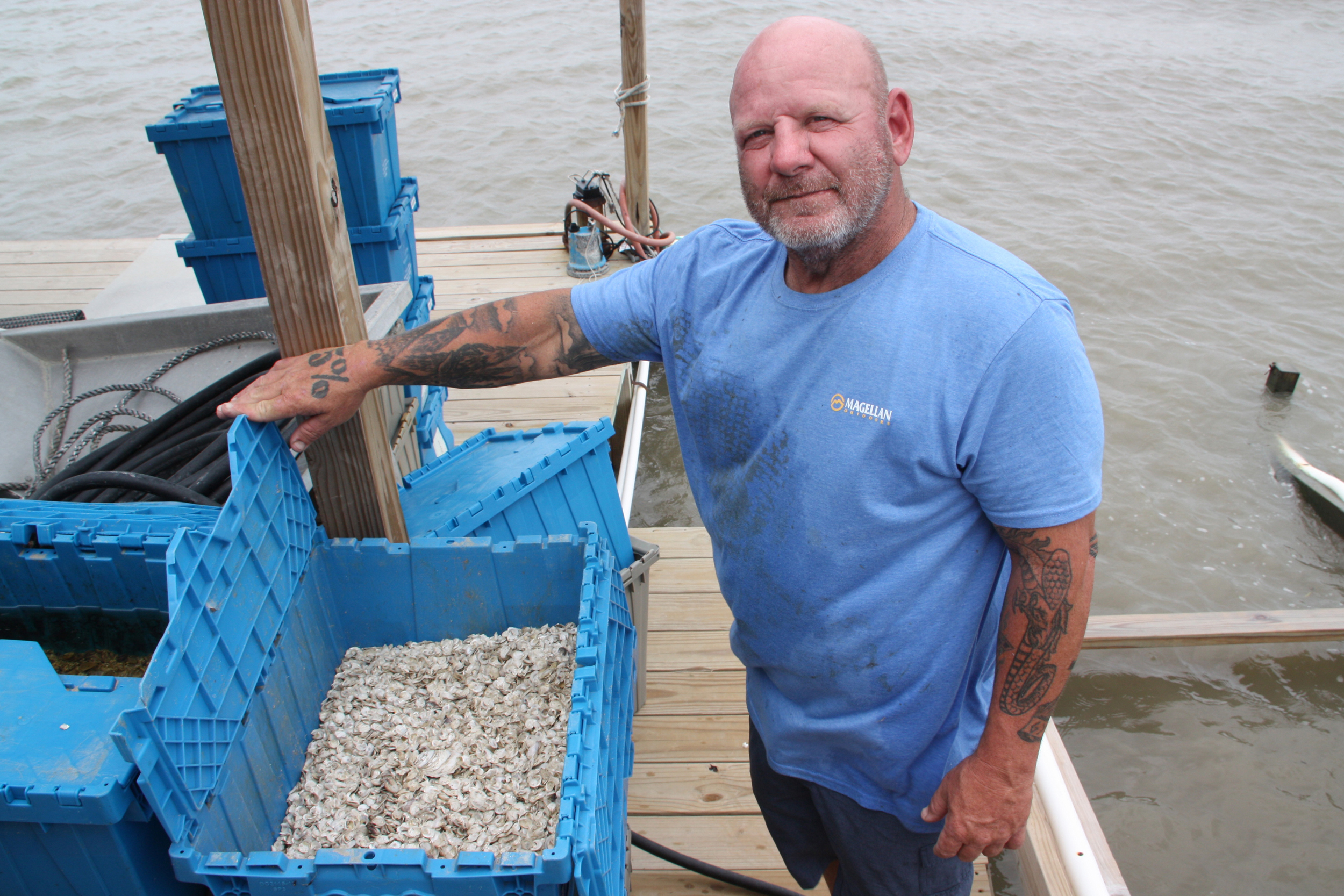
On a windy day this spring, Theriot hauled one of the black plastic cages onto his oyster boat to inspect his crop. Theriot is stocky and bald, with gray stubble on his face and tattoos on his arms. His mom grew up in Cameron, he said, and he started working its waters as a teenager.
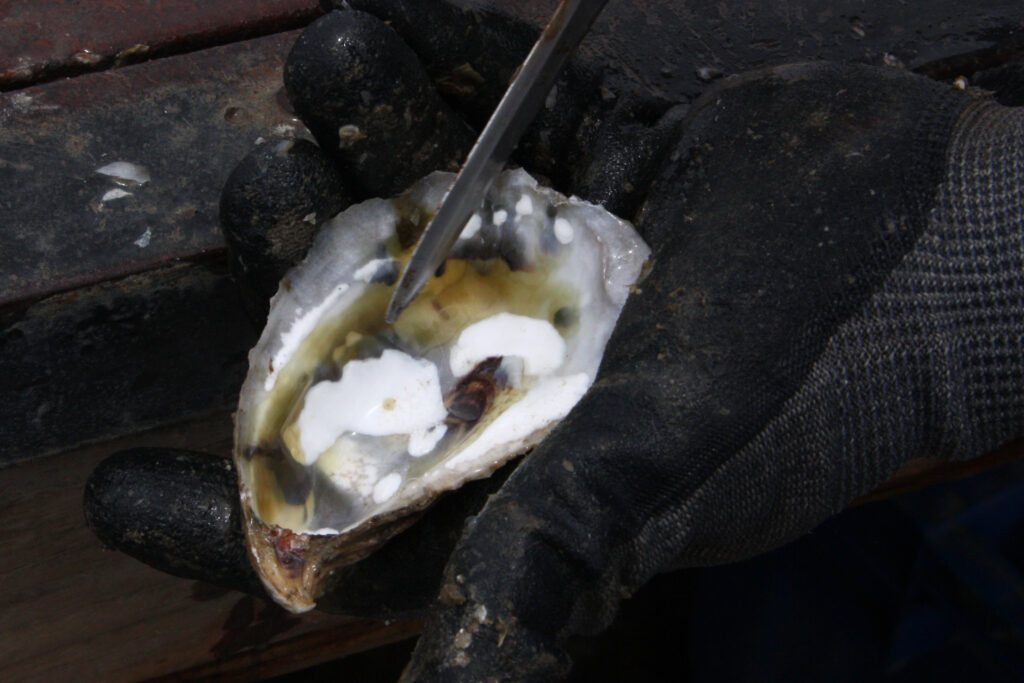
The first batch Theriot pulled was covered with a thin layer of grime. He opened an oyster and cut its flesh off the shell, revealing black streaks on the pearly surface.
“The sediment is getting inside them,” Theriot said, piercing the streak to reveal mud encased in a thin layer of shell. “Nobody wants to buy this and see that on their plate.”
Another oyster farm on the lake was sued by the restaurant it supplied after it started sending inedible oysters. In response, the oyster farm added Venture Global as a third party, saying that company was responsible. Venture Global has asked to be dismissed from the case.
The farm had 5.2 million oysters in the water as of November, according to a court filing, with “the vast majority” of those harvested since the spill unfit for sale.
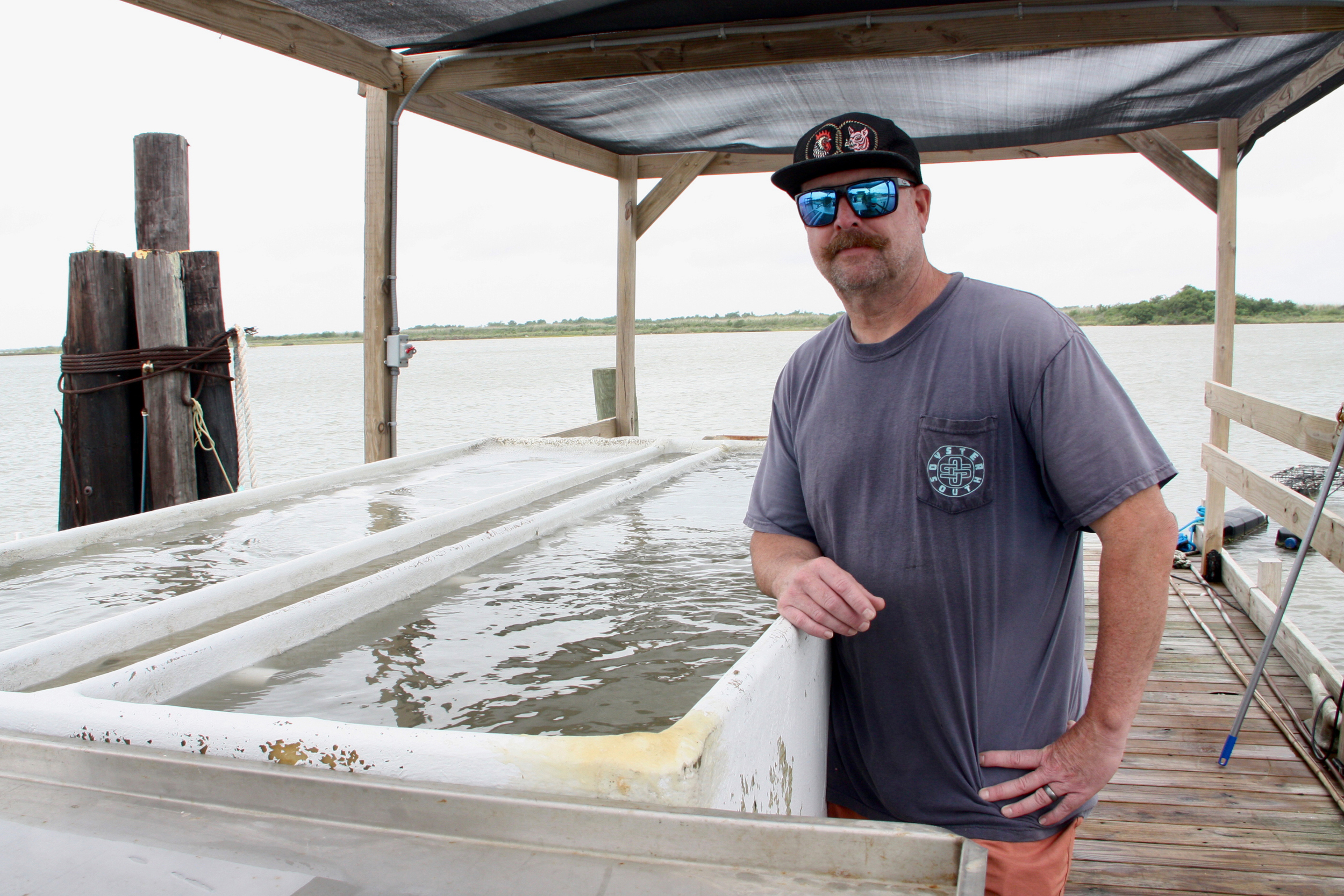
“We try to pull our oysters and take a look at them, see if by chance they’re filtering through,” said David Sorrells, who owns the oyster farm involved in the lawsuit. He was speaking from his dock on the lake, where a tank for cleaning oysters sat empty. “The truth is, they’re not. If anything, they’re getting worse.”
Theriot said he had 750,000 oysters before the spill, worth 50 cents each. Only about 300,000 remain, all unfit for sale so far, he said.
While the dredging was technically the project of the Cameron Parish Port, Harbor and Terminal District, the work was paid for and performed by Venture Global.
The company had been warned that its project could leak. On June 10, 2025, the day dredging began, a manager with the Louisiana Coastal Protection and Restoration Authority sent an email to Peter Bell, a vice president at Venture Global, saying his agency had “consistently voiced concerns” in a series of meetings that the project’s design risked spilling the dredge material beyond its boundaries.
The manager wrote that the company appeared to have an “aggressive schedule” with high pumping rates. He added that his agency “has concerns that these pumping rates and discharge volumes could exacerbate the migration of material into the drainage way.”
Two days later, Bell replied, saying the work would be “closely monitored,” adding that the company wanted to minimize any leaks of material because removing it after the fact “will be challenging.”
The emails were obtained in a public records request and provided to Inside Climate News.
The dredging was halted in early August, after an advocacy group publicized videos showing mud in waterways.
Today, fishermen say sediment from the spill continues to spoil the waters. Site observations in recent months by the Louisiana Department of Conservation and Energy, the state agency overseeing the dredging permit, have continued to find turbid waters next to some ongoing dredging operations related to CP2.
In an email, the department press secretary, Patrick Courreges, said it was requiring Venture Global to restore the area to “pre-spill conditions” by dredging the material that has spilled beyond project boundaries. The company had dredged 33,175 cubic yards as of late May, and the department was reviewing reports submitted by the company to determine whether more work is needed. Courreges said department inspectors had found no evidence of further leaks from the project, which is separate from but adjacent to the ongoing dredging for CP2.
The Cameron Parish Port declined to respond to questions submitted for this article.
Venture Global did not reply to repeated requests for comment, including a list of questions from Inside Climate News, but told other news organizations earlier this year that there were “no significant offsite impacts” from the spill.
Even before the dredging, some fishermen said LNG operations had harmed their work. Theriot told the Federal Energy Regulatory Commission in 2024 that he sustained an “unprecedented” decline in his shrimp harvest in 2022 and 2023, the first two years of operation for CP1. His catch was cut nearly in half the first year and dropped another 40 percent the following year, according to his annual catch records.
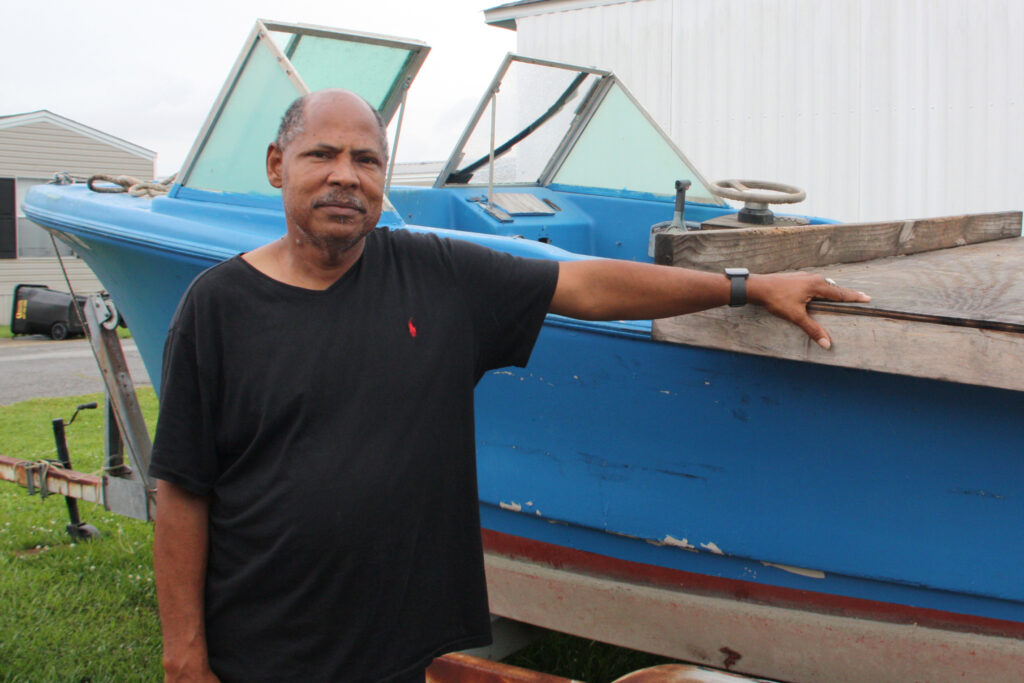
Eddie Lejuine, who catches drum in the lake, has reported declines too. He’s taken to driving 50 miles to Sabine Lake instead because his catches were so bad, adding four hours of driving on his twice-a-day round trips and more than $100 in additional fuel costs daily.
As fishermen kept coming to Venture Global with problems last year, the company started offering $20,000 settlements that required anyone who accepted to sign away rights to sue the company in the future and prohibited them from disparaging it, according to a copy of a settlement agreement obtained by Inside Climate News.
“I thought it was an insult,” Lejuine said, adding that the company’s operations have slashed his catches and increased his costs for years, with his finances deteriorating along the way.
The Louisiana Department of Wildlife and Fisheries said shrimp and finfish landings in the Calcasieu Basin were down more than 30 percent last year from the 10-year average, and had been below average the previous two years, too. But shrimp harvests have declined across the Gulf. A federal fisheries report attributed the drop in catches to imports driving down prices, not fewer shrimp in the water.
When asked if the LNG operations are having an impact on fishing, the state Department of Wildlife and Fisheries said, “no trends in the data indicate a need for adjusting management of commercial species in the basin.”
Venture Global is now seeking a permit to discharge wastewater from CP2 into the ship channel and pass that would include stormwater, “miscellaneous non-process wastewaters, commissioning waters, utility waters, backwashes, condensates, building washdown, and equipment washwater.”
Venture Global offered Theriot more than most fishermen because of his investment in the oyster farm, he said. While he declined to share the amount, Theriot said it was far less than what he lost.
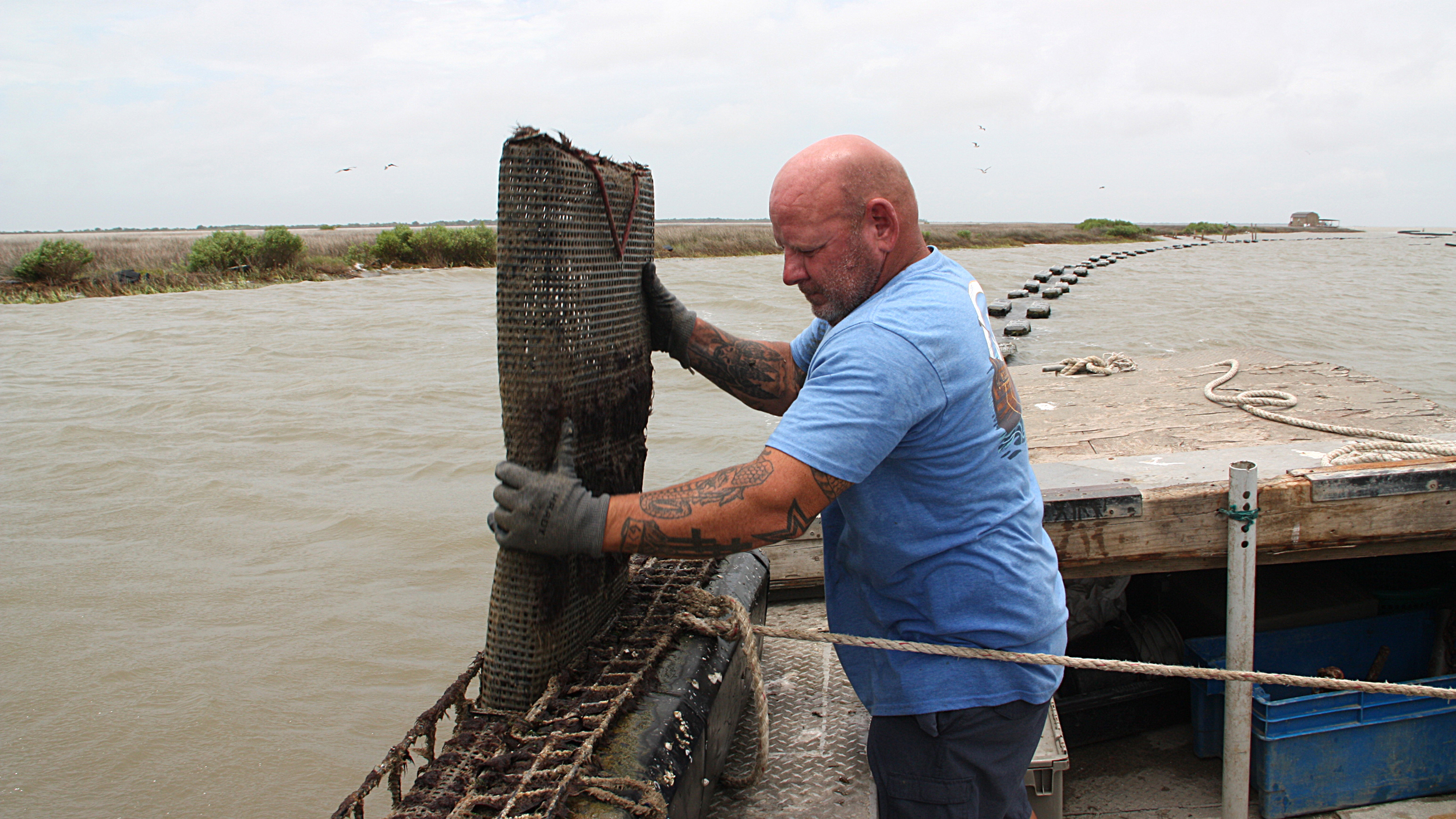
Theriot is part of a small group of locals speaking out against LNG development, drawing rebukes from some in the community who welcome the influx of workers. Sometimes, the backlash has made him doubt himself, he said. “Am I just a complaining person?” Theriot said from his oyster boat, passing the cranes erecting the giant docks where LNG tankers will fill with fuel from CP2. “Your Facebook posts and everything else, that’s what you hear. ‘Y’all are just complaining all the time.’”
But he feels he has few other options. A small group of landowners are getting rich off development, Theriot said, “but the rest of us are all starving.”
A Global Disruptor
Sabel and Pender launched Venture Global in 2013 with a plan to disrupt the nascent LNG industry.
Competitors were building terminals with a small number of massive “trains,” which cool methane to minus 260 degrees Fahrenheit, making it dense enough to ship like oil. Venture Global would build with smaller trains that could be manufactured offsite and strung together to reach the same output. The arrangement would slash costs and speed construction, the founders asserted.
LNG companies make their money on the “spread,” the gap between U.S. natural gas prices and higher ones in Europe and Asia. As it happened, CP1 shipped its first cargo a week after Russia invaded Ukraine, an event that widened the spread dramatically.
While Venture Global had already committed most of its gas at pre-arranged prices through long-term contracts, the company argued that because of its unique model of powering up a string of smaller trains, it was still commissioning CP1 even as it was able to sell gas. With prices spiking, the company spurned its long-term contracts and sold directly onto spot markets.
Shell, one of its customers, said in a federal filing that Venture Global’s estimated 2023 revenue of $7.6 billion was $4.5 billion higher than it would have been if it had sold to its long-term customers. (All told, Venture Global’s 2023 revenue turned out even higher than that estimate, according to its initial public offering.)
This story is funded by readers like you.
Our nonprofit newsroom provides award-winning climate coverage free of charge and advertising. We rely on donations from readers like you to keep going. Please donate now to support our work.
The customers, who might otherwise have earned that windfall themselves, were not happy. Shell, BP, Repsol and at least four other companies filed arbitration claims, saying Venture Global had violated their contracts. While the LNG shipper prevailed against Shell and Repsol, and settled some other claims, it lost to BP, which Venture Global said is seeking potentially more than $6 billion. Sabel told analysts he expects an arbitration panel will decide on the award next year. Venture Global is still facing two arbitration claims seeking at least $2.4 billion more.
Venture Global said in its annual securities filing that “we disagree with the assertions and legal claims” in each of the cases.
In a 2023 interview with the Financial Times, Sabel said the big energy companies were filing claims because Venture Global was lowering prices, undercutting their profits.
“We are a catastrophe for them,” Sabel said.
Meanwhile, as revenues grew, many of the company’s first employees alleged that Sabel and Pender blocked them from exercising their stock options. One lawsuit, filed in 2023 by a former employee, a former advisor and the widow of a former employee, accused Sabel and Pender of a “malicious and bad faith scheme” to prevent them from exercising their options “in order to further consolidate their personal ownership.”
Former employees have filed lawsuits seeking as much as $280 million, according to Venture Global’s annual securities filing. Most of the suits had been resolved, according to the filing. Court records show they were dismissed by the plaintiffs, which can be a sign the claims were settled privately. Venture Global, Sabel and Pender have denied the allegations.
Other lawsuits claimed that the company’s build-fast approach led to shoddy work. One former supervisor was cited in a lawsuit brought by investors saying the delays that Venture Global used to extend the commissioning period at CP1 were “self-induced” because it was rushing to capitalize on high prices rather than following proper procedures, resulting in mistakes and breakdowns.
It was during that first year of operation that the company repeatedly violated its air permits. Over the course of 2022, CP1 exceeded its allowed emissions 139 times for nitrogen oxides, particulate matter, carbon monoxide and volatile organic compounds, according to a compliance order issued by the state Department of Environmental Quality. Some of the incidents stretched over months. The order also lists four exceedances for sulfur dioxide and a dozen for hazardous air pollutants, with some of these lasting months, too. Some of these pollutants contribute to lung- and heart-damaging smog. Others contribute to a range of chronic health problems, including cancer.
Venture Global failed to report these incidents within the required time frame, the order said. In one case the report came 56 days late. The company told state regulators that the venting of natural gas was caused by “a combination of a failure in the management of change process, lack of adherence to procedures, and a lack of training.”
Faced with a year full of violations, the company sought more leniency from regulators. In March 2023, Venture Global asked to modify its permits to allow it to release more pollutants each year, including an additional 91 tons of nitrogen oxides, 230 tons of carbon monoxide, 115 tons of volatile organic compounds and nearly 14 tons of toxic air pollutants. Two years later, regulators granted the request.
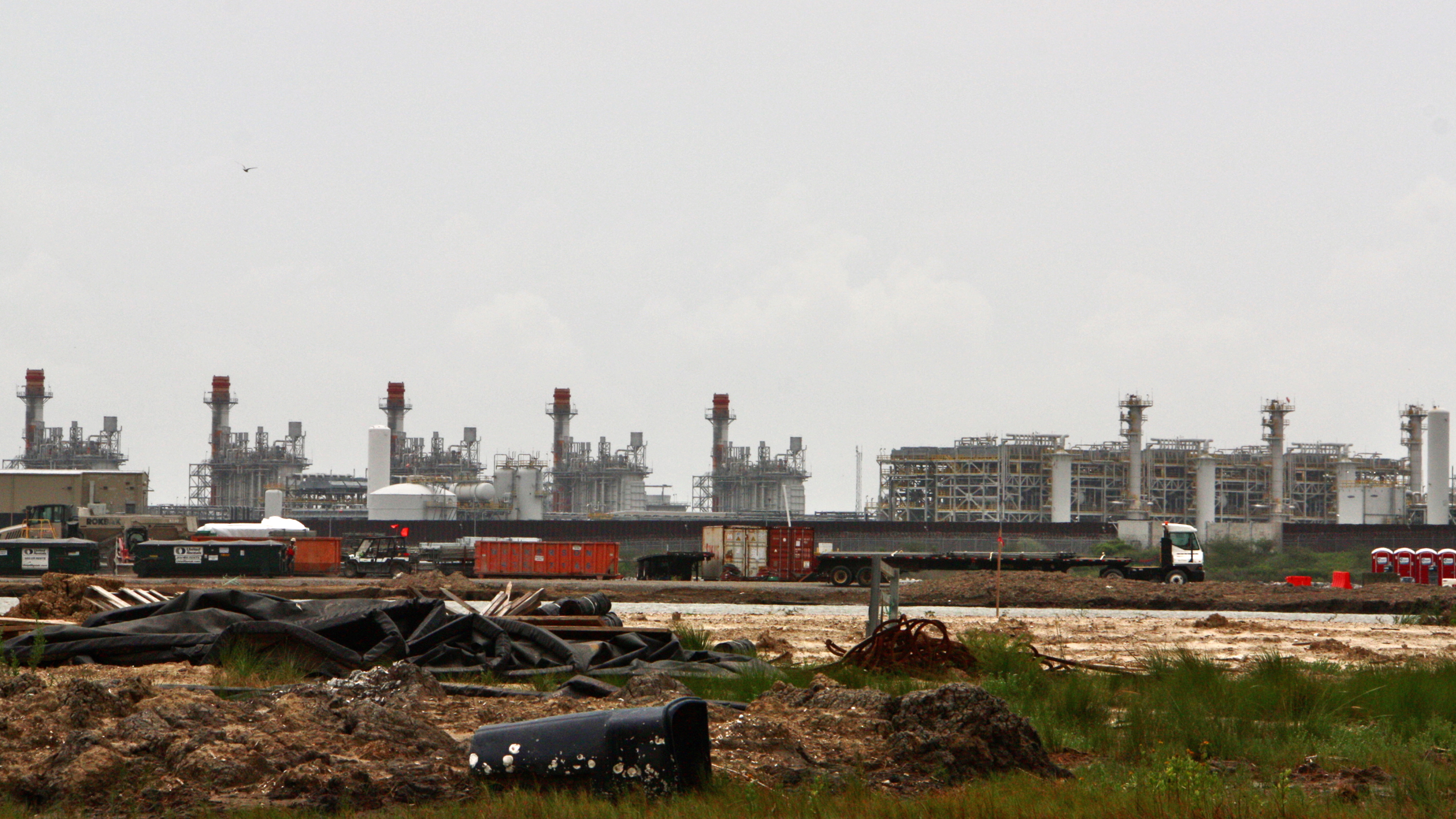
The department could have proposed fining Venture Global millions of dollars for its earlier permit violations, according to the compliance order. But in February, the agency proposed a settlement agreement with a $245,000 penalty that would allow the company to deny it had committed any violations.
The department declined to answer questions about the proposed settlement agreement, saying it could not comment until it was completed.
Environmental advocates and some residents say these incidents and lawsuits amount to a pattern of pushing boundaries and flouting rules.
“This company really is only concentrated on their own profits and money making,” said James Hiatt, who founded an environmental group called For a Better Bayou, in nearby Lake Charles. “I don’t know if they actually believe that they’re fueling the world or doing anything good. The reality on the ground is they’re devastating a community.”
LNG companies and their allies say they work to limit local environmental impacts. They argue that the wars in Ukraine and Iran underscore the benefits the industry brings by providing fuel to U.S. allies in Europe and Asia while generating more revenue domestically.
When the United States began bombing Iran, Venture Global once again found itself in a position to benefit. This time, the company’s Plaquemines LNG plant was up and running but still in the extended commissioning period, with gas available for spot sales.
“I don’t know if they actually believe that they’re fueling the world or doing anything good. The reality on the ground is they’re devastating a community.”
— James Hiatt, For a Better Bayou
“We probably have the largest number of available cargoes in the market,” Sabel said during an earnings call the week after the war began. He said they were hoping for a quick end to the fighting, and that the company’s long-term preference was for low prices. But Sabel acknowledged that high prices caused by the war “are helpful for our spreads, obviously.”
In May, Venture Global reported a first-quarter profit of $488 million, 23 percent higher than the same period last year. That report captured only the first month of the war.
Venture Global has used its cash to finance ever more growth. The company is currently building CP2 and expanding its Plaquemines LNG plant. At full capacity, the company’s terminals will be able to export a peak of nearly 100 million metric tons of gas per year—not far off the nation’s total output last year.
A Town Emptied Out
Nearly every new building in Cameron sits high above the floodplain, perched awkwardly, often with parking spaces below. Storms washed away many older structures and much of what remains at ground level are camper vans, hundreds of them, ranging from brand-new to old and dilapidated.
When Venture Global started construction, anyone with land to spare set it up as an RV park to house temporary workers. Today Cameron has more rooms on wheels than permanent homes.
Like any boomtown, Cameron feels unbalanced. There is no supermarket, nor many other establishments, but there is a modern structure built by Venture Global with a new restaurant and bar and a convenience store looking out over the Calcasieu Ship Channel.
On dry days, the air is filled with dust from construction and truck-battered roads. Those trucks have made Peshoff, the lifetime Cameron resident, reluctant to take her Ford pickup out of her driveway. Everyone talks about deadly traffic accidents since an influx of workers began hauling up and down the two-lane highway that connects Cameron with the rest of the world.
On a May evening, the sun casting long shadows, Peshoff drove around Cameron pointing out spots where she used to net crabs from bayous. She’d eat some and share the rest with elderly friends in Lake Charles, who would contribute gas money in return. When she was a girl her dad kept horses and cattle out by where CP2 now stands, and they’d ride free through the grasslands.
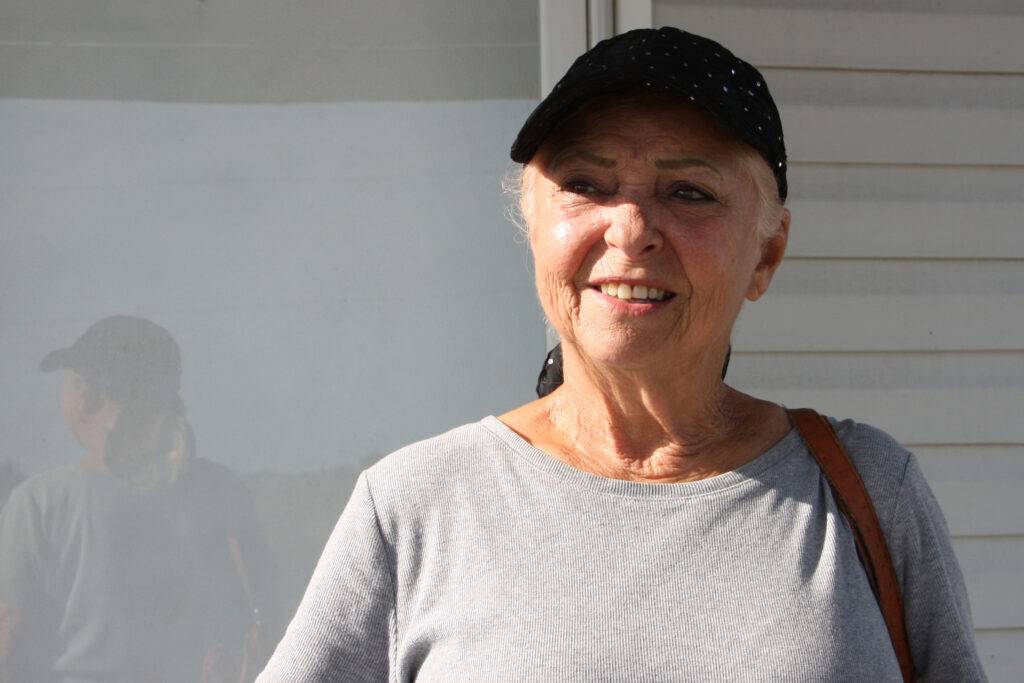
Peshoff is quick to acknowledge that the company has brought jobs for some, including her daughter, who started by driving a shuttle bus for workers and is now an operator at CP1.
Some in Cameron praise the financial stimulus that Venture Global has brought, including offering to build or buy structures the parish needed help with. In 2024, the company said it would contribute $6 million to increase salaries for Cameron public school teachers and staff.
Yet many people don’t want to discuss the issue publicly. The Cameron Parish Police Jury, the local governing body, declined a request for an interview and refused to answer questions for this article.
And while $6 million might seem like a lot for local schools, it is far smaller than the amount of taxes Venture Global has avoided thanks to state incentives. The company’s two operating terminals are benefiting from some $5.6 billion in tax incentives through 2040, according to a 2024 analysis by the Sierra Club. Plaquemines LNG is receiving another $964 million. In return, Venture Global pledged to create 870 jobs across the three terminals, meaning each job cost the state millions in lost revenue.
In addition to Venture Global, Cameron Parish is home to three other LNG terminals either operating or under construction. All told, the parish is missing out on more than $15 billion in revenue, including $3.8 billion for its schools, the Sierra Club found.
“Louisiana in general should be one of the richest states in the country,” said Hiatt, with For a Better Bayou. “Instead we’re the lowest on the quality-of-life indexes, time and time again.” Instead of reaping more wealth from industry, he said, “we’ve been conditioned to just be happy with the crumbs that they leave us.”
At one recent police jury meeting, a resident spoke for 40 minutes about the disruptions to his life, from the campers taking over the area to fewer available docks for fishermen. One day, he said, his son’s school bus was held up for 45 minutes as traffic from the terminal clogged the roads. Eventually, he said, his son wet his pants.
“Let that sink in,” he told the jurors. “Seven-year-old boy couldn’t hold it no longer. That’s just one thing.”
“Louisiana in general should be one of the richest states in the country. Instead we’re the lowest on the quality-of-life indexes, time and time again.”
— James Hiatt, For a Better Bayou
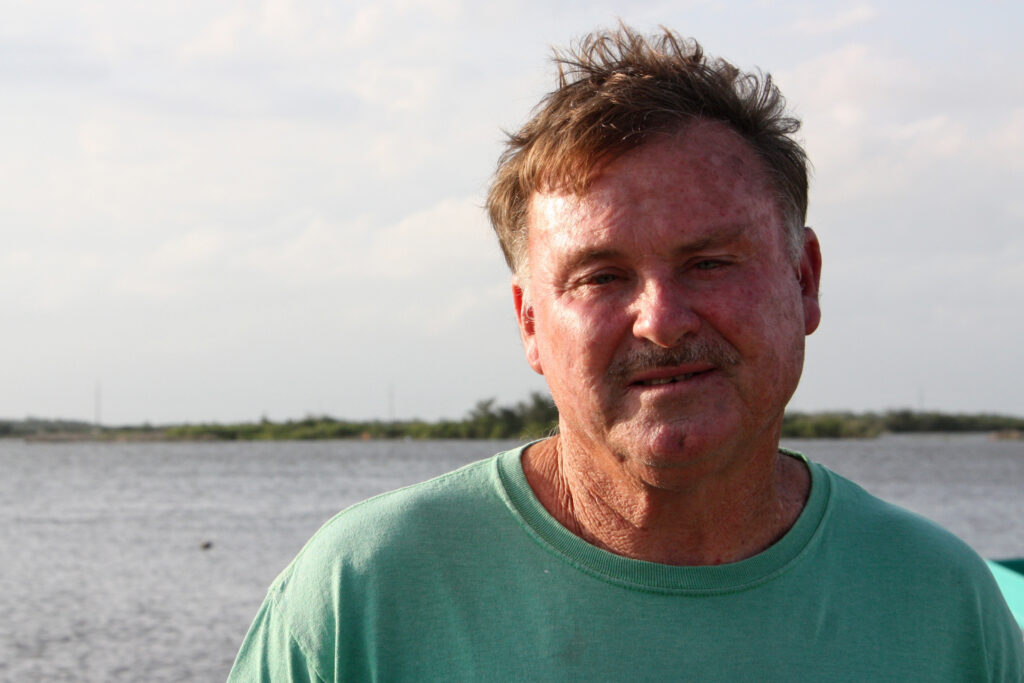
He wanted to be bought out. So do Theriot, the fisherman, and Peshoff, the longtime resident. Peshoff said Venture Global has asked her how much she’d like for her land, close as it is to CP2’s fence, but she wants the company to make an offer because she doesn’t feel like she can come up with a figure herself.
“How do you put a price on 73 years of memories?” she said.
Peshoff remembers Hurricane Audrey, which swept through Cameron when she was 4. With stormwaters rising above the tailpipe of the family car, her father and neighbors pushed the vehicle packed with her mom, her siblings and her, along with another family, to a big white house where they sheltered from the storm, the floor buckling with each wave.
It was 48 years before another hurricane arrived. Then Rita and Ike hit three years apart, and 12 years later Laura and Delta hit just weeks apart. Peshoff’s trailer washed away during Rita and again during Ike, and then she got a grant to lift a new trailer on pilings, putting 19 steps between the ground and her front door. After Laura and Delta dumped rain through the roof, her dad talked her through replacing the drywall and rewiring the structure, she said.
Her parents left after Rita and didn’t return. When her son visits, she said, he tells her “the neighborhood used to be so big, but it looks so little now.”
Most of what surrounds her home are campers, ready to be rolled away.
About This Story
Perhaps you noticed: This story, like all the news we publish, is free to read. That’s because Inside Climate News is a 501c3 nonprofit organization. We do not charge a subscription fee, lock our news behind a paywall, or clutter our website with ads. We make our news on climate and the environment freely available to you and anyone who wants it.
That’s not all. We also share our news for free with scores of other media organizations around the country. Many of them can’t afford to do environmental journalism of their own. We’ve built bureaus from coast to coast to report local stories, collaborate with local newsrooms and co-publish articles so that this vital work is shared as widely as possible.
Two of us launched ICN in 2007. Six years later we earned a Pulitzer Prize for National Reporting, and now we run the oldest and largest dedicated climate newsroom in the nation. We tell the story in all its complexity. We hold polluters accountable. We expose environmental injustice. We debunk misinformation. We scrutinize solutions and inspire action.
Donations from readers like you fund every aspect of what we do. If you don’t already, will you support our ongoing work, our reporting on the biggest crisis facing our planet, and help us reach even more readers in more places?
Please take a moment to make a tax-deductible donation. Every one of them makes a difference.
Thank you,

Reporter, New York